Question
Explain the Doppler's effect.

Answer

Whenever there is a relative motion between a source of sound and the listener, the apparent frequencies of sound heard by the listener is different from the actual frequency of sound emitted by the source.
For sound the observed frequency v' is given by
$\text{v}'=\Big(\frac{v+v_0}{v+v_\text{s}}\Big)\text{v}$

Need a full question paper?

Generate a complete, print-ready paper with questions like this in minutes — across 16+ boards, with answer keys.
Start Generating Free

Similar questions

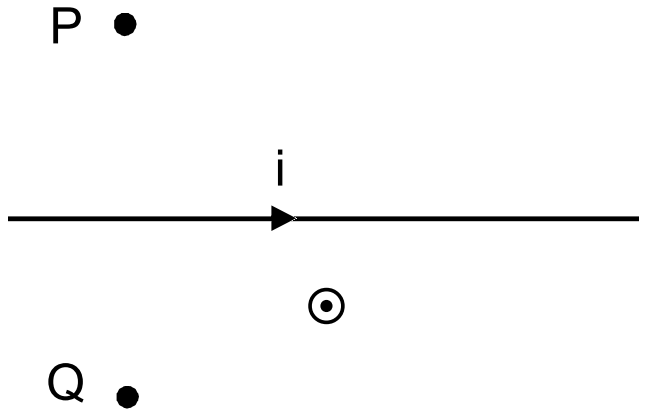
A long, straight wire carrying a current of 1.0A is placed horizontally in a uniform magnetic field B = 1.0 × 10⁻⁵T pointing vertically upward figure. Find the magnitude of the resultant magnetic field at the points Pand Q, both situated at a distance of 2.0cm from the wire in the same horizontal plane.

Time period of a planet around the Sun is 11.6 years. How far is the planet from the Sun? The distance between the Sun and the earth is 1.5 × 10⁸km.
Define 'Radius of Gyration'. Derive an expression for it.
A body travels uniformly a distance of $(13.8 \pm 0.2)\text{m}$ in a time $(4.0 \pm 0.3) \text{s}.$ What is the velocity of the body within error limits?
A positive ion having just one electron ejects it if a photon of wavelength $288\mathring{\text{A}}$ or less is absorbed by it. Identify the ion.
A particle starts from the origin, goes along the X-axis to the point (20m, 0) and then returns along the same line to the point (-20m, 0). Find the distance and displacement of the particle during the trip.
A long, straight wire of radius r carries a current i and is placed horizontally in a uniform magnetic field B pointing vertically upward. The current is uniformly distributed over its cross-section.
  1. At what points will the resultant magnetic field have maximum magnitude? What will be the maximum magnitude?
  2. What will be the minimum magnitude of the resultant magnetic field?
Distinguish between conduction, convection and radiation.
A semiconducting material has a band gap of 1eV. Acceptor impurities are doped into it which create acceptor levels 1meV above the valence band. Assume that the transition from one energy level to the other is almost forbidden if kT is less than $\frac{1}{50}$ of the energy gap. Also, if kT is more than twice the gap, the upper levels have maximum population. The temperature of the semiconductor is increased from 0K. The concentration of the holes increases with temperature and after a certain temperature it becomes approximately constant. As the temperature is further increased, the hole concentration again starts increasing at a certain temperature. Find the order of the temperature range in which the hole concentration remains approximately constant.
For ordinary terrestrial experiments, which of the observers below are inertial and which are non-inertial:
  1. A child revolving in a giant wheel.
  2. A driver in a sports car moving with a constant high speed of 200kmh-1 on a straight road.
  3. The pilot of an aeroplane which is taking off.
  4. A cyclist negotiating a sharp turn.
  5. The guard of a train which is slowing down to stop at a station.