Question
Explain the effect of electric potential (potential difference) on photoelectric current and derive the definition and formula of stopping potential.
Answer

Initially, plate C is illuminated with light keeping plate A at positive potential with respect to plate C and keeping the frequency (v) and intensity (I) of incident light constant. Due to the positive potential of $A$, some of the emitted photo electrons are attracted towards, plate A and form a photocurrent.
Now if the magnitude (value) of the positive potential of A is increased then more and more emitted electrons are attracted to A and form more photocurrent. Thus, photocurrent increases with voltage.
After some time, all the electrons emitted from plate C are collected by plate A and form the maximum photocurrent in the circuit. This value of current is saturated (maximum), meaning that on increasing the potential no longer increase the photocurrent. This maximum value of the photocurrent is called saturation current.
• Stopping Potential :
Now apply a negative potential to the plate A with respect to the plate $C$.
By doing this the electrons emitted from C will be repelled by A , so the electrons that have enough energy to overcome the repulsion of A will reach A and form a current in the circuit, so the photocurrent will decrease.
Now if the negative potential of A is increased i.e. made more negative, more and more electrons will be repelled and the number of electrons falling on A will decrease, so the photocurrent will also decrease rapidly.
For some minimum value of the negative potential of A , all electrons arriving at A will be stopped. i.e. the photocurrent in the circuit will be zero. This minimum value of negative potential of A is called the stopping potential or cut-off voltage.
Each electron emitted from C has a different energy (kinetic energy), so if the electron with the maximum kinetic energy is stopped by the repulsion of the plate A , all the electrons are stopped and the photocurrent in the circuit is stopped.
Suppose, maximum kinetic energy of electron is $K _{\max }$.
The energy provided by the repulsion of A to stop this electron $=e V_0$
Thus, photocurrent stops if $K _{\max }=e V_0$.
Here the voltage $V _0$ will be the stopping potential or cut-off voltage.
Image
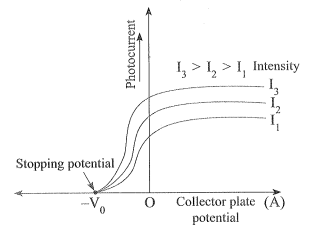
Now keeping the frequency of the incident light constant and increasing its intensity (i.e. intensity $I_2$ then $I _3$, where $I _3> I _2> I _1$ ) a graph of photocurrent versus collector plate can be drawn.
It is clear from this graph that by increasing the intensity of light the value of the maximum saturated photocurrent increases, So $I =\frac{q}{t}=$ $\frac{n e}{t}$ as the number of electrons emitted in 1 sec increases by $\left(\frac{n}{t}\right)$, but the value of the stopping potential does not change, so it can be said from
$K _{\max }=e V_0$, the maximum kinetic energy of emitted photoelectrons does not depend on the intensity of incident light.
$K _{\max }$ does not depend on the intensity of incident radiation.

Need a full question paper?

Generate a complete, print-ready paper with questions like this in minutes — across 16+ boards, with answer keys.
Start Generating Free

Similar questions

A closely wound solenoid of 2000 turns and area of cross-section 1.6 × 10–4 m2, carrying a current of 4.0 A, is suspended through its centre allowing it to turn in a horizontal plane.
  1. What is the magnetic moment associated with the solenoid?
  2. What is the force and torque on the solenoid if a uniform horizontal magnetic field of 7.5 × 10–2 T is set up at an angle of 30º with the axis of the solenoid?
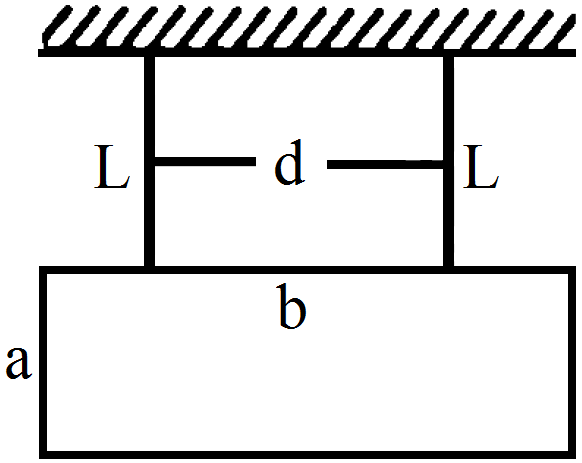
A rectangular plate of sides a and b is suspended from a ceiling by two parallel strings of length L each figure The separation between the strings is d. The plate is displaced slightly in its plane keeping the strings tight. Show that it will execute simple harmonic motion. Find the time period.

  1. A giant refracting telescope has an objective lens of focal length 15 m. If an eye piece of focal length 1.0 cm is used, what is the angular magnification of the telescope?
  2. If this telescope is used to view the moon, what is the diameter of the image of the moon formed by the objective lens? The diameter of the moon is 3.48 × 10⁶ m and the radius of lunar orbit is 3.8 x 10⁸ m.
A parallel plate capacitor is charged by a battery. After sometime the battery is disconnected and a dielectric slab with its thickness equal to the plate separation is inserted between the plates. How will (i) the capacitance of the capacitor, (ii) potential difference between the plates and (iii) the energy stored in the capacitor be affected?
Justify your answer in each case.
Electromotive forces of two cells are $E_1$ and $E _2$ and their internal resistances are $r_1$ and $r_2$. Find equivalent electromotive force and equivalent internal resistance on joining them in series.
A person has near point at 100cm. What power of lens is needed to read at 20cm if he/ she uses.
  1. Contact lens,
  2. Spectacles having glasses 2.0cm separated from the eyes?
A myopic person has been using spectacles of power –1.0 dioptre for distant vision. During old age he also needs to use separate reading glass of power + 2.0 dioptres. Explain what may have happened.
Suppose the rod in the previous problem has a mass of 1kg distributed uniformly over its length:
  1. Find the initial angular acceleration of the rod.
  2. Find the tension in the supports to the blocks of mass 2kg and 5kg.
A p-n photodiode is fabricated from a semiconductor with band gap of 2.8 eV. Can it detect a wavelength of 6000 nm?
Explain electrical energy and power.