Question
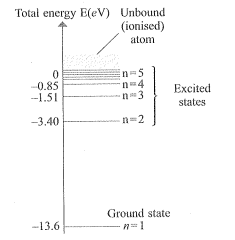
Explain the excited states for the hydrogen atom.

Answer

Image
$\rightarrow $ At room temperature, most of the hydrogen atoms are in ground state.
$\rightarrow $ When a hydrogen atom receives energy by processes such as electron collisions, the atom may acquire sufficient energy to raise the
electron to higher energy states. The atom is then said to be in an excited state.
$\rightarrow $ Putting $n=2$ in
$E _{ n }=-\frac{13.6}{n^2} e V$
$E _2=-3.4 e V .$
$\rightarrow $ It means that the energy required to excite an electron in hydrogen atom to its first excited state, is an energy equal to
$E _2- E _1 =-3.40 eV -(-13.6) eV$
$ =-3.4 eV +13.6 eV$
$ =10.2 eV$
$\rightarrow $ Similarly, $E _3=-1.51 eV$
$\rightarrow $ To excite the hydrogen atom from its ground state to second excited state, energy required is
$E _3- E _1 =-1.51 eV -(-13.6) eV$
$ =-1.51 eV +13.6 eV$
$ =12.09 eV$
$\rightarrow $ In contrast, when an electron moves from an excited state to a lower energy state a photon is emitted.
$\rightarrow $ Thus, as the excitation of hydrogen atom increases $($as $n$ increases$)$ the value of minimum energy required to free the electron from the excited atom decreases.
$\rightarrow $ The energies of the excited states come closer and closer together as $n$ increases.

Need a full question paper?

Generate a complete, print-ready paper with questions like this in minutes — across 16+ boards, with answer keys.
Start Generating Free

Similar questions

Define the distance of closest approach. An α-particle of kinetic energy 'K' is bombarded on a thin gold foil. The distance of the closest approach is 'r'. What will be the distance of closest approach for an α-particle of double the kinetic energy?
The radii of curvature of the faces of a double convex lens are 10 cm and 15 cm. If focal length of the lens is 12 cm, find the refractive index of the material of the lens.
A copper wire of diameter 1.6 mm carries 20A. Find the maximum magnitude of the magnetic field $\overrightarrow{\text{B}}$ due to this current.
Explain emission lines and absorption lines.
Answer the following:
The discharging current in the atmosphere due to the small conductivity of air is known to be 1800A on an average over the globe. Why then does the atmosphere not discharge itself completely in due course and become electrically neutral? In other words, what keeps the atmosphere charged?
Derive the equation of electric potential due to a system of electric charges.
Discuss the similarities and differences of BiotSavart law with the Coulomb's law.
A platinum surface having work function 5.63 eV is illuminated by a monochromatic source of $1.6 \times 10^{15} Hz$ Hz. What will be the minimum wavelength associated with the ejected electron.
During an experiment, an ideal gas is found to obey an additional law $pV^2 =$ constant. The gas is initially at a temperature T and volume V. Find the temperature when it expands to a volume 2V.
How does the energy stored in a capacitor change if the plates of a charged capacitor are moved farther, the battery remaining connected?