Question
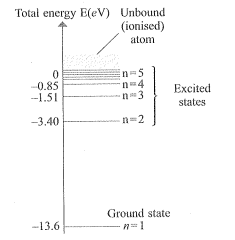
Explain the excited states for the hydrogen atom.

Answer


Image
$\rightarrow$ At room temperature, most of the hydrogen atoms are in ground state.
$\rightarrow$ When a hydrogen atom receives energy by processes such as electron collisions, the atom may acquire sufficient energy to raise the
electron to higher energy states.
The atom is then said to be in an excited state.
$\rightarrow$ Putting $n=2$ in
$E _{ n }=-\frac{13.6}{n^2} e V$
$E _2=-3.4 e V .$
$\rightarrow $ It means that the energy required to excite an electron in hydrogen atom to its first excited state, is an energy equal to
$E _2- E _1 =-3.40 eV -(-13.6) eV$
$ =-3.4 eV +13.6 eV$
$ =10.2 eV$
$\rightarrow$ Similarly, $E _3=-1.51 eV$
$\rightarrow$ To excite the hydrogen atom from its ground state to second excited state, energy required is
$E _3- E _1 =-1.51 eV -(-13.6) eV$
$ =-1.51 eV +13.6 eV$
$ =12.09 eV$
$\rightarrow$ In contrast, when an electron moves from an excited state to a lower energy state a photon is emitted.
$\rightarrow$ Thus, as the excitation of hydrogen atom increases $($as $n$ increases$)$ the value of minimum energy required to free the electron from the excited atom decreases.
$\rightarrow$​​​​​​​ The energies of the excited states come closer and closer together as $n$ increases.

Need a full question paper?

Generate a complete, print-ready paper with questions like this in minutes — across 16+ boards, with answer keys.
Start Generating Free

Similar questions

Arrange the following electromagnetic radiations in ascending order of their frequencies:
  1. Microwave.
  2. Radio wave.
  3. X-rays.
  4. Gamma rays.
Write two uses of any one of these.
An atom absorbs a photon of wavelength 500nm and emits another photon of wavelength 700nm. Find the net energy absorbed by the atom in the process.
A barometer correctly reads the atmospheric pressure as 76cm of mercury. Water droplets are slowly introduced into the barometer tube by a dropper. The height of the mercury column first decreases and then becomes constant. lf the saturation vapour pressure at the atmospheric temperature is 0.80cm of mercury, find the height of the mercury column when it reaches its minimum value.
Is work-energy theorem valid in non-inertial frames?
A block of mass m is attached to two unstretched springs of spring constants $k_1$ and $k_2$ as shown in figure. The block is displaced towards right through a distance $x$ and is released. Find the speed of the block as it passes through the mean position shown.
If 12 resistances each of $12 \Omega$ resistance are joined in a cubical network, then calculate the equivalent resistance at the corners opposite to diagonals of this network.
Image
Two transparent slabs having equal thickness but different refractive indices $\mu_1$ and $\mu_2$ are pasted side by side to form a composite slab. This slab is placed just after the double slit in a Young's experiment so that the light from one slit goes through one material and the light from the other slit goes through the other material. What should be the minimum thickness of the slab so that there is a minimum at the point $P_0$ which is equidistant from the slits?
A single lens is mounted in a tube. A parallel beam enters the tube and emerges out of the tube as a divergent beam. Can you say with certainty that there is a diverging lens in the tube?
The equation $\omega=\frac{\mu_\text{v}-\mu_\text{r}}{\mu-1}$ asderived for a prism having small refracting angle. Is it also valid for a prism of large refracting angle? Is it also valid for a glass slab or a glass sphere?
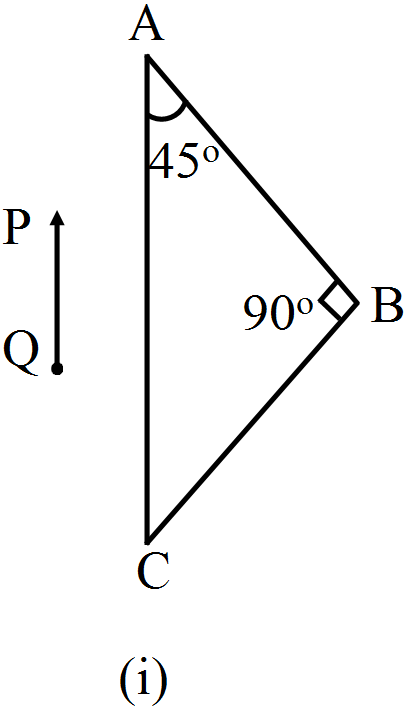
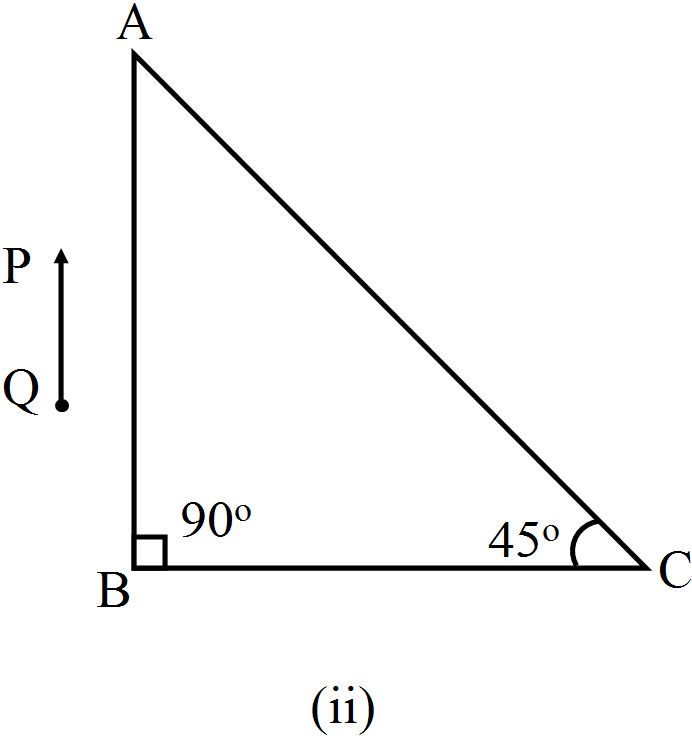
A right-angled crown glass prism with critical angle 41° is placed before an object, PQ in two positions as shown in the figures (i) and (ii). Trace the paths of the rays from P and Q passing through the prisms in the two cases.