Question
Explain the experiment which represents the total internal reflection.

Answer

Image
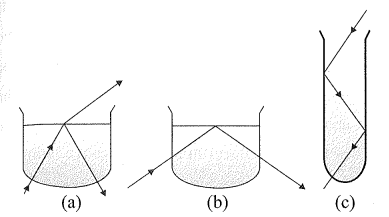
→Take a glass beaker with clear water in it. Add a few drops of milk or any other suspension to water and stir the water a few times, so that it becomes a little turbid. Take a laser pointer and shine its beam through the turbid water. You will find that the path of the beam inside the water shines brightly.
→As shown in fig (a) shine the beam from below the beaker such that it strikes at the upper water surface at the other end. Partial reflection and partial refraction of an incident ray can be observed in water.
→As shown in figure (b) direct the laser beam from one side of the beaker such that it strikes the upper surface of water more obliquely. Adjust the direction of laser beam until you find the angle, for which the refraction above the water surface is totally absent and the incident ray undergoes total internal reflection in water itself.
→Pour this water in a long test tube and shine the laser light from top as shown in fig (c). Adjust the direction of the laser beam such that it is totally internally reflected every time it strikes the walls of the tube.
Need a full question paper?

Generate a complete, print-ready paper with questions like this in minutes — across 16+ boards, with answer keys.

Start Generating Free

Similar questions

Define the term “cut off frequency” in photoelectric emission. The threshold frequency of a metal is f. When the light of frequency 2f is incident on the metal plate, the maximum velocity of photo-electrons is $v_1$. When the frequency of the incident radiation is increased to 5f, the maximum velocity of photo-electrons is $v_2$. Find the ratio $v_1 : v_2.$
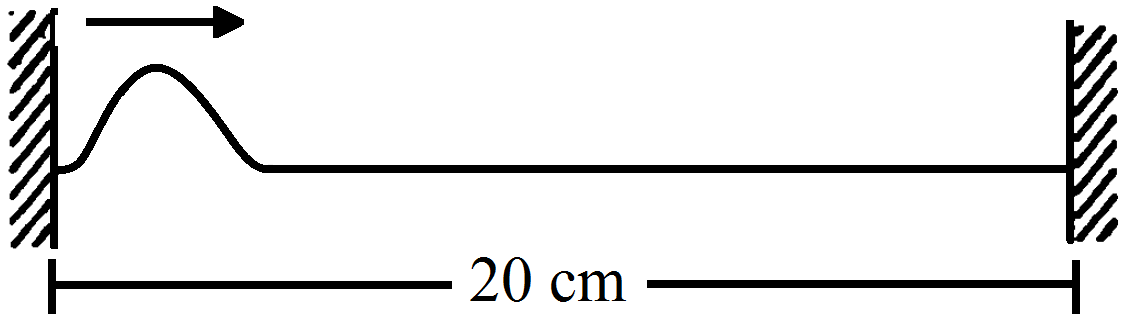
A string of length 20cm and linear mass density 0.40g/cm is fixed at both ends and is kept under a tension of 16N. A wave pulse is produced at t = 0 near an end as shown in figure, which travels towards the other end.
  1. When will the string have the shape shown in the figureagain
  2. Sketch the shape of the string at a time half of that found in part (a).
Consider two pairs of neutrons. In each pair, the separation between the neutrons is the same. Can the force between the neutrons have different magnitudes for the two pairs?
A transverse wave of amplitude 0.50mm and frequency 100Hz is produced on a wire stretched to a tension of 100N. If the wave speed is 100m/s, what average power is the source transmitting to the wire?
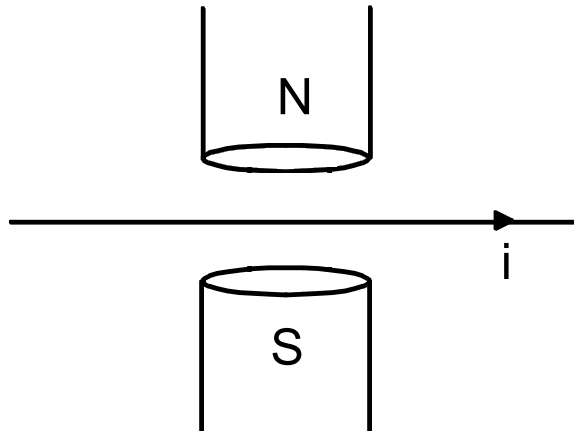
A magnetic field of strength 1.0T is produced by a strong electromagnet in a cylindrical region of radius 4.0cm, as shown in the figure. A wire, carrying a current of 2.0A, is placed perpendicular to and intersecting the axis of the cylindrical region. Find the magnitude of the force acting on the wire.
Can two particles be in equilibrium under the action of their mutual gravitational force? Can three particles be? Can one of the three particles be?
In a pure semiconductor, the number of conduction electrons is $6 \times 10^{19}$ per cubic metre. How many holes are there in a sample of size 1cm × 1cm × 1mm?
A string of length L fixed at both ends vibrates in its fundamental mode at a frequency v and a maximum amplitude A.
  1. Find the wavelength and the wave number k.
  2. Take the origin at one end of the string and the X-axis along the string. Take the Y-axis along the direction of the displacement. Take t = 0 at the instant when the middle point of the string passes through its mean position and is going towards the positive y-directian. Write the equation describing the standing wave:
Two equal charges are placed at a separation of 1.0m. What should be the magnitude of the charges so that the force between them equals the weight of a 50kg person?
i. Differentiate between three segments of a transistor on the basis of their size and level of doping.
ii. When is a transistor said to be in active state?
iii. Draw a plot of transfer characteristic ($V _0$ vs. $V _{ i }$ ) and show which portion of the characteristic is used in amplification and why?
iv. Draw the circuit diagram of the base bias transistor amplifier in CE configuration and briefly explain its working.