Question
Explain the experiment which represents the total internal reflection.

Answer

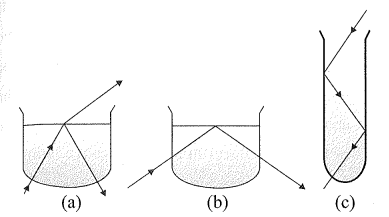
Image
→Take a glass beaker with clear water in it. Add a few drops of milk or any other suspension to water and stir the water a few times, so that it becomes a little turbid. Take a laser pointer and shine its beam through the turbid water. You will find that the path of the beam inside the water shines brightly.
→As shown in fig (a) shine the beam from below the beaker such that it strikes at the upper water surface at the other end. Partial reflection and partial refraction of an incident ray can be observed in water.
→As shown in figure (b) direct the laser beam from one side of the beaker such that it strikes the upper surface of water more obliquely. Adjust the direction of laser beam until you find the angle, for which the refraction above the water surface is totally absent and the incident ray undergoes total internal reflection in water itself.
→Pour this water in a long test tube and shine the laser light from top as shown in fig (c). Adjust the direction of the laser beam such that it is totally internally reflected every time it strikes the walls of the tube.
Need a full question paper?

Generate a complete, print-ready paper with questions like this in minutes — across 16+ boards, with answer keys.

Start Generating Free

Similar questions

A water particle of mass 10.0mg and having a charge of 1.50 × 10-6C stays suspended in a room. What is the magnitude of electric field in the room? What is its direction?
There are two sources of light A and B. The wavelength of light emitted from A is from $8000\mathring{\text{A}}$ to $11000\mathring{\text{A}},$ while that from B is from $3000\mathring{\text{A}}$ to $6000\mathring{\text{A}}.$ The intensity of A is 4 times that of B. But when light of A falls on metal, photoelectrons are not emitted whereas light of B can eject photoelectrons from the same metal. Explain its reason.
How long can an electric lamp of 100W be kept glowing by fusion of 2.0 kg of deuterium? Take the fusion reaction as:
$^2_1\text{H}+^2_1\text{H}\rightarrow\ ^3_2\text{He}+\text{n}+3.27\text{ MeV}$
Establish a relationship between electric current and drift velocity. Draw the direction of electron flowing in a circuit by drawing an electric circuit.
A string of linear mass density 0.5g/cm and a total length 30cm is tied to a fixed wall at one end and to a frictionless ring at the other end figure, The ring can move on a vertical rod. A wave pulse is produced on the string which moves towards the ring at a speed of 20cm/s. The pulse is symmetric about its maximum which is located at a distance of 20cm from the end joined to the ring.
  1. Assuming that the wave is reflected from the ends without loss of energy, find the time taken by the string to regain its shape.
  2. The shape of the string changes periodically with time. Find this time period.
  3. What is the tension in the string?

Draw a circuit diagram of a common emitter amplifier using n-p-n transistor. Derive an expression for the current gain $\beta_{ac}.$
The temperature and the relative humidity are 300K and 20% in a room of volume 50m3. The floor is washed with water, 500g of water sticking on the floor. Assuming no communication with the surrounding, find the relative humidity when the floor dries. The changes in temperature and pressure may be neglected. Saturation vapour pressure at 300K = 3.3kPa.
The momentum p of a particle changes with time t according to the relation $\frac{\text{dp}}{\text{dt}}=(10\text{N})+(2\text{N/s)t}.$ If the momentum is zero at t = 0, what will the momentum be at t = 10s?
With the help of an example, explain how the neutron to proton ratio changes during $\alpha-$decay of a nucleus.
A coil of inductance 5.0mH and negligible resistance is connected to the oscillator of the previous problem. Find the peak currents in the circuit for $\omega=100\text{s}^{-1},500\text{s}^{-1},1000\text{s}^{-1}.$