Question
Explain the factors affecting the rate of chemical reaction with example.

Answer

The factors that affect the rate of a chemical reaction are as follows:
  1. Nature of the reactants: Nature or reactivity of reactants influences the rate of a chemical reaction.
    E.g. Al is more reactive than $Zn$. Therefore, the rate of reaction of Al with hydrochloric acid is higher than that of $Zn.$
  2. Size of the particles of the reactants: Smaller the size of the reactant particles, higher is the rate of the reaction.
    E.g. When $HCl$ is added to pieces of Shahabad tile, the $CO_2$ effervescence is formed slowly. However, when $HCl$ is added to Shahabad powder, the $CO_2$ effervescence is formed at a faster rate.
  3. Concentration of the reactants: The rate of a chemical reaction increases with increase in the concentration of the reactants.
    E.g. Dilute $HCl$ reacts slowly with calcium carbonate, $CaCO_3$ whereas concentrated $HCl$ reacts rapidly with $CaCO_3.$
  4. Temperature of the reaction: Higher the temperature, faster is the rate of a chemical reaction.
    E.g. The temperature in the refrigerator is low. So, the rate of decomposition of perishable foodstuffs is low and it remains fresh for a longer time.
  5. Catalyst: Presence of catalyst increases the rate of a chemical reaction.
    E.g. The decomposition of hydrogen peroxide into water and oxygen takes place slowly at room temperature. However, the same reaction occurs at a faster rate on adding manganese dioxide $(MnO_2) $ powder in it.

Need a full question paper?

Generate a complete, print-ready paper with questions like this in minutes — across 16+ boards, with answer keys.

Start Generating Free

Similar questions

In the previous example, how much time the satellite will take to complete one revolution around the earth?
P and Q are two types of plants having weak stems which cannot stand upright on their own. The plants P and Q have organs R and S respectively which can grow towards any support which they happen to touch and wind around that support. It is observed that organ R originates from the leaves of the plant whereas organ S originates directly from the stem of the plant.
  1. What is (i) R, and (ii) S?
  2. What is the name of growth movement exhibited by the organs R and S?
  3. Name the stimulus involved in this case.
  4. State whether the behaviour of organs R and S is a tropic movement or a nastic movement.
  5. Name one plant like P and another plant like Q.
Explain the statement 'We have got this Earth planet on lease from our future generations and not as ancestral property from our ancestors'.
What are the merits of the modern periodic table of elements?
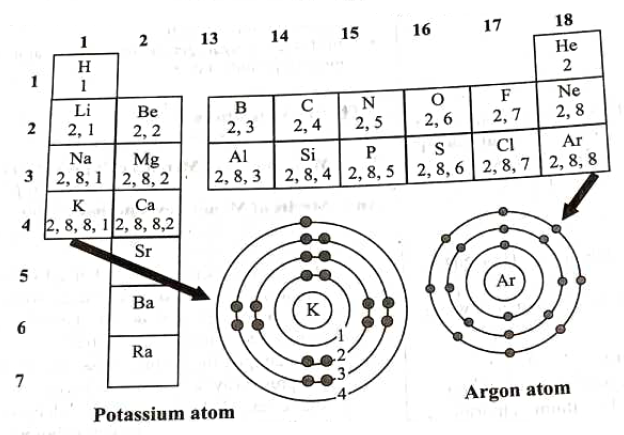
Observe the following diagram and write the answers of the following questions:
Image
i. Write the atomic numbers of first two elements in the second group.
ii. Write the number of valence electrons of the elements in the halogen group.
iii. Draw the diagram of electronic configuration of magnesium atom.
iv. After completion of a period, what change does take place in the electronic configuration of the next element?
v. Write the names of any two elements from the diagram which do not take part in chemical reaction.
An object is placed (a) 20cm, (b) 4cm, in front of a concave mirror of focal length 12cm. Find the nature and position of the image formed in each case.
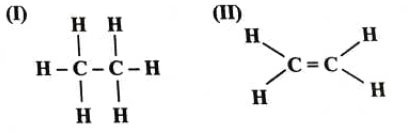
Observe and write the answers to the questions given below:

Image
i. Write the names of compound I and II.
ii. Draw electron-dot structure for I and II.
iii. Which one of the above structures is saturated compound and unsaturated compound?
Differentiate between nuclear fission and nuclear fusion.
The surface of water in a lake appears green due to a layer of tiny free-floating organisms X on its surface. The lake water also contains organisms like water beetle, fish and tadpole. The sun shines over the lake water and provides energy for the functioning of this lake ecosystem.
  1. What could organisms X be?
  2. Write a food chain comprising of all the four organisms mentioned.
  3. What is the general name of the food chains like the one written above?
  4. Name (i) secondary consumer (ii) producer (iii) tertiary consumer, and (iv) primary consumer, in the above food chain.
  5. If the tertiary consumer gets 0.2 J of energy from the secondary consumer, then how much energy was radiated by the sun to the producer?
Write the names of all the major endocrine glands present in the human body. Which of these glands also function as exocrine glands?