Question
Explain the first law of reflection of light.

Answer

According to Huygens' principle, reflection of light has been explained in this way :
Angle of incidence $\angle i=$ Angle of reflection $\angle r$. In this, the incident wave front, reflected wave front and normal all three lie in the same plane.

Need a full question paper?

Generate a complete, print-ready paper with questions like this in minutes — across 16+ boards, with answer keys.
Start Generating Free

Similar questions

An electric field $\vec{\text{E}}=\vec{\text{i}}\text{Ax}$ exists in the space, where $A= 10Vm^{-2}.$ Take the potential at $(10m, 20m)$ to be zero. Find the potential at the origin.
Define electric field intensity and equipotential surface in current carrying conductor.
Derive the equation of magnetic potential energy of a magnetic dipole placed in a uniform magnetic field and discuss its special cases.
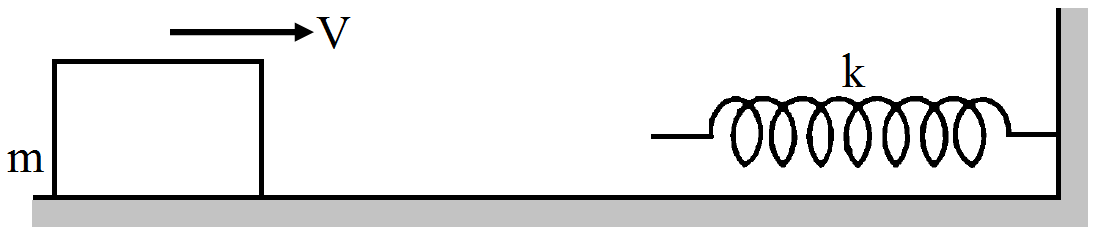
A block of massip, sliding on a smooth horizontal surface with a velocity $\vec{\text{v}}$ meets a long horizontal spring fixed at one end and having spring constant k as shown in figure. Find the maximum compression of tin spring. Will the velocity of the block be the same $\vec{\text{v}}$ when it comes back to the original position shown?
A voltage of 30 V is applied across a carbon resistor with first, second and third rings of blue, black and yellow colours respectively. Calculate the value of current, in mA, through the resistor.
Which of the following moving with the same velocity has the longest de Broglie wavelength; electron, proton, deuteron, $\alpha-$particle?
Explain Ohm's law.
Write down the equation of displacement current and derive the Ampere$-$Maxwell's law.
In Ampere's $\oint\overrightarrow{\text{B}}.\text{d}\overrightarrow{\text{l}}=\mu_0\text{i},$ the current outside the curve is not included on the right hand side. Does it mean that the magnetic field B calculated by using Ampere's law, gives the contribution of only the currents crossing the area bounded by the curve?
Ultraviolet light is incident on two photosensitive materials having work functions $W_1$ and $W_2 \ (W_1 > W_2).$ In which case will the kinetic energy of the emitted electrons be greater? Why?