Question
Explain the following :
(i) Fermentation
(ii) Dehydration
(iii) Hydrogen bonding in alcohols.

Answer

self

Need a full question paper?

Generate a complete, print-ready paper with questions like this in minutes — across 16+ boards, with answer keys.
Start Generating Free

Similar questions


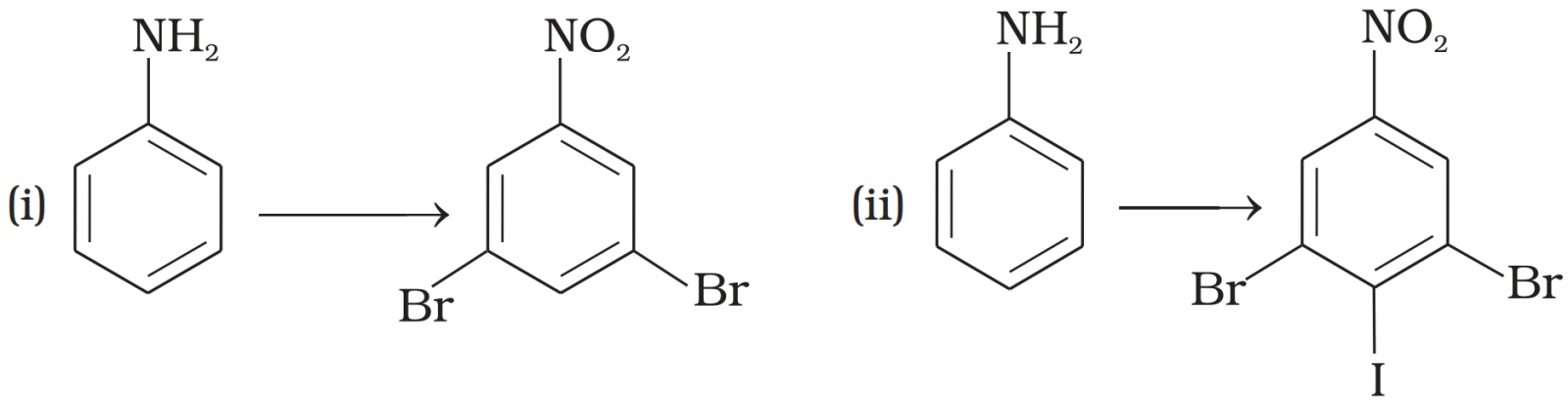
How will you carry out the following conversions?
  1. What are essential and non-essential amino acids? Give two examples of each.
  2. What are the two types of photosynthesis in green plants? Give the basic equations of photosynthesis.
  3. Mention the two products of glycolysis.
Explain the various methods of determining the order of a reaction.
Explain the open chain structure of glucose.
What is crystal field theory? On the basis of this, explain the crystal field splitting in octahedral coordinaton compounds.
i. Write one chemical reaction for each
a. Carbylamine reaction
b. Acetylation reaction
ii. Write structure of N,N-ethylmethylethanamide
The decomposition of $\mathrm{N}_2 \mathrm{O}_5(\mathrm{~g})$ is a first order reaction with a rate constant of $5 \times 10^{-4} \mathrm{~s}^{-1}$ at $45^{\circ} \mathrm{C}$, i.e., $2 \mathrm{~N}_2 \mathrm{O}_5(\mathrm{~g}) \rightarrow$ $4 \mathrm{NO}_2(\mathrm{~g})+\mathrm{O}_2(\mathrm{~g})$. If initial concentration of $\mathrm{N}_2 \mathrm{O}_5$ is $0.25\ M$ , calculate its concentration after $2$ min . Also, calculate halflife for decomposition of $\mathrm{N}_2 \mathrm{O}_5(\mathrm{~g})$.
Answer the following questions: For $M^{2+}/M$ and $M^{3+}/M^{2+}$^ systems, $E^\circ $ values for some metals are as follows:
$Cr^{2+}/Cr = - 0.9 V$ $Cr^{3+}/Cr^{2+} = - 0.4 V$
$Mn^{2+}/Mn = 0 1.2 V$ $Mn^{3+}/Mn^{2+} = +1.5 V$
$Fe^{2+}/Fe = - 0.4 V$ $Fe^{3+}/Fe^{2+} = +0.8 V$
Use this data to comment upon:
  1. The stability of $Fe^{3+}$​​​​​​​^ in acid solution as compared to that of $Cr^{3+}$​​​​​​​^ and $Mn^{3+}.$
  2. The ease with which iron can be oxidised as compared to the similar process for either Cr or Mn metals.
Answer the following questions:
Give reasons:
  1. d-block elements exhibit more oxidation states than f-block elements.
  2. Orange solution of potassium dichromate turns yellow on adding sodium hydroxide to it.
  3. Zirconium (Z = 40) and Hafnium (Z = 72) have almost similar atomic radii.
Differentiate between $1^{\circ}, 2^{\circ}$ and $3^{\circ}$ alcohols by catalytic dehydrogenation.