Question
Answer the following questions: For $M^{2+}/M$ and $M^{3+}/M^{2+}$^ systems, $E^\circ $ values for some metals are as follows:
$Cr^{2+}/Cr = - 0.9 V$ $Cr^{3+}/Cr^{2+} = - 0.4 V$
$Mn^{2+}/Mn = 0 1.2 V$ $Mn^{3+}/Mn^{2+} = +1.5 V$
$Fe^{2+}/Fe = - 0.4 V$ $Fe^{3+}/Fe^{2+} = +0.8 V$
Use this data to comment upon:
  1. The stability of $Fe^{3+}$​​​​​​​^ in acid solution as compared to that of $Cr^{3+}$​​​​​​​^ and $Mn^{3+}.$
  2. The ease with which iron can be oxidised as compared to the similar process for either Cr or Mn metals.
Answer

a. Higher the reduction potential of a species, greater is the ease with which it undergo reduction. Among these pairs, $Mn ^{3+} / Mn ^{2+}$ has largest positive reduction potential. Hence $Mn ^{3+}$ can be easily reduced to $Mn ^{2+}$ i.e., $Mn ^{3+}$ is least stable. $Cr ^{3+} / Cr ^{2+}$ has a negative $E ^{\circ}$ value, therefore, $Cr ^{3+}$ is most stable. $Fe ^{3+} / Fe ^{2+}$ has a positive value but small. Hence, $Fe ^{3+}$ is more stable than $Mn ^{3+}$ but less stable than $Cr ^{3+}$.
b. Lower the reduction potential or higher the oxidation potential of a species, greater is the ease with which it undergo oxidation. Among these pairs, $Mn ^{2+} / Mn$ has the most negative reduction potential or most positive oxidation potential. Therefore, it will be most easily oxidised. Thus, the decreasing order of their ease of oxidation is $Mn > Cr > Fe$.

Need a full question paper?

Generate a complete, print-ready paper with questions like this in minutes — across 16+ boards, with answer keys.

Start Generating Free

Similar questions

Graphically explain the effect of temperature on the rate constant of reaction. How can this temperature effect on rate constant be represented quantitatively?
  1. Account for the following:
  1. Transition metals form large number of complex compounds.
  2. The lowest oxide of transition metal is basic whereas the highest oxide is amphoteric or acidic.
  3. $E^\circ $ value for the $Mn^{3+}/Mn^{2+}$ couple is highly positive (+1.57 V) as compare to $Cr^{3+}/Cr^{2+}. 56/1/1 9.$
  1. Write one similarity and one difference between the chemistry of lanthanoid and actinoid elements.
Why is it not possible to obtain pure ethanol by fractional distillation? What general name is given to binary mixtures which show deviation from Raoult’s law and whose components cannot be separated by fractional distillation. How many types of such mixtures are there?
Classify carbohydrates and also give examples of each.
  1. Describe the general trends in the following properties of the first series of the transition elements:
  1. Stability of +2 oxidation state.
  2. Formation of oxometal ions.
  1. Assign reason for each of the following:
  1. Transition elements exhibit variable oxidation states.
  2. Transition metal ions are usually coloured.
Answer the following question:
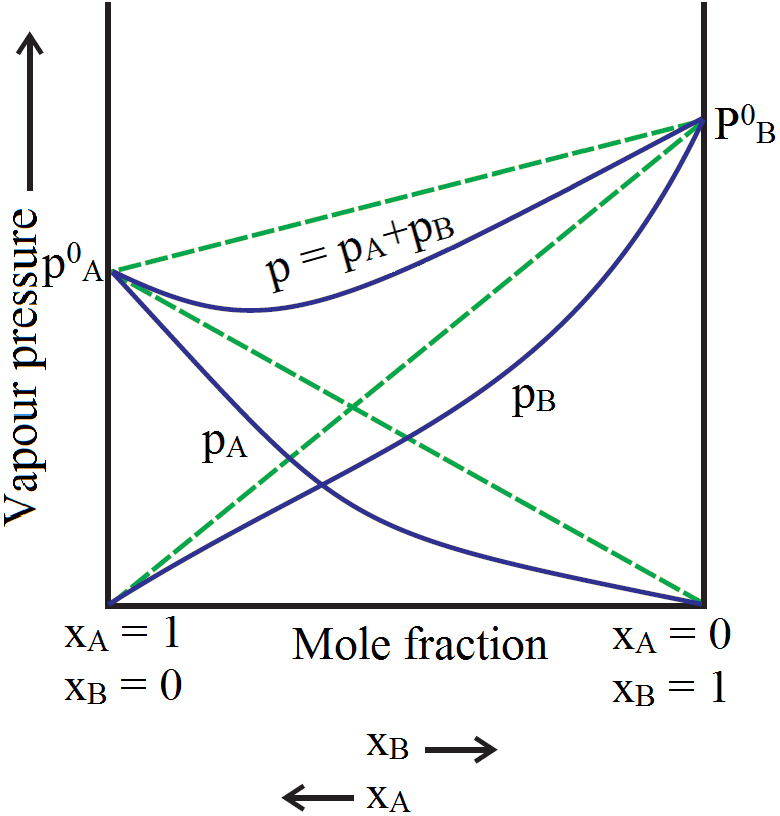
The graphical representation of vapour pressures of two component system as a function of composition is given alongside. By graphic inspection, answer the following questions:
  1. Are the A-B interactions weaker, stronger or of the same magnitude as A-A and B-B?
  2. Name the type of deviation shown by this system from Raoult’s law.
  3. Predict the sign of $\Delta_\text{mix}\text{H}$ for this system.
  4. Predict the sign of $\Delta_\text{mix}\text{H}$ for this system.
  5. Give an example of such a system.
  6. What type of azeotrope will this system form, if possible?
State the reactions and reaction conditions for the following conversions:
i. Benzene diazonium chloride to nitrobenzene.
ii. Aniline to benzene diazonium chloride.
iii. Ethylamine to methylamine.
$i. \text{IUPAC} $ Write structures of different isomeric amines corresponding to the molecular formula, $C_4H_{11}N.$
$ii.$ Write $ \text{IUPAC} $ names of all the isomers.
$iii.$ What type of isomerism is exhibited by different pairs of amines?
  1. Complete the following equations:
  1. $\text{Cr}_{2}\text{O}_{7}^{2-}+\text{2OH}^{-}\rightarrow$
  2. $\text{MnO}_{4}^{-}+\text{4H}^{+}+\text{3e}^{-}\rightarrow$
  1. Account for the following:
  1. Zn is not considered as a transition element.
  2. Transition metals form a large number of complexes.
  3. The $E ^{\circ}$ value for the $Mn ^{3+} / Mn ^{2+}$ couple is much more positive than that for $Cr ^{3+} / Cr ^{2+}$ couple.
The air is a mixture of a number of gases. The major components are oxygen and nitrogen with approximate proportion of 20% is to $79\%$ by volume at $298\ K$. The water is in equilibrium with air at a pressure of $10$ atm. At $298\ K$ if the Henry’s law constants for oxygen and nitrogen at $298\ K$ are $3.30 \times 10^7 mm$ and $6.51 \times 10^7 mm$ respectively, calculate the composition of these gases in water.