Question
Explain the following: (i) Markownikov's Law (ii) Peroxide effect

Answer

SELF

Need a full question paper?

Generate a complete, print-ready paper with questions like this in minutes — across 16+ boards, with answer keys.

Start Generating Free

Similar questions

An aqueous solution contains an unknown concentration of Ba2+. When 50mL of 1M solution of Na2SO4 is added, BaSO4 first begin to precipitate. The final volume is 500mL. The solubility product of BaSO4 is 1.0 × 10⁻¹⁰. What is original concentration of Ba2+?
Explain the mechanism of halogenation of alkanes.
Balance the following ionic equations.
$\text{MnO}^{-}_4+\text{SO}^{2-}_3+\text{H}^+\xrightarrow{ \ \ \ \ \ \ \ \ \ }\text{Mn}^{2+}+\text{SO}^{2-}_4+\text{H}_2\text{O}$
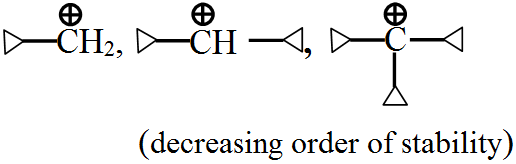
  1. Arrange the following according to given property

$\text{CH}_3\stackrel{\oplus \ \ \ }{\text{CH}}_2,\text{C}_6\text{H}_5-\stackrel{\oplus\ \ \ \ }{\text{CH}}_2,(\text{CH}_3)_3\stackrel{\oplus \ \ \ \ }{\text{CH}},$

$\text{CH}_2=\text{CH}-\stackrel{\oplus\ \ \ \ }{\text{CH}}_2$ (decreasing order of stability)

  1. $\text{HC}\equiv\text{C}^{\ominus},\text{Ch}_2=\stackrel{\ominus\ \ \ \ \ \ }{\text{CH}_2},\text{CH}_3-\stackrel{\ominus\ \ \ \ \ }{\text{CH}_2},\stackrel{\ominus \ \ \ \ \ }{\text{CH}_3}$ (increasing order of stabillity)

  2. $\text{C}_6\text{H}_5\stackrel{\bf. \ \ \ \ }{\text{CHCH}_3},\text{C}_6\text{H}_5\text{CH}_2\stackrel{\bf.\ \ \ \ \ }{\text{CH}_2},\text{C}_6\text{H}_5\stackrel{\bf.}{\text{C}}_3(\text{CH}_3)_2$ (increasing order of stabillity)

  3. $\text{CH}_3-\stackrel{\oplus \ \ \ \ }{\text{CH}}-\text{O}-\text{CH}_3,\text{CH}_3-\stackrel{\oplus \ \ \ \ }{\text{CH}},-\text{OCH}_3,$

${\ \ \ \ \ \ \ \ \ \ \ \ \ \ \ \ \ \ \ \ \text{O}}\\{\ \ \ \ \ \ \ \\ \ \ \ \ \ \ \ \ \ \ \ \ \ \\ \|}\\\ \text{CH}_3-\stackrel{\oplus \ \ \ \ }{\text{CH}}\text{C}-\text{OCH}_3$ (decreasing order of stability)
  1.  

  1. Define solubility product. Write solubility product expression in terms of molar solubility for FeCl3
  2. What is the effect of temperature on solubility of gases in liquids?
  3. Equilibrium constant for the reaction is 4.0. What will be the equilibrium constant for the reverse reaction.
  4. Calculate the pH of 10-8M HCl solution.
Derive the Rydberg formula.
Explain why cation are smaller and anions larger in radii than their parent atoms?
Four moles of PCl5 are heated in a closed 4dm3(L) container to reach equilibrium at 400K. At equilibrium 50% of PCl5 is dissociated. What is the value of Kc for the dissociation of PCl5 into PCl3 and Cl2 at 400K.
Arrange in properties:
  1. HF, HCI, HBr, HI [Thermal stability]
  2. LiF, LiCI, LiBr, Lil [Ionic character]
  3. PH3, PCI3, PF3, [Covalent character]
  4. H2O, NH3, H2S, HF [Polarity]
  5. BeCl2, BCI3, CCI4, PCI3, [Bond angle]
Extensive properties depend on the quantity of matter but intensive properties do not. Explain whether the following properties are extensive or intensive. Mass, internal energy, pressure, heat capacity, molar heat capacity, density, mole fraction, specific heat, temperature and molarity.