Question
Explain the following:
  1. Sodium chloride is an ionic compound which does not conduct electricity in soild state where as it does conduct electricity in molten state as well as in aqueous solution.
  2. Reactivity of aluminium decrease if it is dipped in nitric acid.
  3. Metals like calcium and magnesium are never found in their free state in nature.
Answer

a. In molten state, due to heat the electrostatic forces of attraction between the oppositely charged ions are overcome. So ions move freely and conduct electricity. In aqueous solutions ions are free and conduct electricity
b. Due to the formation of a coating of aluminium oxide/ $Al _2 O _3$.
c. Reactive metals like calcium and magnesium react easily with different elements and occur in the form of ores.

Need a full question paper?

Generate a complete, print-ready paper with questions like this in minutes — across 16+ boards, with answer keys.

Start Generating Free

Similar questions

A diverging mirror of radius of curvature 40cm forms an image which is half the height of the object. Find the object and image positions.
What is a period in a periodic table? How do atomic structures (electron arrangements) change in a period with increase in atomic numbers from left to right?
Draw the ray diagram and also state the position, relative size and nature of the image formed by a concave mirror when the object is placed between its centre of curvature, C and the focus, F.
Describe and explain, how a normal eye can see objects lying at various distances clearly.
Why does micelle formation take place when soap is added to water? Will a micelle be formed in other solvents like ethanol also?
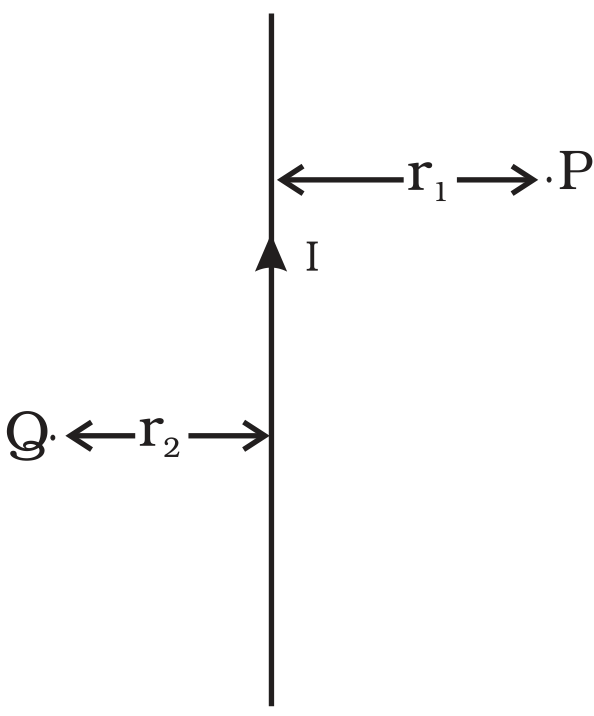
AB is a current carrying conductor in the plane of the paper as shown in Figure. What are the directions of magnetic fields produced by it at points P and Q? Given $r_1 > r_2$, where will the strength of the magnetic field be larger?
What possible values of resultant resistance one can get by combining two resistances, one of value 2 ohm and the other 6 ohm?
The filament of a lamp is 80cm from a screen and a converging lens forms an image of it on a screen, magnified three times. Find the distance of the lens from the filament and the focal length of the lens.
Give two circumstances in which a concave mirror can form a magnified image of an object placed in
front of it. Illustrate your answer by drawing labelled ray diagrams for both.
Intake of small quantity of methanol can be lethal. Comment.