Question
Explain the following terms with suitable examples:
(a) Cationic detergents, (b) Anionic detergents, (c) Neutral detergents.
Answer

(a) Cationic detergents: These are mostly acetates or chlorides of quarternary ammonium salts. They are more expansive therefore used to limited extents. Such detergents possess germicidal properties and are used extensively as germicides, e.g., cetyl trimethyl ammonium chloride $\left[ CH _3\left( CH _2\right)_{15} N\left( CH _3\right)_3\right]^{+} Cl ^{-}$ is cationic detergent.
(b) Anionic detergents: These are so called because a large part of their molecules are anions. These are of two types:
(i) Sodium alkyl sulphates : For example, sodium lauryl sulphate $C _{11} H _{23} CH _2 OSO _3 Na$.
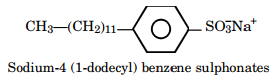
(ii) Sodium alkyl benzene sulphonates: The most widely used domestic detergent is sodium 4 (1-dodecyl) benzene sulphonates.
Image
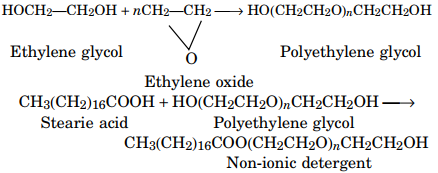
(c) Neutral detergents : Some of the detergents are non-ionic, like the esters of high molecular mass formed by reactions between polyethylene glycol and stearic acid.
Image

Need a full question paper?

Generate a complete, print-ready paper with questions like this in minutes — across 16+ boards, with answer keys.

Start Generating Free

Similar questions

Match the items of Column I and Column II on the basis of data given below:
$\text{E}^{\ominus}_{\text{F}_2/\text{F}^-}=2.87\text{V},\text{ E}^{\ominus}_{\text{Li}^+/\text{Li}}=-3.5\text{V},\text {E}^{\ominus}_{\text{Au}^{3+}/\text{Au}}=1.4\text{V},\text{ E}^{\ominus}_{ \text{Br}_2/\text{Br}^-}=1.09\text{V}$
 
Column I
 
Column II
i.
F2
a.
Metal is the strongest reducing agent.
ii.
Li
b.
Metal ion which is the weakest oxidising agent.
iii.
Au3+
c.
Non metal which is the best oxidising agent.
iv.
Br-
d.
Unreactive metal.
v.
Au
e.
Anion that can be oxidised by Au3+
vi.
Li+
f.
Anion which is the weakest reducing agent.
vii.
F-
g.
Metal ion which is an oxidising agent.
What is polymerisation? Define the terms 'addition polymerisation' and Give one example.
Specify the oxidation numbers of the metals in the following coordination entities:
i. $\left[ Co \left( H _2 O \right)( CN )( en )_2\right]^{2+}$
ii. $\left[ Pt ( Cl )_4\right]^{2-}$
iii. $K _3\left[ Fe ( CN )_6\right]$
iv. $\left[ Cr \left( NH _3\right)_3 Cl _3\right]$
What is vapour pressure? When a non- volatile solute is dissolved in any liquid, the vapour pressure of the liquid decreases. Give reason.
Write the applications of organometallic compounds.
Which forces are responsible for the stability of $\alpha-\text{helix}?$ Why is it named as 3.613 helix?
  1. Complete the following equations:
  1. $\text{Cr}_{2}\text{O}_{7}^{2-}+\text{2OH}^{-}\rightarrow$
  2. $\text{MnO}_{4}^{-}+\text{4H}^{+}+\text{3e}^{-}\rightarrow$
  1. Account for the following:
  1. Zn is not considered as a transition element.
  2. Transition metals form a large number of complexes.
  3. The Eo value for the Mn3+/Mn2+ couple is much more positive than that for Cr3+/Cr2+ couple.
Derive a formula to determine the molar mass of a solute by depression of freezing point.
For the decomposition of azoisopropane to hexane and nitrogen at 543 K , the following data is obtained :
$t( sec )$$P$ (mm of Hg )
035.0
36054.0
72063.0

Calculate the rate constant.