Question
Explain the following:
(a) Ground Waves, (b) Sky Waves, (c) Space Waves.

Answer

(a) Ground waves : The waves which travel directly from the transmitting to the receiving anteena following the surface of the earth are called ground waves. These waves can turn about the curvature of the earth. These are the waves below 1.5 MHz frequency.
(b) Sky waves : The radio waves which travel from the transmitting to the receiving anteena after being reflected from the ionosphere are called sky waves. These are the waves of frequency range (2 MHz - 10 MHz).
(c) Space waves : The radio waves of frequency higher than 30 MHz are called space waves. These waves cannot be reflected back by ionosphere but they enter and crosses the ionosphere.

Need a full question paper?

Generate a complete, print-ready paper with questions like this in minutes — across 16+ boards, with answer keys.
Start Generating Free

Similar questions

A nearsighted person cannot see beyond 25cm. Assuming that the separation of them glass from the eye is 1cm, find the power of lens needed to see distant objects.
A straight, long wire carries a current of $20A$. Another wire carrying equal current is placed parallel to it. If the. force acting on a length of $10\ cm$ of the second wire is $2 \times 10^{-5}N,$ what is the separation between them?
Find the acceleration of the moon with respect to the earth from the following data:
Distance between the earth and the moon $= 3.85 \times 10^5\ km$ and the time taken by the moon to complete one revolution around the earth $= 27.3$ days.
A block is projected along a rough horizontal road with a speed of 10m/s. If the coefficient of kinetic friction is 0.10, how far will it travel before coming to rest?
Obtain expression $\vec{J}=\sigma \vec{E}$ of Ohm's law on the basis of drift velocity.
If the horizontal force needed for the turn in the previous problem is to be supplied by the normal force by the road, what should be the proper angle of banking?
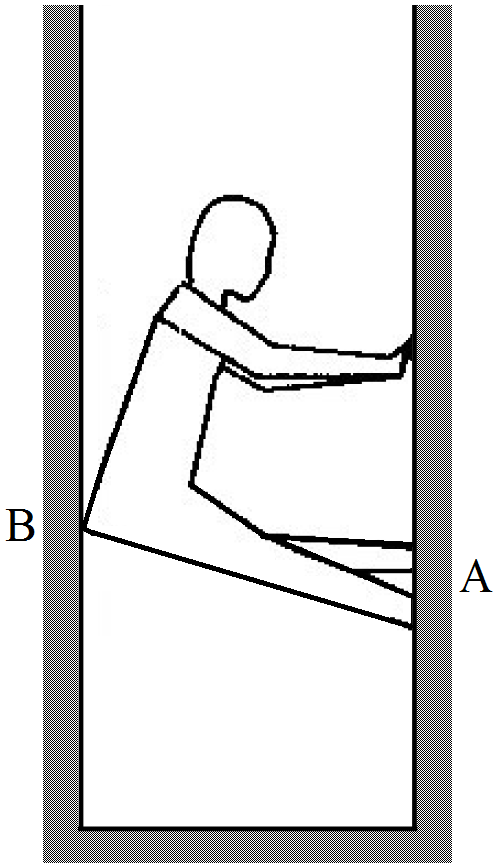
A person $(40\ kg)$ is managing to be at rest between two vertical walls by pressing one wall A by his hands and feet and the other wall B by his back. Assume that the friction coefficient between his body and the walls is $0.8$ and that limiting friction acts at all the contacts.
  1. Show that the person pushes the two walls with equal force.
  2. Find the normal force exerted by either wall on the person. Take $g = 10m/s^2.$
A circular ring of radius $r$ made of a nonconducting material is placed with its axis parallel to a uniform electric field. The ring is rotated about a diameter through $180^\circ$ . Does the flux of electric field change? If yes, does it decrease or increase?
A convex lens produces a double size real image when an object is placed at a distance of 18cm from it. Where should the object be placed to produce a triple size real image?
An inductor-coil, a capacitor and an AC source of rms voltage 24V are connected in series. When the frequency of the source is varied, a maximum rms current of 6.0A is observed. If this inductor coil is connected to a battery of emf 12V and internal resistance $4.0\Omega,$ what will be the current?