Questions

3 Marks Question

Take a timed test

5 questions · self-marked practice — reveal the answer and mark yourself.

Question 13 Marks
Explain the following:
(a) Ground Waves, (b) Sky Waves, (c) Space Waves.
Answer
(a) Ground waves : The waves which travel directly from the transmitting to the receiving anteena following the surface of the earth are called ground waves. These waves can turn about the curvature of the earth. These are the waves below 1.5 MHz frequency.
(b) Sky waves : The radio waves which travel from the transmitting to the receiving anteena after being reflected from the ionosphere are called sky waves. These are the waves of frequency range (2 MHz - 10 MHz).
(c) Space waves : The radio waves of frequency higher than 30 MHz are called space waves. These waves cannot be reflected back by ionosphere but they enter and crosses the ionosphere.
View full question & answer
Question 23 Marks
What is Remote Sensing ? Mention two of its applications.
Answer
Remote Sensing : It can be defined as obtaining information about an object by observing it from a distance and without coming to actual contact with it.
Infact when we see an object and understand what it is, our eye is sensing that object remotely. This is a broad definition. But we generally use this terms for observing the surface of earth from space using satellites.
The most useful of remote sensing technology is that it makes possible the repetitive surveys of west areas in a very short time, even if the areas are inaccessible.
Space-based remote sensing is a new technology. It has high potential for applications in nearly all aspects of resource management.
Applications :
(i) In Forestry : Remote sensing helps in providing information about the extent of forest cover. It also gives a general idea of the types of forest cover. It also helps in the detection of forest hazards like fire, disease and excessive felling. It also helps in biomass and fuel-wood assessments.
(ii) In Land use mapping : Remote sensing data can be used to great advantage in up-to-date land use pattern of large areas at any given time. The changes that occur from time to time can also be monitored.
View full question & answer
Question 33 Marks
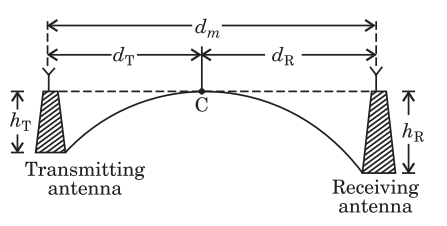
Explain LOS mode of communication.
Answer
LOS communication ie. Line of Sight communication : The radio waves of frequency greater that 30 MHz are called space waves. The transmission of these waves from transmitting antenna to receiving antenna is called space wave propagation. In this mode of transmission these waves are transmitted horizontally. This mode of transmission is called Line of Sight (LOS) mode of transmission.
Image
View full question & answer
Question 43 Marks
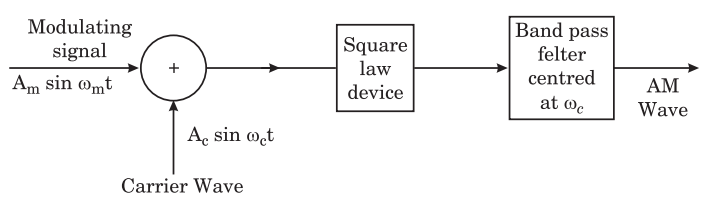
What is amplitude modulation ? Draw the simple block diagram of a modulator to get amplitude modulated wave.
Answer
Amplitude Modulation : The process of modulation in which modulating wave is superimposed on a carrier wave in such a manner that the frequency of the modulated wave is the same as that of the carrier wave but its amplitude is modified in accordance with that of the modulated wave is called amplitude modulation.
Block diagram to get amplitude modulated wave :
Image
View full question & answer
Question 53 Marks
Explain the terms: (i) Attenuation, (ii) Demodulation used in communication system.
Answer
Attenuation : The loss of strength of a transmitted signal during its propagation through transmission channel is called attenuation.
Demodulation : For reception and reproduction of audio signal it is necessary to separate them from modulated wave. The process of separating the audio frequency signal from the modulated wave is called demodulation or detection and the device used for this purpose is called demodulator or detector which is also an electronic device. Demodulation is the reverse process of modulation.
View full question & answer