Question
Explain the formation of the barrier potential in a p-n junction.

Answer

When the electrons and holes move towards each other leaving the charged ions negative on the p side and positive on the n side then an electric field is generated and the potential thus formed is called barrier potential.

Need a full question paper?

Generate a complete, print-ready paper with questions like this in minutes — across 16+ boards, with answer keys.
Start Generating Free

Similar questions

Explain the method of charging by friction briefly.
A proton and an a-particle have the same de-Broglie wavelength. Determine the ratio of (i) Their accelerating potentials and (ii) Their speeds.
At a hydroelectric power plant, the water pressure head is at a height of 300m and the water flow available is $100m^3s^{-1}$. If the turbine generator efficiency is 60%, estimate the electric power available from the plant $(g = 9.8ms^{-2}).$
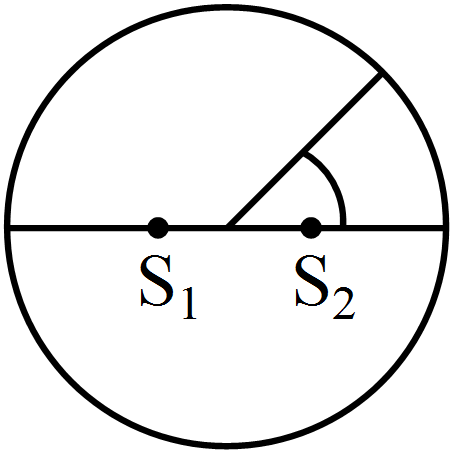
Figure, shows two coherent sources $S_1$ and $S_2$ which emit sound of wavelength $\lambda$ in phase. The separation between the sources is $3\lambda.$ A circular wire of large radius is placed in such a way that $S_1S_2$ lies in its plane and the middle point of $S_1S_2$ is at the centre of the wire. Find the angular positions $\theta$ on the wire for which constructive interference takes place.
Two transparent slabs having equal thickness but different refractive indices $\mu_1$ and $\mu_2$ are pasted side by side to form a composite slab. This slab is placed just after the double slit in a Young's experiment so that the light from one slit goes through one material and the light from the other slit goes through the other material. What should be the minimum thickness of the slab so that there is a minimum at the point $P_0$ which is equidistant from the slits?
White light is used in a Young's double slit experiment. Find the minimum order of the violet fringe $(\lambda=400\text{nm}),$ which overlaps with a red fringe $(\lambda=700\text{nm}).$
According to Maxwell's theory of electrodynamics, an electron going in a circle should emit radiation of frequency equal to its frequency of revolution. What should be the wavelength of the radiation emitted by a hydrogen atom in ground state if this rule is followed?
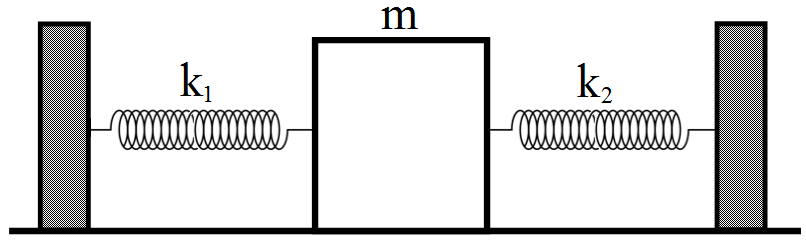
Both the springs shown in figure are unstretched. If the block is displaced by a distance x and released, what will be the initial acceleration?
A source of sound with adjustable frequency produces 2 beats per second with a tuning fork when its frequency is either 476Hz or 480Hz. What is the frequency of the tuning fork?
Plot a graph showing the variation of stopping potential with the frequency of incident radiation for two different photosensitive materials having work functions $W_1$ and $W_2\left(W_1>W_2\right)$. On what factors does the (i) slope and (ii) intercept of the lines depend?