Question
Explain the forward and the reverse characteristic of a Zener diode.

Answer

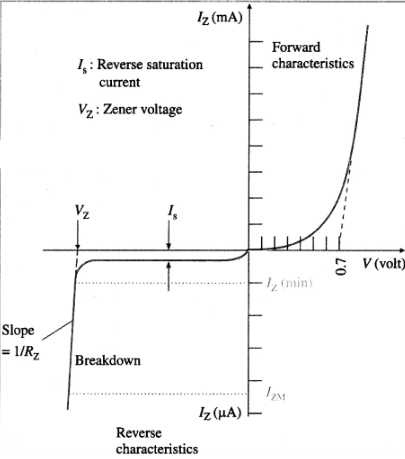
The forward bias region of a Zener diode is identical to that of a regular diode. There is forward current only after the barrier potential of the pn- junction is overcome.
Beyond this threshold or cut in voltage, there is an exponential upward swing.
The typical forward voltage at room temperature with a current of around $1\ mA $is around $0.6\ V$ . In the reverse bias condition the Zener diode is an open circuit and only a small reverse saturation current flows as shown with change of scale.
At the reverse breakdown voltage there is an abrupt rapid increase in the current-the knee is very sharp, followed by an almost vertical increase in current.
The voltage across the Zener diode in the breakdown region is very nearly constant with only a small increase in voltage with increasing current.
There is a minimum Zener current, $I _{ Z }( min )$, that places the operating point in the desired breakdown region.
At some high current level, $I _{ ZM }$, the power dissipation of the diode becomes excessive beyond which the diode can be damaged.

Image

Zener diode characteristics
The $I-V$ characteristics of a Zener diode is not totally vertical in the breakdown region. This means that for slight changes in current, there will be a small change in the voltage across the diode. The voltage change for a given change in current is the resistance $Rz$ of the Zener diode.

Need a full question paper?

Generate a complete, print-ready paper with questions like this in minutes — across 16+ boards, with answer keys.
Start Generating Free

Similar questions

Derive an expression for equation of stationary wave on a stretched string.
Describe how a potentiometer is used to compare the emfs of two cells by combination method.
State and explain the hydrostatic paradox. OR Explain hydrostatic paradox.
A metallic ring of mass $1\ kg$ has moment of inertia $1\ kg\ m^2$​​​​​​​ when rotating about one of its diameters. It is molten and remoulded into a thin uniform disc of the same radius. How much will its moment of inertia be, when rotated about its own axis.
 
It is observed in an experiment on photoelectric effect that an increase in the intensity of the incident radiation does not change the maximum kinetic energy of the electrons. Where does the extra energy of the incident radiation go? Is it lost? State your answer with explanatory reasoning.
Two circular discs A and B, having the same mass, have four identical small circular discs placed on them, as shown in the diagram. They are simultaneously released from rest at the top of an inclined plane. If the discs roll down without slipping, which disc will reach the bottom first?

Image

Obtain an expression for the self inductance of a solenoid.
State Einstein’s photoelectric equation. Explain all characteristics of the photoelectric effect, on the basis of Einstein’s photoelectric equation.
A needle of a sewing machine moves along a path of amplitude $4 cm$ with frequency $5 Hz$. Find its acceleration $\frac{1}{30} s$ after it has crossed the mean position.
A blackbody with initial temperature of $300^{\circ} \mathrm{C}$ is allowed to cool inside an evacuated enclosure surrounded by melting ice at the rate of $0.35^{\circ} \mathrm{C} /$ second. If the mass, specific heat and surface area of the body are $32 \mathrm{grams}, 0.10 \mathrm{cal} / \mathrm{g}{ }^{\circ} \mathrm{C}$ and $8 \mathrm{~cm}^2$ respectively, calculate Stefan's constant. (Take J $=4200 \mathrm{j} / \mathrm{kcal}$.)