Question
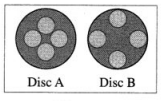
Two circular discs A and B, having the same mass, have four identical small circular discs placed on them, as shown in the diagram. They are simultaneously released from rest at the top of an inclined plane. If the discs roll down without slipping, which disc will reach the bottom first?
Image

Answer

The disc A has the smaller discs closer to the centre than disc B. Hence, the moment of inertia of disc $A\left(I_A\right)$ is less than that of disc $B\left(I_B\right)$.
[Suppose the larger discs have radius $R$, the smaller discs have mass $m$ and radius $r$, and the centre of each smaller disc on disc $\mathrm{A}$ is at a distance $\mathrm{x}$ from the centre. Then, $\mathrm{x}=\sqrt{2} \mathrm{rr}$ and, it can be shown that, $\left.I_B-I_A=4 m\left[R^2-(x-r)^2\right]>0.\right]$
Each composite disc is equivalent to a disc of the same radius $R$ and mass $M^{\prime}=M+4 m$, where $m$ is the mass of each smaller disc, but of different thicknesses.
Suppose, starting from rest, the composite discs roll down the same distance $L$ along a plane inclined at an angle $\theta$, their respective accelerations will be
$
a_{\mathrm{A}}=\frac{g \sin \theta}{1+\left(I_{\mathrm{A}} / M^{\prime} R^2\right)}, \quad a_{\mathrm{B}}=\frac{g \sin \theta}{1+\left(I_{\mathrm{B}} / M^{\prime} R^2\right)}
$
so that, the respective times taken to travel the distance $L$ are
$
\begin{aligned}
t_{\mathrm{A}} & =\sqrt{\frac{2 L}{a_{\mathrm{A}}}}=\sqrt{\frac{2 L}{g \sin \theta} \cdot\left(1+\frac{I_{\mathrm{A}}}{M^{\prime} R_2}\right)} \text { and } \\
t_{\mathrm{B}} & =\sqrt{\frac{2 L}{a_{\mathrm{B}}}}=\sqrt{\frac{2 L}{g \sin \theta} \cdot\left(1+\frac{I_{\mathrm{B}}}{M^{\prime} R_2}\right)} \\
\therefore t_{\mathrm{A}} & <t_{\mathrm{B}},
\end{aligned}
$
i.e., the disc A will reach the bottom first.

Need a full question paper?

Generate a complete, print-ready paper with questions like this in minutes — across 16+ boards, with answer keys.

Start Generating Free

Similar questions

A mercury drop of radius $0.5 \mathrm{~cm}$ falls from a height on a glass plate and breaks into one million droplets, all of the same size. Find the height from which the drop fell. [Density of mercury $=13600 \mathrm{~kg} / \mathrm{m} 3$, surface tension of mercury $=0.465 \mathrm{~N} / \mathrm{m}$ ]
Derive an expression for the maximum safe speed for a vehicle on a circular horizontal road without toppling/overturning/rollover.
Calculate the wavelength associated with an electron, its momentum and speed
(a) when it is accelerated through a potential of $54\ V$
The lower end of a capillary tube of diameter $1 \mathrm{~mm}$ is dipped $10 \mathrm{~cm}$ below the water surface in a beaker. What pressure is required to blow a hemispherical air bubble at the lower end of the tube? Present your answer rounded off to 4 significant figures. [Surface tension $=0.072$ $\mathrm{N} / \mathrm{m}$, density $=10^3 \mathrm{~kg} / \mathrm{m}^3$, atmospheric pressure $\left.=101.3 \mathrm{kPa}, \mathrm{g}=9.8 \mathrm{~m} / \mathrm{s}^2\right]$
A particle executing SHM has velocities $v _1$ and $v _2$ when at distances $x _1$ and $x _2$ respectively from the mean position. Show that its period is $T=2 \pi \sqrt{\frac{x_1^2-x_2^2}{v_2^2-v_1^2}}$ and the amplitude of SHM is $A =\sqrt{\frac{v_2^2 x_1^2-v_1^2 x_2^2}{v_2^2-v_1^2}}$
Describe how a potentiometer is used to compare the emf's of two cells by the combination method.
Deduce the expression for period of simple pendulum. Hence state the factors on which its period depends.
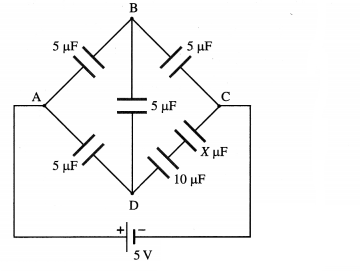
Six capacitors of capacities $5 \mu F , 5 \mu F , 5 \mu F , 5 \mu F , 10 \mu F$, and $X \mu F$ are connected as shown in the network given below:
Image
Find $(a)$ the value of $X$ if the network is balanced $(b)$ the resultant capacitance between $A$ and $C.$
Show that for a given positive ion species in a cyclotron,
$(i)$ the radius of their circular path inside a dee is directly proportional to their speed
$(ii)$ the time spent in a dee $($or the cyclotron frequency or the magnetic resonance frequency$)$ is independent of the radius of their path and speed
$(iii)$ the maximum ion energy obtainableis directly proportional to the square of the magnetic induction.
Why is a potentiometer preferred over a voltmeter for measuring emf?