Question
Explain the forward bias characteristics of $p-n$ junction diode with necessary graph.

Answer

Image

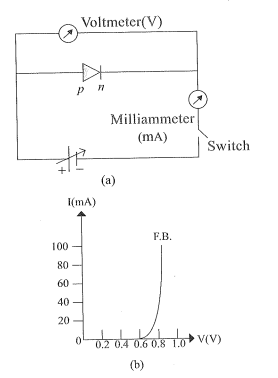
The circuit arrangement for studying the V-I characteristics of a diode, (i.e. Variation of current I as a function of applied voltage V ) is shown in fig. (a).
As shown in Fig., the battery is connected to the diode through a potentiometer (or rheostat) so that the applied voltage to the diode can be changed.
For different values of voltages, the value of current is noted. A graph between V and I is obtained as shown in fig. (b). For the forward bias, the current is of the order of $m A$.
As it is seen in the fig., in forward bias, the current first increases very slowly, almost negligibly till the voltage across the diode crosses a certain value.
After the characteristic voltage, the diode current increases significantly (exponentially) even for a very small increase in the diode bias voltage. This voltage is called the threshold voltage or cut-in voltage ( $\sim 0.2 V$ for germanium diode and $\sim 0.7 V$ for silicon diode).
For diodes, the ratio of small change in voltage $\Delta V$ to a small change in current $\Delta I$ is called dynamic resistance.
$r_d=\frac{\Delta V }{\Delta I }$
Its unit is ohm $(\Omega)$.
The resistance of the diode in forward bias mode is approximately between $10 \Omega$ to $100 \Omega$.

Need a full question paper?

Generate a complete, print-ready paper with questions like this in minutes — across 16+ boards, with answer keys.
Start Generating Free

Similar questions

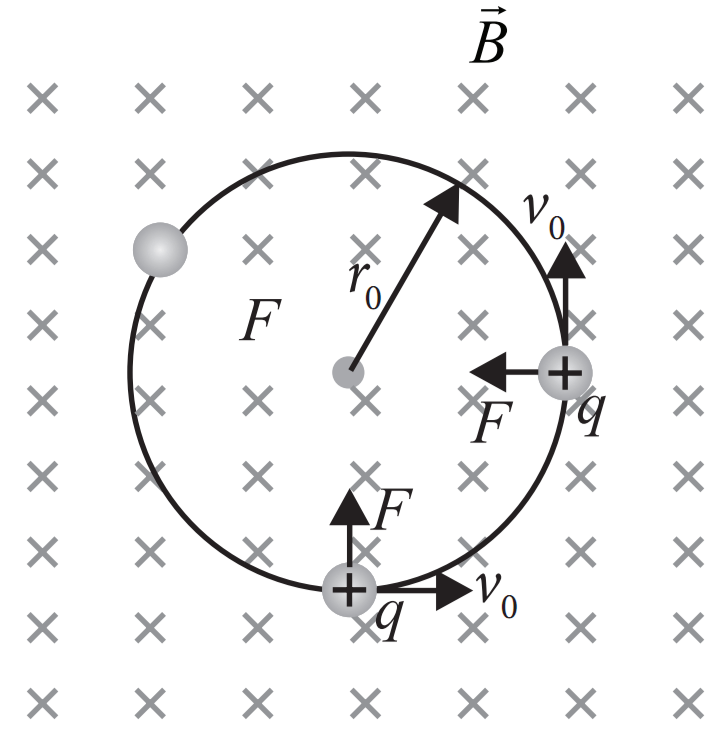
An electron with speed $v_0 << c$ moves in a circle of radius $r_0$ in a uniform magnetic field. This electron is able to traverse a circular path as magnetic field is perpendicular to the velocity of the electron. A force acts on the particle perpendicular to both $\vec{\text{v}}_0$ and $\vec{\text{B}},$ This force continuously deflects the particle sideways without changing its speed and the particle will move along a circle perpendicular to the field. The time required for one revolution of the electron is $T_0$.
  1. If the speed of the electron is now doubled to $2v_0$. The radius of the circle will change to :
  1. $4r_0$
  2. $2r_0$
  3. $r_0$
  4. $\frac{\text{r}_0}{2}$
  1. If $v_0 = 2v_0$ then the time required for one revolution of the electron will change to:
  1. $4T_0$
  2. $2T_0$
  3. $T_0$
  4. $\frac{\text{T}_0}{2}$
  1. A charged particles is projected in a magnetic field $\vec{\text{B}}=(2\hat{\text{i}}+4\hat{\text{j}})\times10^2\text{ T}.$ The acceleration of the particle is found to be $\vec{\text{a}}=(\text{x}\hat{\text{i}}+2\hat{\text{j}})\text{m s}^{-2}$ Find the value of $x$.
  1. $4ms^{-2}$
  2. $-4ms^{-2}$
  3. $-2ms^{-2}$
  4. $2ms^{-2}$
  1. If the given electron has a velocity not perpendicular to $B,$ then trajectory of the electron is :
  1. Straight line.
  2. Circular.
  3. Helical.
  4. Zig$-$zag.
  1. If this electron of charge $(e)$ is moving parallel to uniform magnetic field with constant velocity $v,$ the force acting on the electron is:
  1. Bev
  2. $\frac{\text{Be}}{\text{v}}$
  3. $\frac{\text{B}}{\text{ev}}$
  4. Zero
Maxwell showed that the speed of an electromagnetic wave depends on the penneability and pennittivity of the medium through which it travels. The speed of an electromagnetic wave in free space is given by $\text{c}=\frac{1}{\sqrt{\mu_0\epsilon_0}}.$ The fact led Maxwell to predict that light is an electromagnetic wave. The emergence of the speed of light from purely electromagnetic considerations is the crowning achievement of Maxwell's electromagnetic theory. The speed of an electromagnetic wave in any medium of permeability $\mu$ and pennittivity $\epsilon$ will be $\frac{\text{c}}{\sqrt{\text{K}\mu_\text{r}}}$ where $K$ is the dielectric constant of the medium and $\mu,$ is the relative permeability.
  1. The dimensions of $\frac{1}{2}\epsilon_0\text{E}^2$ ($\epsilon:$ pennittivity of free space; $E =$ electric field$)$ is:
  1. $MLT^{-1}$
  2. $ML^2T^{-2}$
  3. $ML^{-1}T^{-2}$
  4. $ML^2T^{-1}$
  1. Let $[\epsilon_0]$ denote the dimensional formula of the permittivity of the vacuum. $UM =$ mass, $L =$ length, $T = $ time and $A =$ electric current, then
  1. $[\epsilon_0]=\text{M}^{-1}\text{L}^{-3}\text{T}^2\text{A}$
  2. $[\epsilon_0]=\text{M}^{-1}\text{L}^{-3}\text{T}^4\text{A}^2$
  3. $[\epsilon_0]=\text{MLT}^{-2}\text{A}^{-2}$
  4. $[\epsilon_0]=\text{ML}^{2}\text{A}^{-1}$
  1. An electromagnetic wave offrequency $\text{3MHz}$ passes from vacuum into adielectricmedium with permittivity $\epsilon=4.$ Then
  1. Wavelength and frequency both remain unchanged.
  2. Wavelength is doubled and the frequency remains unchanged.
  3. Wavelength is doubled and the frequency becomes half.
  4. Wavelength is halved and the frequency remains unchanged.
  1. Which of the following are not electromagnetic waves?
  1. Cosmic rays
  2. $\gamma-\text{rays}$
  3. $\beta-\text{rays}$
  4. $X-$rays
  1. The electromagnetic waves travel with,
  1. The same speed in all media.
  2. The speed oflight $c = 3 \times 10^8ms^{-1}$ in free space.
  3. The speed oflight $c = 3 \times 10^8ms^{-1}$ in solid medium
  4. The speed of light $c = 3 \times 10^8ms^{-1}$ in fluid medium.
What is power factor? Explain.
A 4.5 cm needle is placed 12 cm away from a convex mirror of focal length 15 cm. Give the location of the image and the magnification. Describe what happens as the needle is moved farther from the mirror.
In motor vehicles, a convex mirror is attached near the driver's seat to give him the view of the traffic behind. What is the special function of this convex mirror which a plane mirror can not do?
Two cations with equal charge repel each other with a force of $3.7 \times 10^{-9}$ Newton while the distance between them is $5 A$. How many electrons are less in each ion than in the normal state?
A hot body is placed in a closed room maintained at a lower temperature. Is the number of photons in the room increasing?
(a) What do you mean by equivalent lens? In a system of two lenses these are placed at a some distance from each other. Establish the formula for the equivalent focal length of the system.
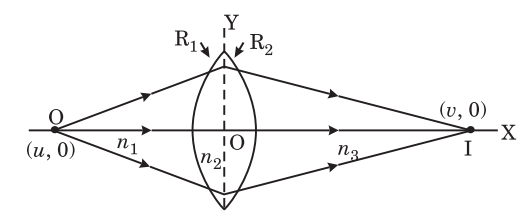
(b) A lens converted by two curved surfaces of radius of curvature R1 and R2 is placed according to the following figure :
Image
Prove that: $\frac{n_3}{v}-\frac{n_1}{u}=\frac{n_2-n_1}{R_1}+\frac{n_3-n_2}{R_2}$
In the year 1939, German scientist Otto Hahn and Strassmann discovered that when an uranium isotope was bombarded with a neutron, it breaks into two intermediate mass fragments. It was observed that, the sum of the masses of new fragments formed were less than the mass of the original nuclei. This difference in the mass appeared as the energy released in the process. Thus, the phenomenon of splitting of a heavy nucleus (usually A > 230) into two or more lighter nuclei by the bombardment of proton, neutron $\alpha$-particle, etc. with liberation of energy is called nuclear fission.
$\ _{92}\text{U}^{235}+\ _0\text{n}^{1}\rightarrow_{92}\text{U}^{236} \rightarrow\ _{56}\text{B}^{114}+\ _{36}\text{Kr}^{89}\ +3\ _{0}\text{n}^{1} + \text{Q}$
$\big[\because \ _{92}\text{U}^{236}= \text{Unstable nucleus}\big]$
  1. Nuclear fission can be explained on the basis of.
  1. Millikan's oil drop method
  2. Liquid drop model
  3. Shell model
  4. Bohr's model.
  1. For sustaining the nuclear fission chain reaction in a sample (of small size) of $_{92}^{235}\text{U}$ it is desirable to slow down fast neutrons by.
  1. Friction
  2. Elastic damping/ scattering
  3. Absorption
  4. None of these.
  1. Which of the following is/ are fission reaction(s)?
  1. $_0^1\text{n}\ +\ _{92}^{235}\text{U}\rightarrow\ _{92}^{235}\text{U}\rightarrow\ _{51}^{133}\text{Sb}+\ _{41}^{99}\text{nb}+\ 4_1^0\text{n}$
  2. $_0^1\text{n}\ +\ _{92}^{235}\text{U}\rightarrow\ _{54}^{1.40}\text{Xe}+\ _{38}^{94}\text{Sr}\ +2_0^1\text{n}$
  3. $_1^2\text{H}\ +\ _1^2\text{H}\rightarrow\ _2^3\text{He}+\ _0^1\text{n}$
  1. Both II and III
  2. Both I and III
  3. Only II
  4. Both I and II
  1. On an average, the number of neutrons and the energy of a neutron released per fission of a uranium atom are respectively.
  1. 2.5 and 2 keV
  2. 3 and 1 keV
  3. 2.5 and 2 MeV
  4. 2 and 2 keV
  1. In any fission process, ratio of mass of daughter nucleus to mass of parent nucleus is.
  1. Less than I
  2. Greater than I
  3. Equal to I
  4. Depends o the mass of parent nucleus.