Question
What is power factor? Explain.

Answer

We know that expression of average power is
$\overline{ P }= E _{ rms } I _{ rms } \cos \phi$
$\cos \phi=\frac{\overline{ P }}{ E _{ rms } I _{ rms }}$
$\cos \phi=\frac{\overline{ P }}{ P _{ app }}$
where $P_{\text {app }}=E_{ rms } I_{ rms }$
Hence the ratio of $\overline{ P }$ and $P _{\text {qpp }}$ is known as power factor.
Image
In other words, cosine of the phase difference $\phi$ between emf and current is known as power factor.
We know that
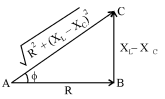
$\tan \phi=\frac{ X _{ L }- X _{ C }}{ R }$
$\cos \phi=\frac{ AB }{ AC }$
$\cos \phi=\frac{ R }{\sqrt{ R ^2+\left( X _{ L }- X _{ C }\right)^2}}$
$\cos \phi=\frac{R}{Z}$
$\because \quad Z =\sqrt{ R ^2+\left( X _{ L }- X _{ C }\right)^2}$
Power factor is equal to the ratio of resistance and impedance.
If $\phi=0^{\circ}, \cos \phi=+1$,maximum power factor.
If $\phi= \pm 90^{\circ}, \cos \phi=0$, minimum power factor.

Need a full question paper?

Generate a complete, print-ready paper with questions like this in minutes — across 16+ boards, with answer keys.
Start Generating Free

Similar questions

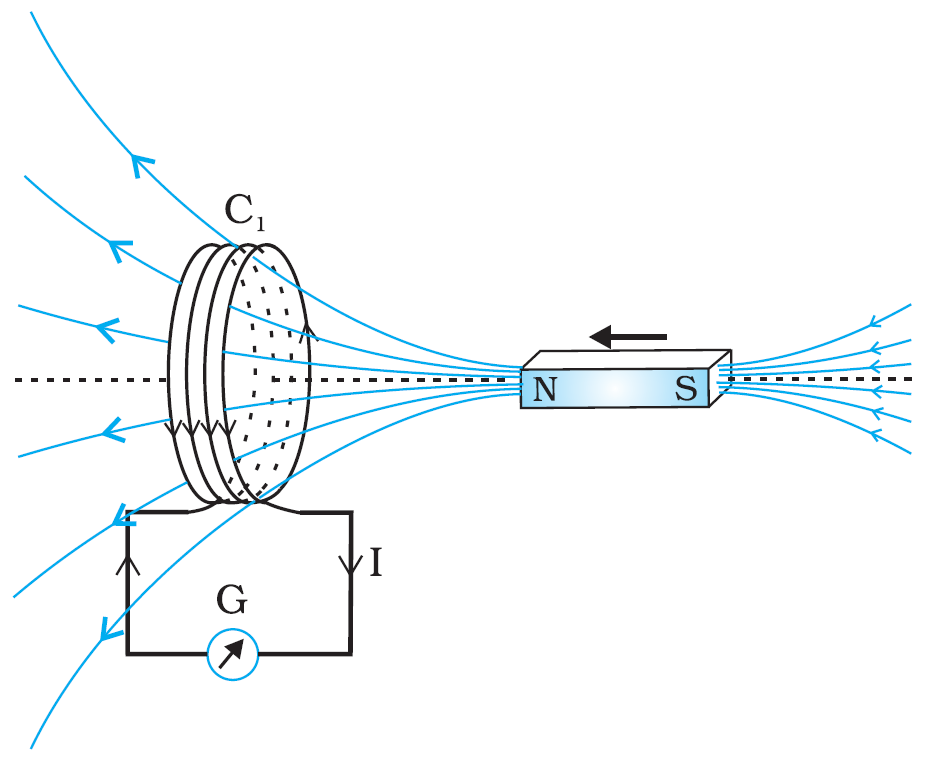
In year 1820 Oersted discovered the magnetic effect of current. Faraday gave the thought that reverse of this phenomenon is also possible i.e., current can also be produced by magnetic field. Faraday showed that when we move a magnet towards the coil which is connected by a sensitive galvanometer. The galvanometer gives instantaneous deflection showing that there is an electric current in the loop. Whenever relative motion between coil and magnet takes place an emf induced in coil. If coil is in closed circuit then current is also induced in the circuit. This phenomenon is called electromagnetic induction.
  1. The north pole of a long bar magnet was pushed slowly into a short solenoid connected to a galvanometer. The magnet was held stationary for a few seconds with the north pole in the middle of the solenoid and then withdrawn rapidly. The maximum deflection of the galvanometer was observed when the magnet was:
  1. Moving towards the solenoid.
  2. Moving into the solenoid.
  3. At rest inside the solenoid.
  4. Moving out of the solenoid.
  1. Two similar circular loops carry equal currents in the same direction. On moving the coils further apart, the electric current will.
  1. Remain unaltered.
  2. Increases in one and decreases in the second.
  3. Increase in both.
  4. Decrease in both.
  1. A closed iron ring is held horizontally and a bar magnet is dropped through the ring with its length along the axis of the ring. The acceleration of the falling magnet is.
  1. Equal to g.
  2. Less than g.
  3. More than g.
  4. Depends on the diameter of the ring and length of magnet.
  1. Whenever there is a relative motion between a coil and a magnet, the magnitude of induced emf set up in the coil does not depend upon the:
  1. Relative speed between the coil and magnet.
  2. Magnetic moment of the coil.
  3. Resistance of the coil.
  4. Number of turns in the coil.
  1. A coil of metal wire is kept stationary in a non-uniform magnetic field:
  1. A n emf and current both are induced in the coil.
  2. A current but no emf is induced in the coil.
  3. An emf but no current is induced in the coil.
  4. Neither emf nor current is induced in the coil.
A container contains water upto a height of 20cm and there is a point source at the centre of the bottom of the container. A rubber ring of radius r floats centrally on the water. The ceiling of the room is 2.0m above the water surface.
  1. Find the radius of the shadow of the ring formed on the ceiling if r = 15cm.
  2. Find the maximum value of r for which the shadow of the ring is formed on the ceiling. Refractive index of water $\frac{4}{3}.$
(a) Two insulated charged copper spheres A and B have their centres separated by a distance of 50 cm. What is the mutual force of electrostatic repulsion if the charge on each is 6.5 x $10^{-7} C$ ? The radii of A and B are negligible compared to the distance of separation.
(b) What is the force of repulsion if each sphere is charged double the above amount, and the distance between them is halved?
A bar magnet whose area of cross-section is $0.25 cm^2$ is kept in a magnetising field of intensity of $5000 A / m$. If magnitude of magnetic flux passing through the bar is $2.5 \times 10^{-5}$ weber, then calculate :(a) Magnetic induction (b) Magnetic susceptibility (c) Intensity of magnetisation.
Mention the difference between $n$-type and $p$-type semiconductors.
A metallic loop is placed in a nonuniform magnetic field. Will an emf be induced in the loop?
Deduce the expression for the torque $\overrightarrow{\tau}$  acting on a planar loop of area $\overrightarrow{\text{A}}$ and carrying current I placed in a uniform magnetic field $\overrightarrow{\text{B}}.$ 
If the loop is free to rotate, what would be its orientation in stable equilibrium?
Consider a gravity$-$free hall in which an experimenter of mass $50\ kg$ is resting on a $5\ kg$ pillow, $8ft$ above the floor of the hall. He pushes the pillow down so that it starts falling at a speed of $8ft/s.$ The pillow makes a perfectly elastic collision with the floor, rebounds and reaches the experimenter's head. Find the time elapsed in the process.
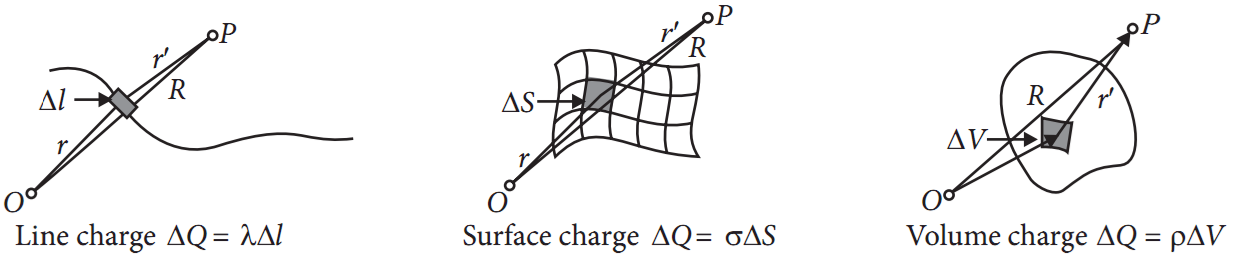
ln practice, we deal with charges much greater in magnitude than the charge on an electron, so we can ignore the quantum nature of charges and imagine that the charge is spread in a region in a continuous manner. Such a charge distribution is known as continuous charge distribution. There are three types of continuous charge distribution : $(i)$ Line charge distribution $(ii)$ Surface charge distribution $(iii)$ Volume charge distribution as shown in figure.
  1. Statement $1$ : Gauss's law can't be used to calculate an electric field near an electric dipole.
Statement $2$ : Electric dipole don't have symmetrical charge distribution.
  1. Statement $1$ and statement $2$ are true.
  2. Statement $1$ is false but statement $2$ is true.
  3. Statement $1$ is true but statement $2$ is false.
  4. Both statements are false.
  1. An electric charge of $8.85 \times 10^{-13}C$ is placed at the centre of a sphere of radius $1m$. The electric flux through the sphere is:
  1. $0.2NC^{-1} m^2$
  2. $0.1NC^{-1} m^2$
  3. $0.3NC^{-1} m^2$
  4. $0.01NC^{-1} m^2$
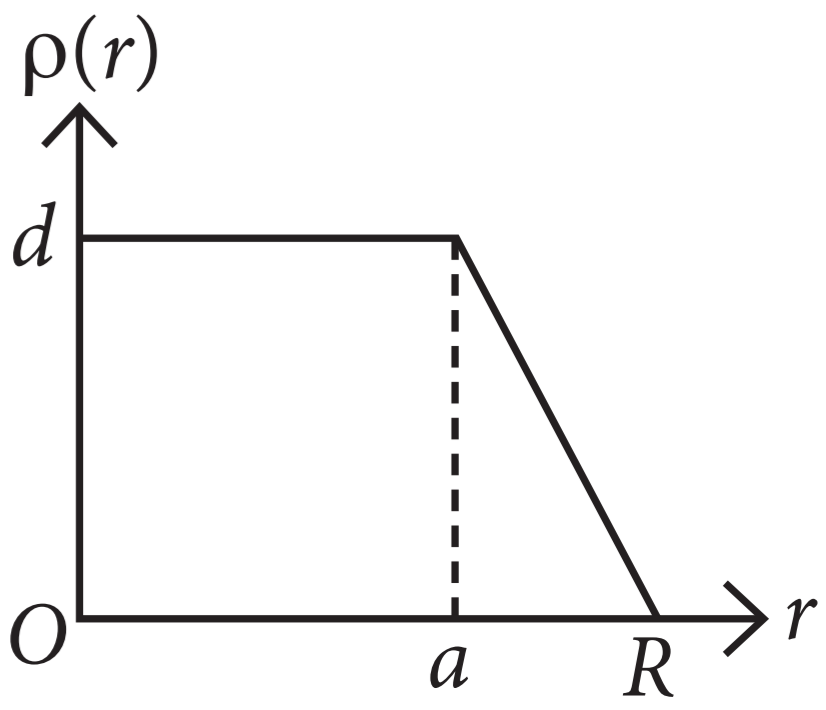
  1. The electric field within the nucleus is generally observed to be linearly dependent on $r$. So,
  1. $a = 0$
  2. $\text{a}=\frac{\text{R}}{2}$
  3. $a = R$
  4. $\text{a}=\frac{\text{2R}}{3}$
  1. What charge would be required to electrify a sphere of radius $25\ cm$ so as to get a surface charge density of $\frac{3}{\pi}\text{Cm}^{-2}?$
  1. $0.75C$
  2. $7.5C$
  3. $75C$
  4. Zero
  1. The $\text{SI}$ unit of linear charge density is :
  1. $Cm$
  2. $Cm^{-1}$
  3. $Cm^{-2}$
  4. $Cm^{-3}$
Using only NAND gate make combination diagrams to obtained NOT, AND and OR gates.