Question
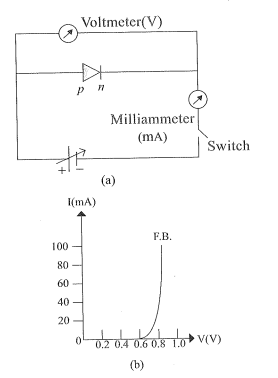
Explain the forward bias characteristics of $p-n$ junction diode with necessary graph.
Answer

Image

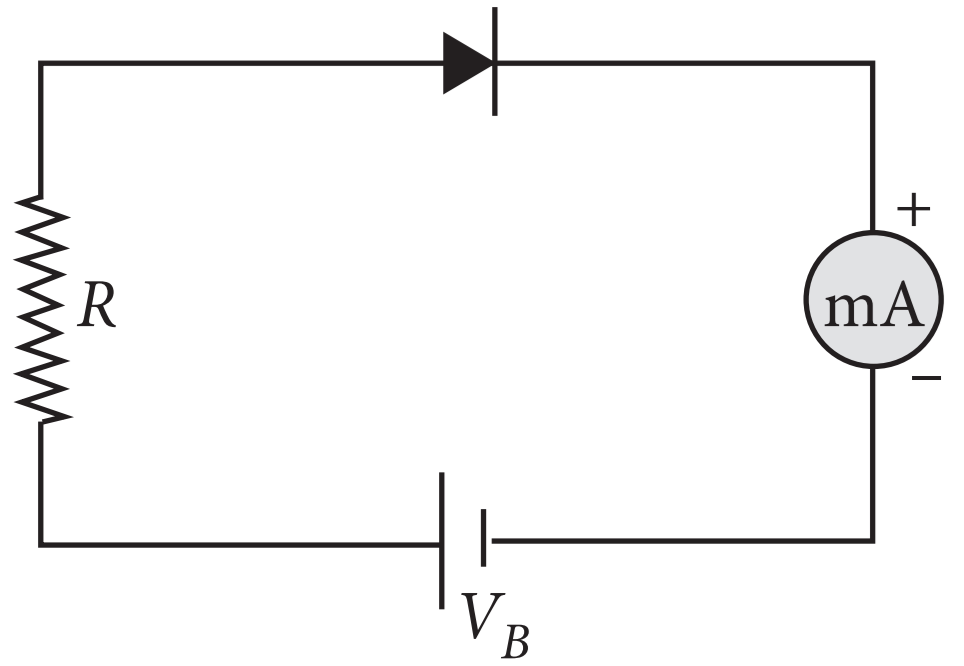
The circuit arrangement for studying the V-I characteristics of a diode, (i.e. Variation of current I as a function of applied voltage V ) is shown in fig. (a).
As shown in Fig., the battery is connected to the diode through a potentiometer (or rheostat) so that the applied voltage to the diode can be changed.
For different values of voltages, the value of current is noted. A graph between V and I is obtained as shown in fig. (b). For the forward bias, the current is of the order of $m A$.
As it is seen in the fig., in forward bias, the current first increases very slowly, almost negligibly till the voltage across the diode crosses a certain value.
After the characteristic voltage, the diode current increases significantly (exponentially) even for a very small increase in the diode bias voltage. This voltage is called the threshold voltage or cut-in voltage ( $\sim 0.2 V$ for germanium diode and $\sim 0.7 V$ for silicon diode).
For diodes, the ratio of small change in voltage $\Delta V$ to a small change in current $\Delta I$ is called dynamic resistance.
$r_d=\frac{\Delta V }{\Delta I }$
Its unit is ohm $(\Omega)$.
The resistance of the diode in forward bias mode is approximately between $10 \Omega$ to $100 \Omega$.

Need a full question paper?

Generate a complete, print-ready paper with questions like this in minutes — across 16+ boards, with answer keys.
Start Generating Free

Similar questions

A police jeep is chasing a culprit going on a motorbike. The motorbike crosses a turning at a speed of 72km/h. The jeep follows it at a speed of 90km/h, crossing the turning ten seconds later than the bike. Assuming that they travel at constant speeds, how far from the turning will the jeep catch up with the bike?
A narrow pencil of parallel light is incident normally on a solid transparent sphere of radius r. What should be the refractive index if the pencil is to he focused.
  1. At the surface of the sphere.
  2. At the centre of the sphere.
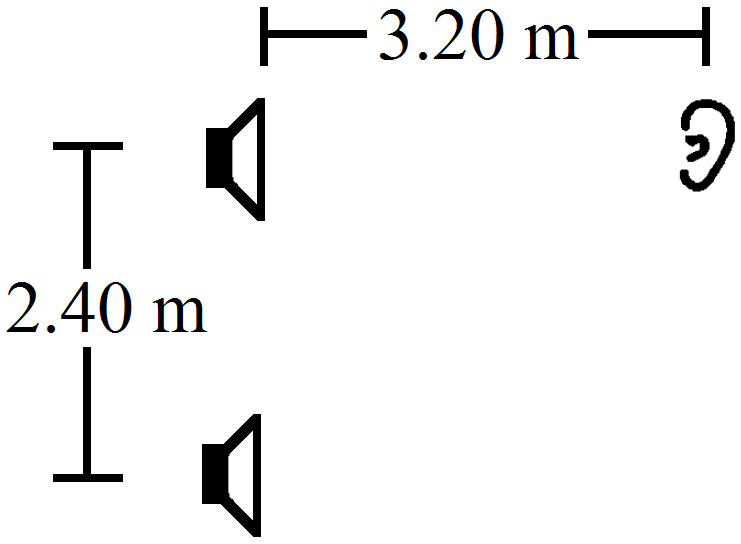
Two stereo speakers are separated by a distance of 2.40m. A person stands at a distance of 3.20m directly in front of one of the speakers as shown in figure, Find the frequencies in the audible range (20-2000Hz) for which the listener will hear a minimum sound intensity. Speed of sound in air = 320m/s.

Write the equation of average power for $L - C - R$ series AC circuit and discuss its special cases.
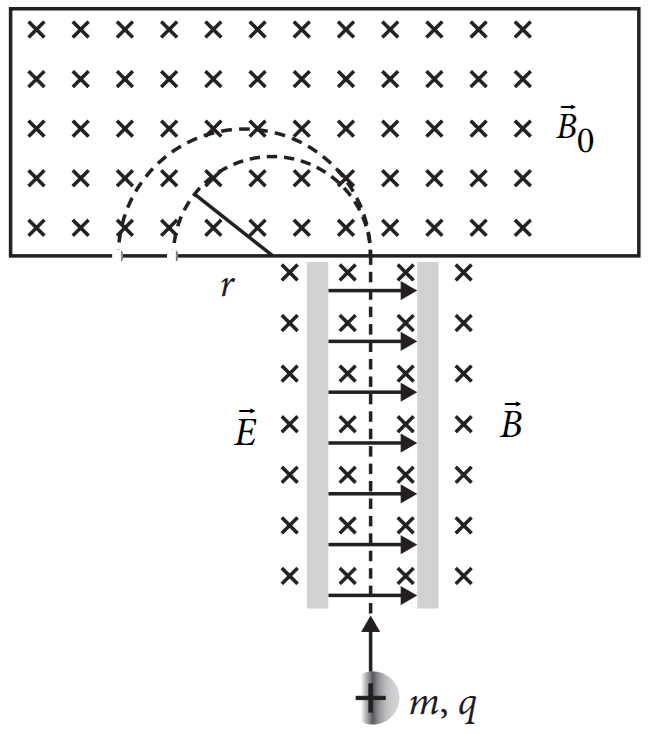
Various methods can be used to measure the mass of an atom. One possibility is through the use of a mass spectrometer. The basic feature of a Banbridge mass spectrometer is illustrated in figure. A particle carrying a charge +q is first sent through a velocity selector and comes out with velocity $\text{v}=\frac{\text{E}}{\text{B}}.$
The applied electric and magnetic fields satisfy the relation E = vB so that the trajectory of the particle is a straight line. Upon entering a region where a second magnetic field $\vec{\text{B}}_0$ pointing into the page has been applied, the particle will move in a circular path with radius rand eventually strike the photographic plate.

  1. In mass spectrometer, the ions are sorted out in which of the following ways?
  1. By accelerating them through electric field.
  2. By accelerating them through magnetic field.
  3. By accelerating them through electric and magnetic field.
  4. By applying a high voltage.
  1. Radius of particle in second magnetic field B0 is:
  1. $\frac{2\text{mv}}{\text{qE}_0}$
  2. $\frac{\text{mv}}{\text{qE}_0}$
  3. $\frac{\text{mv}}{\text{qB}_0}$
  4. $\frac{2\text{mE}_0\text{v}}{\text{qB}_0}$
  1. Which of the following will trace a circular trajectory with largest radius?
  1. Proton
  2. ct-particle
  3. Electron
  4. A particle with charge twice and mass thrice that of electron.
  1.  Mass of the particle in terms q, B0, B, rand E is:
  1. $\frac{\text{qbr}}{\text{E}}$
  2. $\frac{\text{qbr}}{\text{E}}$
  3. $\frac{\text{qbr}}{\text{E}}$
  4. $\frac{\text{qbr}}{\text{E}}$ 
  1. The particle comes out of velocity selector along a straight line, because:
  1. Electric force is less than magnetic force.
  2. Electric force is greater than magnetic force.
  3. Electric and magnetic force balance each other.
  4. Can't say.
Out of the two magnetic materials, 'A' has relative permeability slightly greater than unity while oB' has less than unity. Identify the nature of the materials 'A' and 'B'. Will their susceptibilities be positive or negative?

When a monochromatic radiations of suitable frequency obtained from source S, after being filtered by a filter attached on the window W, fall on the photosensitive place C, the photo electrons are emitted from C, which get accelerated towards the plate A if it is kept at positive potential. These electrons flow in the outer circuit resulting in photoelectric current. Due to it, the microammeter shows a deflection. The reading of micrommeter measures the photoelectric current.
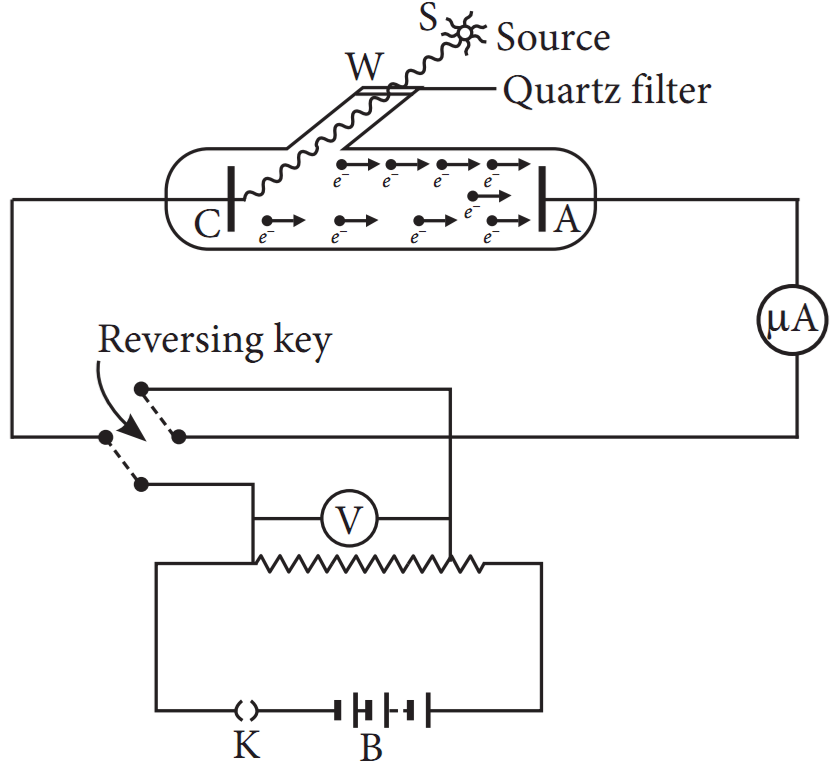
An experimental setup of verification of photoelectric effect is shown in figure. The voltage across the electrodes is measured with the help ofan ideal voltmeter, and which can be varied by moving jockey Jon the potentiometer wire. The battery used in potentiometer circuit is of 16 V and its internal resistance is $2\Omega$. The resistance of 100cm long potentiometer wire is $8\Omega$.
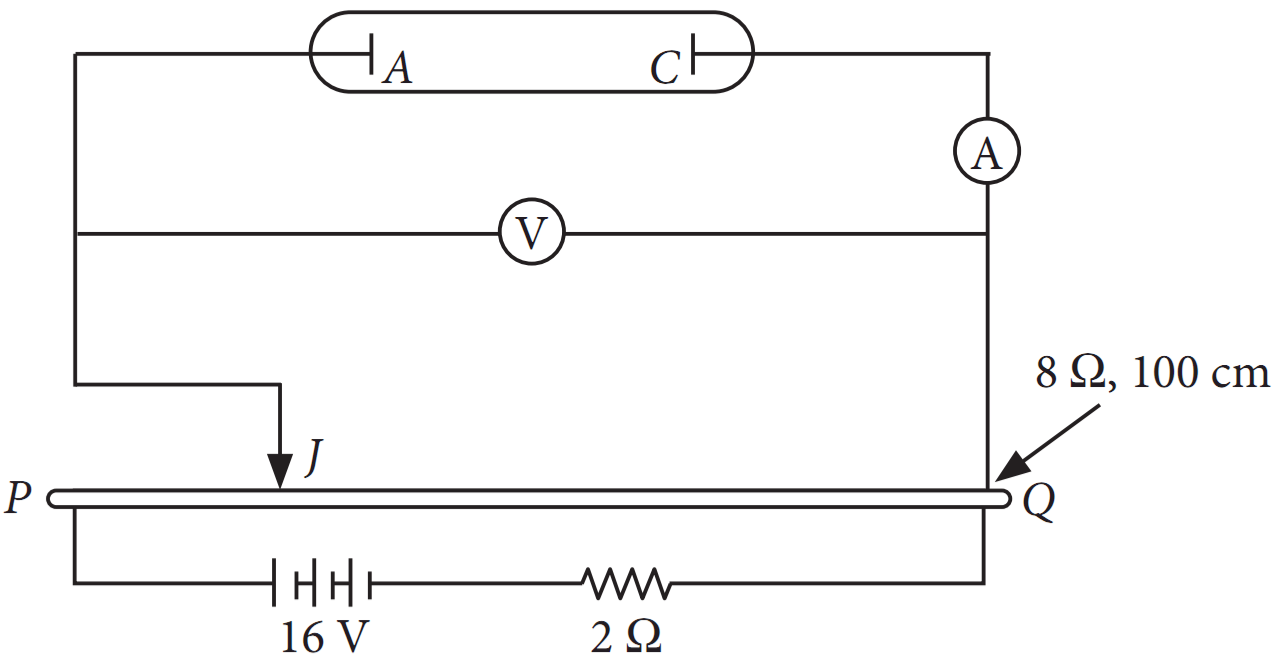
The photocurrent is measured with the help of an ideal ammeter. Two plates of potassium oxide of area 50cm2 at separation 0.5mm are used in the vacuum tube. Photocurrent in the circuit is very small, so we can treat the potentiometer circuit as an independent circuit.

Light
1 Violet
2 Blue
3 Green
4 Yellow
5 Orange
6 Red
$\lambda(\text{in } \mathring{\text{A}})$
4000-500
4500-5000
5000-5500
5500-6000
6000-6500
6500-7000
  1. When radiation falls on the cathode plate, a current of $2\mu\text{A}$ is recorded in the ammeter. Assuming that the vacuum tube setup follows Ohm's law, the equivalent resistance of vacuum tube operating in the case when jockey is at end P is:

  1. $8\times10^8\Omega$

  2. $16\times10^6\Omega$

  3. $8\times10^6\Omega$

  4. $10\times10^6\Omega$

  1. It is found that ammeter current remains unchanged $(2\mu\text{A})$ even when the jockey is moved from the end P to the middle point of the potentiometer wire. Assuming that all the incident photons eject electrons and the power of the light incident is $4\times10^{-6}\Omega$. Then, the color of the incident light is:
  1. Green
  2. Violet
  3. Red
  4. Orange
  1. Which of the following colors may not give photoelectric effect for this cathode?
  1. Green
  2. Violet
  3. Red
  4. Orange
  1. When other light falls on the anode plate, the anuneter reading zero till jockey is moved from the end P to the middle point of the wire PQ. Therefore, the deflection is recorded in the anuneter. The maximum kinetic energy of the emitted electron is:
  1. 16eV
  2. 8eV
  3. 4eV
  4. 10eV
  1. If the intensity of incident radiation is increased twice, the number of photoelectrons emitted per second will be:
  1. Halves
  2. Double
  3. Remain same
  4. Four times
A bar magnet whose area of cross-section is $0.25 cm^2$ is kept in a magnetising field of intensity of $5000 A / m$. If magnitude of magnetic flux passing through the bar is $2.5 \times 10^{-5}$ weber, then calculate :(a) Magnetic induction (b) Magnetic susceptibility (c) Intensity of magnetisation.
A silicon p-n junction diode is connected to a resistor Rand a battery of voltage VB through milliammeter (mA) as shown in figure. The knee voltage for this junction diode is VN = 0.7V. The p-n junction diode requires a minimum current of 1mA to attain a value higher than the knee point on the I-V characteristics of this junction diode. Assuming that the voltage Vacross the junction is independent of the current above the knee point. A p-n junction is the basic building block of many semiconductordevices like diodes. Important process occurring during the formation of a p-n junction are diffusion and drift. ln an n-type semiconductor concentration of electrons is more as compared to holes. ln a p-type semiconductor concentration of holes is more as compared to electrons.

  1. If V= 5V, the maximum value of R so that the voltage V is above the knee point voltage is:
  1. $40\text{k}\Omega$
  2. $4.3\text{k}\Omega$
  3. $5.0\text{k}\Omega$
  4. $5.7\text{k}\Omega$
  1. If VB = 5V, the value of R in order to establish a current to 6mA in the circuit is:
  1. $833\Omega$
  2. $717\Omega$
  3. $950\Omega$
  4. $733\Omega$
  1. If VB = 6V, the power dissipated in the resistor R, when a current of 6mA flows in the circuit is:
  1. 30.2mW
  2. 30.8mW
  3. 31.2mW
  4. 31.8mW
  1. When the diode is reverse biased with a voltage of 6V and Vbi = 0.63V. Calculate the total potential.
  1. 9.27V
  2. 6.63V
  3. 5.27V
  4. 0.63V
  1. Which of the below mentioned statement is false regarding a p-n junction diode?
  1. Diodes are uncontrolled devices.
  2. Diodes are rectifying devices.
  3. Diodes are unidirectional devices.
  4. Diodes have three terminals.
When the atomic dipoles are aligned partially or fully, there is a net magnetic moment in the direction of the field in any small volume of the material. The actual magnetic field inside material placed in magnetic field is the sum of the applied magnetic field and the magnetic field due to magnetisation. This field is called magnetic intensity (H).
$\text{H}=\frac{\text{B}}{\mu_0}-\text{M}$
where Mis the magnetisation of the material, flo is the permittivity of vacuum and B is the total magnetic field. The measure that tells us how a magnetic material responds to an external field is given by a dimensionless quantity is appropriately called the magnetic susceptibility: for a certain class of magnetic materials, intensity of magnetisation is directly proportional to the magnetic intensity.
  1. Magnetization of a sample is:
  1. Volume of sample per unit magnetic moment.
  2. Net magnetic moment per unit volume.
  3. Ratio of magnetic moment and pole strength.
  4. Ratio of pole strength to magnetic moment.
  1. Identify the wrongly matched quantity and unit pair.
  1. Pole strength - Am
  2. Magnetic susceptibility - dimensionless number
  3. Intensity of magnetisation - Am-1
  4. Magnetic permeability - Henry m
  1. A closed surface S encloses a magnetic dipole of magnetic moment 2ml. The magnetic flux emerging from the surface is:
  1. 2 × 10⁵A/ m
  2. 3 × 10⁵A/ m
  3. 4 × 10⁵A/ m
  4. 5 × 10⁵A/ m
  1. A solenoid has core of a material with relative permeability 500 and its windings carry a current of 1A. The number of turns of the solenoid is 500 per metre. The magnetization of the material is nearly,
  1. 2.5 × 10³Am-1
  2. 2.5 × 105Am-1
  3. 2.0 × 10³Am-1
  4. 2.0 × 105Am-1
  1. The relative penneability of iron is 6000. Its magnetic susceptibility is:
  1. 5999
  2. 6001
  3. 6000 × 10-7
  4. 6000 × 107