Question 14 Marks
Explain the reverse blas characteristics of $p-n$ junction diode with proper graph.
Answer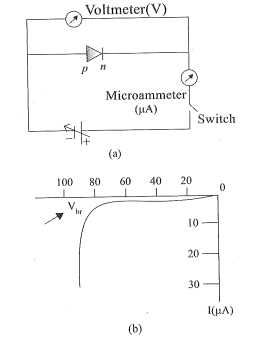
→The circuit arrangement for studying the V-I characteristics of a diode in Reverse bias is shown in the figure.
→As shown the battery is connected to the diode through a potentiometer (or rheostat) so that the applied voltage to the diode can be changed.
→For different values of voltages, the value of the current is noted, and as shown in fig (b), a `graph of $V \rightarrow I$ is obtained. The current obtained in the reverse bias is of the order of micro ampere, $(\mu A )$. This current is known as reverse saturation current.
→For the diode in reverse bias, the current is very small and almost remains constant (increases very slowly) with change in bias.
→Beyond a particular value of characteristic voltage, diode current changes/increases suddenly with small change in voltage. The reverse voltage, at which this phenomenon is seen is called Breakdown voltage.
→In reverse bias, after the breakdown occurs, voltage almost remains constant. Regulator circuits are prepared using this characteristic of a diode.
→In reverse bias mode, the dynamic resistance of $p-n$ junction is of the order of $10^6 \Omega( M \Omega)$.
View full question & answer→→The circuit arrangement for studying the V-I characteristics of a diode in Reverse bias is shown in the figure.
→As shown the battery is connected to the diode through a potentiometer (or rheostat) so that the applied voltage to the diode can be changed.
→For different values of voltages, the value of the current is noted, and as shown in fig (b), a `graph of $V \rightarrow I$ is obtained. The current obtained in the reverse bias is of the order of micro ampere, $(\mu A )$. This current is known as reverse saturation current.
→For the diode in reverse bias, the current is very small and almost remains constant (increases very slowly) with change in bias.
→Beyond a particular value of characteristic voltage, diode current changes/increases suddenly with small change in voltage. The reverse voltage, at which this phenomenon is seen is called Breakdown voltage.
→In reverse bias, after the breakdown occurs, voltage almost remains constant. Regulator circuits are prepared using this characteristic of a diode.
→In reverse bias mode, the dynamic resistance of $p-n$ junction is of the order of $10^6 \Omega( M \Omega)$.