Question
Explain the Gauss’ law for magnetic fields.
Answer

i. Analogous to the Gauss' law for electric field, the Gauss' law for magnetism states that, the net magnetic flux $\left(\emptyset_{ B }\right)$ through a closed Gaussian surface is zero. $\emptyset_{ B }=\int \vec{B} \cdot \overrightarrow{d S}=0$
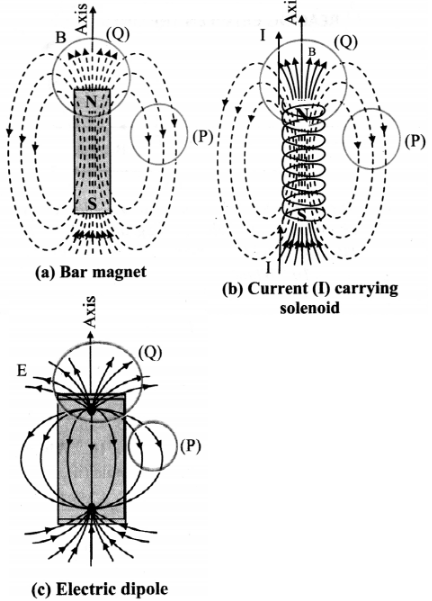
ii. Consider a bar magnet, a current carrying solenoid and an electric dipole. The magnetic field lines of these three are as shown in figures.
Image

iii. The areas (P) and (Q) are the cross – sections of three dimensional closed Gaussian surfaces. The Gaussian surface (P) does not include poles while the Gaussian surface (Q) includes N-pole of bar magnet, solenoid and the positive charge in case of electric dipole.

iv. The number of lines of force entering the surface (P) is equal to the number of lines of force leaving the surface. This can be observed in all the three cases.

v. However, Gaussian surface (Q) of bar magnet, enclose north pole. As, even thin slice of a bar magnet will have both north and south poles associated with it, the number of lines of Force entering surface (Q) are equal to the number of lines of force leaving the surface.

vi. For an electric dipole, the field lines begin from positive charge and end on negative charge. For a closed surface (Q), there is a net outward flux since it does include a net (positive) charge.
vii. Thus, according to the Gauss' law of electrostatics $\emptyset_{ E }=\int \vec{E} \cdot \overrightarrow{d S}=\frac{q}{\varepsilon_0}$, where $q$ is the positive charge enclosed.
viii. The situation is entirely different from magnetic lines of force. Gauss' law of magnetism can be written as $\varnothing_{ B }=\int \vec{B} \cdot \overrightarrow{d S}=0$
From this, one can conclude that for electrostatics, an isolated electric charge exists but an isolated magnetic pole does not exist.

Need a full question paper?

Generate a complete, print-ready paper with questions like this in minutes — across 16+ boards, with answer keys.

Start Generating Free

Similar questions

State the main characteristics of EM waves.
Discuss the following as special cases of elastic collisions and obtain their exact or approximate final velocities in terms
of their initial velocities.
(i) Colliding bodies are identical.
(ii) A very heavy object collides on a lighter object, initially at rest.
(iii) A very light object collides on a comparatively much massive object, initially at rest.
A spring ball of mass 0.5 kg is dropped from some height. On falling freely for 10 s, it explodes into two fragments of
mass ratio 1:2. The lighter fragment continues to travel downwards with speed of 60 m/s. Calculate the kinetic energy supplied during explosion. [Ans: 200 J]
Explain the concept of drift velocity with neat diagrams.
Estimate the number of images produced if a tiny object is kept in between two plane mirrors inclined at $35^\circ , 36^\circ , 40^\circ $ and $45^\circ $.
State and explain Kepler’s law of orbits.
Explain the I-V characteristics of a reverse biased junction diode.
Explain why the Earth doesn't appear to move even though the object of mass $m \  \ ( m << M )$ kept on the Earth exerts equal and opposite gravitational force on it.
A hole of radius $r$ is cut from a uniform disc of radius $2r.$ Centre of the hole is at a distance $r$ from centre of the disc. Locate centre of mass of the remaining part of the disc.
What is friction? Define coefficient of static friction and coefficient of kinetic friction. Give the necessary formula for each.