Question
State and explain Kepler’s law of orbits.

Answer

Statement:
All planets move in elliptical orbits around the Sun with the Sun at one of the foci of the ellipse.
Explanation:
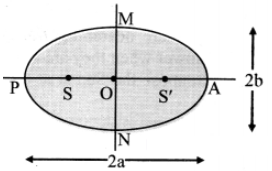
  1. The figure M shows the orbit of a around the planet P Sun.
    Image
  2. Here, S and S’ are the foci of the ellipse and the Sun is situated at S.
  3. P is the closest point along the orbit from S and is called perihelion.
  4. A is the farthest point from S and is called aphelion.
  5. PA is the major axis whose length is 2a. PO and AO are the semimajor axes with lengths ‘a’ each.
    MN is the minor axis whose length is 2b. MO and ON are the semiminor axes with lengths ‘b’ each.

Need a full question paper?

Generate a complete, print-ready paper with questions like this in minutes — across 16+ boards, with answer keys.
Start Generating Free

Similar questions

To understand the process of change of state:
Take some cubes of ice in a beaker. Note the temperature of ice (0 °C). Start heating it slowly on a constant heat source. Note the temperature after every minute. Continuously stir the mixture of water and ice. Observe the change in temperature. Continue heating even after the whole of ice gets converted into water. Observe the change in temperature as before till vapours start coming out. Plot the graph of temperature (along Y-axis) versus time (along X-axis). Obtain a graph of temperature versus time
Define the following terms with the help of a diagram.
i. Electric dipole
ii. Dipole axis
iii. Axial line
iv. Equatorial line
Explain the graph showing variation of acceleration due to gravity with altitude and depth.
Discuss the variation of acceleration due to gravity at poles and equator due to latitude of the Earth.
Find unit vectors perpendicular to the plane of the vectors, $\overrightarrow{ A }=$ and $\overrightarrow{ B }=2 \hat{ i }-\hat{ k }$
Derive an expression for a current generated due to flow of charged particles
Define time period of a satellite.
Obtain an expression for the period of a satellite in a circular orbit round the Earth. Show that the square of the period of revolution of a satellite is directly proportional to the cube of the orbital radius.
Discuss qualitative idea for the gravitational force of attraction due to a hollow, thin spherical shell of uniform density on a point mass situated inside it.
Describe how an artificial satellite using two stage rocket is launched in an orbit around the Earth.
A monochromatic ray of light is incident at $37^\circ $ on an equilateral prism of refractive index $3/2$. Determine angle of emergence and angle of deviation. If angle of prism is adjustable, what should its value be for emergent ray to be just possible for the same angle of incidence.