Question
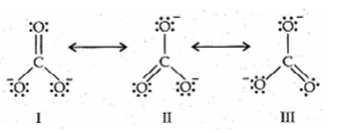
Explain the important aspect of resonance with reference to the $CO _3^{2-}$ ion.

Answer


Image
Resonance in, $CO _3^{2-}$ I, II and III represent the three canonical forms.
i. In these structures, the position of nuclei is the same.
ii. All the three forms have the almost equal energy
iii. The same number of paired and unpaired electrons they differ only in their position.

Need a full question paper?

Generate a complete, print-ready paper with questions like this in minutes — across 16+ boards, with answer keys.
Start Generating Free

Similar questions

A metal ' $X$' for crystalline ionic solid with dihydrogen. The solid produces hydrogen with $\mathrm{H}_2 \mathrm{O}$ and produces $\mathrm{H}_2$ gas and compound ' $Y$ ' is formed. ' $Y$ ' reacts with Aluminium metal and liberates $\mathrm{H}_2$ gas. ' $Y$ ' is also manufactured by electrolysis of brine solution.
Identify ' $X$ ' and ' $Y$ ' and write reaction involved.
Why is $\mathrm{Li}_2 \mathrm{CO}_3$ decomposed at a lower temperature whereas $\mathrm{Na}_2 \mathrm{CO}_3$ at higher temperature?
What is the concentration of sugar $\left(\mathrm{C}_{12} \mathrm{H}_{22} \mathrm{O}_{11}\right)$ in $\mathrm{mol}^{-1}$ if its 20 g are dissolved in enough water to make a final volume up to 2L?
If $4g$ of $NaOH$ dissolves in 36g of $H_2O$, calculate the mole fraction of each component in the solution. Also, determine the molarity of solution (specific gravity of solution is $1g mL^{–1}).$
How many $\sigma$ and $\sigma-$bonds are present in $\text{CH}_2=\text{C}-\text{CH}=\text{CH}_2?$
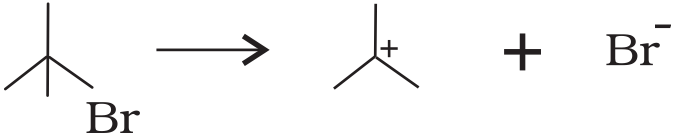
For the following bond cleavages, use curved-arrows to show the electron flow and classify each as homolysis or heterolysis. Identify reactive intermediate produced as free radical, carbocation and carbanion.
What happens:
  1. When $\mathrm{F}_2$ reacts with hot water
  2. Barium peroxide reacts with phosphoric acid
  3. Hydrogen peroxide reacts with ozone.
Write the chemical reacts involved.
What would be the SI unit for the quantity $\text{pV}^2\text{T}^2/\text{n}$?
Why does sharp glass edge become smooth on heating it upto its melting point in a flame? Explain which property of liquids is responsible for this phenomenon.
0.90 g of organic compound on combustion gave $2.64 \mathrm{g}$ of $\mathrm{CO}_2$, and 0.63 g of $\mathrm{H}_2 \mathrm{O}$. Calculate the percentage of C and H in the compound.