Question
Explain the lanthanoid contraction.

Answer

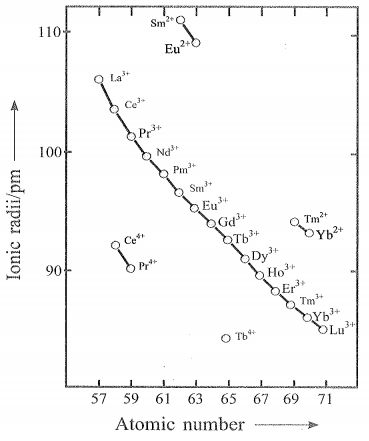
$\rightarrow$ As we move along the lanthanoid series, the atomic number increases gradually by one. This means that the number of electrons and protons present in an atom also increases by one.
$\rightarrow$ As electrons are being added to the same shell, the effective nuclear charge increases.
$\rightarrow$ This happens because the increase in nuclear attraction due to the addition of proton is more pronounced than the increase in the interelectronic repulsions due to the addition of electron.
$\rightarrow$ Also, with the increase in atomic number, the number of electrons in the $4f$ orbital also increases. The $4f$ electrons have poor shielding effect.
$\rightarrow$ Therefore, the effective nuclear charge experienced by the outer electrons increases. Consequently, the attraction of the nucleus for the outermost electrons increases.
$\rightarrow$ This results in a steady decrease in the size of lanthanoids with the increase in the atomic number. This is termed as lanthanoid contraction.
Image
$\rightarrow$ Consequences of lanthanoid contraction
$\rightarrow$ There is similarity in the properties of second and third transition series.
$\rightarrow$ Separation of lanthanoids is possible due to lanthanoid contraction.
$\rightarrow$ It is due to lanthanoid contraction that there is variation in the basic strength of lanthanoid hydroxides. $($Basic strength decreases from $\ce{La(OH)_3}$ to $ \ce{Lu(OH)_3}.)$

Need a full question paper?

Generate a complete, print-ready paper with questions like this in minutes — across 16+ boards, with answer keys.
Start Generating Free

Similar questions

How do you convert:
  1. Chlorobenzene to biphenyl.
  2. Propene to I-iodopropane.
  3. 2-bromobutane to but-2-ene.
Show that half life of first order reaction is independent to initial concentration.
A $0.1539$ molal aqueous solution of cane sugar $($mol. mass $= 342 g\ mol^{-1})$ has a freezing point of $271\ K$ while the freezing point of pure water is $273.15 K$. What will be the freezing point of an aqueous solution containing $5 g$ of glucose $($mol. mass $= 180 g\ mol^{-1})$ per $100 g$ of solution?
Calculate the emf of the following cell at $25^{\circ} C$.$Fe \left| Fe ^{2+}(0.001 M )\right|\left| H ^{+}(0.01 M )\right| H _2(g)(1 bar ) \mid Pt ( s )$
Given that, $E_{ Fe ^{2+} / Fe }^o=-0.44 V ; E_{H^{+} / H_2}^o=0.00 V$
For the complex $\ce{[NiCI_4]^{2-}},$ write
  1. The $\text{IUPAC}$ name.
  2. The hybridization type.
  3. The shape of the complex.
$($Atomic no. of $Ni = 28)$
Aqueous copper sulphate solution and aqueous silver nitrate solution are electrolysed by $1$ ampere current for $10$ minutes in separate electrolytic cells. Will the mass of copper and silver deposited on the cathode be same or different? Explain your answer.
Write one chemical equation for each, to illustrate the following reactions:
  1. Rosenmund reduction.
  2. Cannizzaro reaction.
  3. Fischer esterification.
  1. Draw the pyranose structure of glucose.
  2. What type of linkage is present in proteins?
  3. Give one example each for water-soluble vitamins and fat-soluble vitamins.
Resistance of a conductivity cell filled with $0.1 \ mol L^{-1} KCl$ solution is $100\Omega.$ If the resistance of the same cell when filled with $0.02 \ mol L^{-1} KCl$ solution is $520\Omega,$ calculate the conductivity and molar conductivity of $0.02 \ mol L^{-1} KCl$ solution. The conductivity of $0.1 \ mol L^{-1} KCl$ solution is $1.29\times10^{-2}\Omega^{-1}\text{cm}^{-1}.$
How would you account for the following?
  1. The atomic radii of the metals of the third $(5d)$ series of transition elements are virtually the same as those of the corresponding members of the second $(4d)$ series.
  2. The E^o value for the $\ce{Mn^{3+}/Mn^{2+}}$ couple is much more positive than that for $\ce{Cr^{3+}/Cr^{2+}}$ couple or $\ce{Fe^{3+}/Fe^{2+}}$ couple.
  3. The highest oxidation state of a metal is exhibited in its oxide or fluoride.