Questions

3 Marks Question

Take a timed test

11 questions · self-marked practice — reveal the answer and mark yourself.

Question 13 Marks
Give reason:
(i) Transition elements exhibit higher enthalpies of atomisation.
(ii) In aqueous solution, $Cr ^{2+}$ is stronger reducting agent than $Fe ^{2+}$.
(iii) The second ionisation enthalpy of Cu is higher then $Z n$.
Answer
→ (i) Because transition elements have more unpaired electrons, they have stronger interatomic interactions and hence stronger bonding. so....
→ (ii) In $Cr ^{2+}$ to $Cr ^{3+} d ^4 \rightarrow d ^3$ occurs and in $Fe ^{2+}$ to $Fe ^{3+} d ^6 \rightarrow d ^5$ occurs. In aq. medium $d ^3$ is more stable than $d^5$.
→ (iii) In 2nd ionisation enthalpy of $Cu e ^{-}$is removed from $3 d^{10}$ and in Zn from $4 s^1 .3 d^{10}$ is more stable configuration than $4 s^1$.
View full question & answer
Question 23 Marks
Discuss chemical properties of lanthanoids.
Answer
$\rightarrow$ In their chemical behaviour, in general, the earlier members of the series are quite reactive similar to calcium but, with increasing atomic number, they behave more like aluminium.
$\rightarrow$ The value of $E ^0$ of half reaction
$\operatorname{Ln}_{( aq )}^{3+}+3 e ^{-} \longrightarrow Ln ( s ) \text { range from }-2.21$
to $2.4 V $except for $Eu$ that has $-2.0 V .$
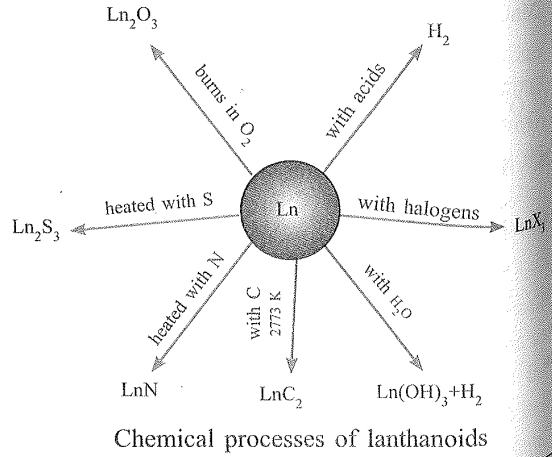
Image
$\rightarrow$ Lanthanoids heated with carbon forms carbides $\ce{Ln_3C, Ln_2C_3}$ and $\ce{LnC_2}$
$\rightarrow$ Lanthanoids form trihalides $\ce{LnX_3}$ with halogen and liberates hydrogen gas when treated with dilute acids.
$\rightarrow$ These metals combine with oxygen to form oxides of type $\ce{Ln_2O_3}$
$\rightarrow$ Oxides are basic in nature and when dissloved in water they form hydroxide $\ce{Ln(OH)_3}.$
View full question & answer
Question 33 Marks
Explain the lanthanoid contraction.
Answer
$\rightarrow$ As we move along the lanthanoid series, the atomic number increases gradually by one. This means that the number of electrons and protons present in an atom also increases by one.
$\rightarrow$ As electrons are being added to the same shell, the effective nuclear charge increases.
$\rightarrow$ This happens because the increase in nuclear attraction due to the addition of proton is more pronounced than the increase in the interelectronic repulsions due to the addition of electron.
$\rightarrow$ Also, with the increase in atomic number, the number of electrons in the $4f$ orbital also increases. The $4f$ electrons have poor shielding effect.
$\rightarrow$ Therefore, the effective nuclear charge experienced by the outer electrons increases. Consequently, the attraction of the nucleus for the outermost electrons increases.
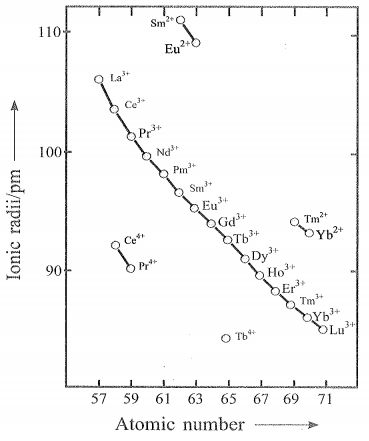
$\rightarrow$ This results in a steady decrease in the size of lanthanoids with the increase in the atomic number. This is termed as lanthanoid contraction.
Image
$\rightarrow$ Consequences of lanthanoid contraction
$\rightarrow$ There is similarity in the properties of second and third transition series.
$\rightarrow$ Separation of lanthanoids is possible due to lanthanoid contraction.
$\rightarrow$ It is due to lanthanoid contraction that there is variation in the basic strength of lanthanoid hydroxides. $($Basic strength decreases from $\ce{La(OH)_3}$ to $ \ce{Lu(OH)_3}.)$
View full question & answer
Question 43 Marks
Explain the variation in ionization enthalpies of transition element in $3d$ series.
Answer
$\rightarrow$ Due to an increase in nuclear charge which accompanies the filling of the inner d orbitals, there is an increase in ionization enthalpy along each series of the transition elements from left to right.
$\rightarrow$ The irregular trend in the first ionization enthalpy of the $3d$ metals, though of little chemical significance, can be accounted for by considering that the removal of one electron alters the relative energies of $4s$ and $3d$ orbitals.
$\rightarrow$ So the unipositive ions have $d^n$ configurations with no $4s$ electrons. There is thus, a reorganization energy accompanying ionization with some gains in exchange energy as the number of electrons increases and from the transference of s electrons into d orbitals.
$\rightarrow$ There is the generally expected increasing trend in the values as the effective nuclear charge increases. However, the value of $Cr$ is lower because of the absence of any change in the d configuration and the value for $Zn$ higher because it represent an ionization from the $4s$ level.
$\rightarrow$ The lowest common oxidation state of these metals is $+2.$ To form the $M^{2+}$ ions fron the gaseous atoms, the sum of the first and second ionization energies is required in addition to the enthalpy of atomization for each element.
$\rightarrow$ The dominant term is the second ionization enthalpy which shows unusually high values for $Cr$ and $Cu$ where the $d^5$ and $d^{10}$ configurations of the $M^+$ ions are disrupted, with considerable loss of exchange energy. The value for $Zn$ is correspondingly low as the ionization consists of the removal of an electron which allows the production of the stable $d^{10}$ configuration.
$\rightarrow$ The trend in the third ionization enthalpies is not complicated by the $4s$ orbital factor and shows the greater difficulty of removing and electron from the $d^5 (Mn^{2+})$ and $d^{10} (Zn^{2+})$ ions superimposed upon the general increasing trend. In general, the third ionization enthalpies are quite high and there is a marked break between the values for $Mn^{2+} $ and $Fe^{2+}.$
$\rightarrow$ Also, the high values for copper, nickel and zinc indicate why it is difficult to obtain oxidation state greater than two for these elements.
View full question & answer
Question 53 Marks
Explain chemical properties of $\ce{KMnO _4}$
Answer
$\rightarrow \ce{KMnO} _4$ act as strong oxidising agent in neutral, alkaline and in acidic medium.
$(1)$ In Acidic Solution
$(a)$ Iodine is liberated from potassium iodide:
$\begin{array}{l}2 MnO _4^{-}+16 H ^{+}+10 e ^{-} \rightarrow 2 \ce{Mn ^{2+}x+8 H _2 O} \\ \ \ \ \ \ \ \ \ \ \ \ \ \ \ \ \ \ \ \ \ \ \ \ \ \ \ \ \ \ \ \ \ \ \  10 I ^{-} \rightarrow 5 I _2+10 e ^{-} \\ \hline 2 \ce{MnO _4}^{-}+16 H ^{+}+10 I^{-} \rightarrow 2 \ce{Mn ^{2+}+5 I _2+8 H _2 O} \\\end{array}$
$(B) Fe ^{2+}$ ion (green) is converted to $Fe ^{3+} ($yellow$)$ :
$\begin{aligned} \ce{MnO _4^{-}+8 H ^{+}+5 e ^{-}} & \rightarrow \ce{Mn ^{2+}+4 H _2 O} \\
5 \ce{Fe ^{2+}} & \rightarrow 5 \ce{Fe ^{3+}+4 e ^{-}} \\ \hline
5 \ce{Fe ^{2+}+ MnO _4^{-}+8 H ^{+}} & \rightarrow \ce{Mn ^{2+}+4 H _2 O +5 Fe ^{3+}}
\end{aligned}$
$(c)$ Oxalate ion or oxalic acid is oxidised at $333 K.$
$\begin{array}{c}2 \ce{MnO _4^{-}+16 H ^{+}+10 e ^{-}} \rightarrow 2 \ce{Mn ^{2+}+8 H _2 O} \\ 5 \ce{C _2 O _4^{2-} \rightarrow 10 CO _2+10 e ^{-}} \\ \hline 5 \ce{C _2 O _4^{2-}+2 MnO _4^{-}+16 H ^{+}} \rightarrow 2 \ce{Mn ^{2+}+10 CO _2+8 H _4}\end{array}$
$(d)$ Hydrogen sulphide is oxidised, sulphur being precipitated:
$\begin{array}{l} \ce{H _2 S \rightarrow 2 H ^{+}+ S ^{2-} \\ 5 S^{2-}+2 MnO _4^{-}+16 H ^{+}} \rightarrow 2 \ce{Mn ^{2+}+8 H _2 O +5 S} \end{array}$
$(e)$ Sulphurous acid or sulphite is oxidised to sulphate or sulphuric acid:
$\begin{array}{r}5 \ce{SO _3^{2-}+2 MnO _4^{-}+6 H ^{+}} \rightarrow 2 \ce{Mn ^{2+}+3 H _2 O
+5 SO_4} ^{2-}\end{array}$
$(f)$ Nitrite is oxidised to nitrate:
$5 \ce{NO _2^{-}+2 MnO _4^{-}+6 H ^{+} \rightarrow 2 Mn ^{2+}+5 NO _3^{-}+3 HO _2}$
$(2)$ In neutral or faintly alkaline solutions:
$(a)$ A notable reaction is the oxidation of iodide to iodate:
$2 \ce{MnO _4^{-}+ H _2 O +\Gamma \rightarrow 2 MnO _2+2 OH ^{-}+ IO _3}$
$(b) $Thiosulphate is oxidised almost quantitatively to sulphate:
$8 \ce{MnO _4^{-}+3 S_2 O _3^{2-}+ H _2 O \rightarrow 8 MnO _2+6 SO _4^{2-}+2 OH^{-}}$
$(c)$ Manganous salt is oxidised to $\ce{MnO_2};$ the presence of zinc sulphate or zinc oxide catalyses the oxidation :
$2 \ce{MnO _4^{-}+3 Mn ^{2+}+2 H _2 O \rightarrow 5 MnO _2+4 H ^{+}}$
View full question & answer
Question 63 Marks
Write a note on halide compounds of Transition elements.
Answer
$\rightarrow$ The Transition elements form Ionic halides with fluorine and co$-$valent halides with chlorine, bromine and iodine.
$\rightarrow$ The highest oxidation numbers are achieved in $TiX _4 ($tetrahalides$), VF_5$ and $CrF_{6.}$
$\rightarrow$ Mn is not known in $+7$ oxidation state with fluorine i.e. $MnF$, is not known. But $MnO_3F$ is known because oxygen stabilizes the compound due to its tendency to form a multiple bonds.
$\rightarrow$ The ability of fluorine to stabilise the highest oxidation state is due to either higher lattice energy as in the case of $CoF_3,$ or higher bond enthalpy terms for the higher covalent compounds, e.g., $VF_5$ and $CrF_6$
$\rightarrow$ Although $V ^{ V }$ is represented only by $VF _5,$ the other halides, however, undergo hydrolysis to give oxohalides, $VOX _3.$ Another feature of fluorides
$\ce{VF _5+ H _2 O \rightarrow VOF _3+2 HF}$
$\rightarrow$ The solution of metal halides are acidic as they produce acid on hydrolysis.
$\rightarrow$ All halides of copper such as $\ce{CuF _2, CuCl _2}$ and $CuBr _2$ are known. However $CuI _2$ is not know because $Cu ^{2+}$ is good oxidising agent while $1$ is good reducing agent. So they form $Cu _2 I _2$ on reaction with each other.
$\ce{2 Cu ^{2+}+4 I ^{-} \rightarrow Cu _2 I _{2(s)}+ I _2}$
$\rightarrow$ However, many copper $(I)$ compounds are unstable in aqueous solution and undergo disproportionation.
$\ce{2 Cu ^{+} \rightarrow Cu ^{2+}+ Cu}$
$\rightarrow$ The stability of $\ce{Cu ^{2+} (aq)}$ rather than $\ce{Cu ^{+}(aq)}$ is due to the much more negative $\ce{\Delta_{\text {hyd }} H ^{\ominus} of Cu ^{2+} (aq)}$ than $\ce{Cu ^{+},}$ which more than compensates for the second ionization enthalpy of $Cu .$
Formulas of Halides of $3d$ Metals
Oxidation Number                  
$+6$     $CrF_6$            
$+5$   $VF_5$ $CrF_5$            
$+4$ $TiX_4$ $VX_4^1$ $CrX_4$ $MnF_4$          
$+3$ $TiX_3$ $VX _3$ $CrX_3$ $MnF_3$ $FeX_3^1$ $CoF_3$   $CuX _2{ }^{11}$ $ZnX _2$
$+2$ $TiX _2{ }^{ III }$ $VX _2$ $CrX_2$ $MnF_2$ $FeX _2$ $CoX _2$ $NiX _2$ $CuX ^{111}$  
$+1$                  
K e $\ce{y: X=F \rightarrow I ; X^1=F \rightarrow B r ; X^{11}=F, C l ; X^{111}=C l \rightarrow I}$
View full question & answer
Question 73 Marks
Write about oxidation states of transition series ?
Answer
$\rightarrow$ One of the notable features of a transition element is the great variety of oxidation states it may show in its compounds.
$Sc$ $Ti$ $V$ $Cr$ $Mn$ $Fe$ $Co$ $Ni$ $Cu$ $Zn$
  $+2$ $+2$ $+2$ $+2$ $+2$ $+2$ $+2$ $+1$ $+2$
$+3$ $+3$ $+3$ $+3$ $+3$ $+3$ $+3$ $+3$ $+2$  
  $+4$ $+4$ $+4$ $+4$ $+4$ $+4$ $+4$    
    $+5$ $+5$ $+5$          
      $+6$ $+6$ $+6$        
        $+7$          
Oxidation States of the first row Transition Metals
$($the most common ones are in bold types$)$
$\rightarrow$ The elements which give the greatest number of oxidation states occur in or near the middle of the series. Manganese, for example, exhibits all the oxidation states from $+2$ to $+7.$
$\rightarrow$ In the starting of series, very less number of $d-$electrons are available for chemical bonding.
Hence, less number of oxidation states are shown by elements present at the starting of series.
e.g.: $\ce{Sc^{+3}, Ti^{+2}, Ti^{+3}, Ti^{+4}}​​​​​​​$​​​​​​​
$\rightarrow$ At the end of the series there are too many $d-$electrons and $d-$orbitals are completely occupied.
Hence, these elements show very less number of oxidation states.
$\rightarrow$ Down the group the stability of elements in higher oxidation states increases because removal of electrons from $d-$orbitals become easy.
$\rightarrow$ For example, in group $6, \ce{Mo(VI)}$ and $\ce{W(VI)}$ are found to be more stable than $\ce{Cr(VI).}$
​​​​​​​Thus, $\ce{Cr(VI)}$ in the form of dichromate in acidic medium is a strong oxidising agent,
whereas $\ce{MoO_3}$ and $\ce{WO_3}$ are not.
$\rightarrow$ Low oxidation states are found when a complex compound has ligands capable of $\pi -$acceptor character in addition to the $o-$bonding.
For example, in $\ce{Ni(CO)_4}$ and $\ce{Fe(CO)_5,}$ the oxidation state of nickel and iron is zero.
View full question & answer
Question 83 Marks
Why transition elements form a coloured ions?
Answer
→ Most of the ionic and covalent compounds of transition elements are coloured. It is due to the presence of incompletely filled d-orbitals.
→ When an electron from a lower energy d orbital is excited to a higher energy d orbital, the energy of excitation corresponds to the frequency of light absorbed.
→ This frequency generally lies in the visible region. The colour observed corresponds to the complementary colour of the light absorbed.
→ The frequency of the light absorbed is determined by the nature of the ligand.
→ In aqueous solutions where water molecules are the ligands, the colours of the ions observed are listed in Table.
ConfigurationExampleColour
$3 d^0$$Sc ^{3+}$colourless
$3 d^0$$Ti ^{4+}$colourless
$3 d^{\prime}$$Ti ^{3+}$purple
$3 d^{\prime}$$V ^{4+}$blue
$3 d^2$$V ^{3+}$green
$3 d^3$$V ^{2+}$violet
$3 d^3$$Cr ^{3+}$violet
$3 d^4$$Mn ^{3+}$violet
$3 d^4$$Cr ^{2+}$blue
$3 d^5$$Mn ^{2+}$pink
$3 d^5$$Fe ^{3+}$yellow
$3 d^6$$Fe ^{2+}$green
$3 d^6 3 d^7$$Co ^{3+} Co ^{2+}$bluepink
$3 d^8$$Ni ^{2+}$green
$3 d^9$$Cu ^{2+}$blue
$3 d^{10}$$Zn ^{2+}$colourless
View full question & answer
Question 93 Marks
Explain magnetic properties of transition element.
Answer
→ When a magnetic field is applied to substances, mainly two types of properties magnetic behaviour are observed : diamagnetism and paramagnetism
→ Diamagnetic substances are repelled by the applied field while the paramagnetic substances are attracted.
→ Substances which are attracted very strongly are said to be ferromagnetic.
→ In fact, ferromagnetism is an extreme form of paramagnetism. Many of the transition metal ions are paramagnetic.
→ Paramagnetism arises from the presence of unpaired electrons, each such electron having a magnetic moment associated with its spin angular momentum and orbital angular momentum.
For these, the magnetic moment is determined by the number of unpaired electrons and is calculated by using the 'spin-only' formula, i.e.,
$
\mu=\sqrt{n(n+2)}
$
→ where $n=$ is the number of unpaired electrons $\mu=$ magnetic moment in units of Bohr magneton $( BM )$.
→ The magnetic moment increases with the increasing number of unpaired electrons.
Calculated and Observed Magnetic Moments (BM)
IonConfigurationUnpaired
Electron(s)
Magnetic moment
CalculatedObserved
$Sc ^{3+}$$3 d^0$000
$Ti ^{3+}$$3 d^1$11.731.75
$Ti ^{2+}$$3 d^2$22.842.76
$V ^{2+}$$3 d^3$33.873.86
$Cr ^{2+}$$3 d^4$44.904.80
$Mn ^{2+}$$3 d^5$55.925.96
$Fe ^{2+}$$3 d^6$44.905.3 – 5.5
$Co ^{2+}$$3 d^7$33.874.4 – 5.2
$Ni ^{2+}$$3 d^8$22.842.9 – 3,4
$Cu ^{2+}$$3 d^9$11.731.8 – 2.2
$Zn ^{2+}$$3 d^{10}$00
View full question & answer
Question 103 Marks
Discuss applications of d and $f-$Block element.
Answer
$\rightarrow$ Iron and steels. construction materials. are the most important
$\rightarrow$ Their production is based on the reduction of iron oxides, the removal of impurities and the addition of carbon and alloying metals such as $\text{Cr, Mn}$ and $Ni.$
$\rightarrow$ Some compounds are manufactured for special purposes such as $\text{TiO}$ for the pigment industry and $MnO_2$ for use in dry battery cells.
$\rightarrow$ The battery industry also requires $Zn$ and $Ni/Cd.$
$\rightarrow UK$ 'copper' coins are copper$-$coated steel. The 'silver' $UK$ coins are a $Cu/Ni$ alloy. Many of the metals and/or their compounds are essential catalysts in the chemical industry.
$\rightarrow V_2O_5$ catalyses the oxidation of $SO_2$ in the manufacture of sulphuric acid.
$\rightarrow TiCl_4$ with $Al(CH_3)_3$ forms the basis of the Ziegler catalysts used to manufacture polyethylene $($polythene$).$
$\rightarrow$ Iron catalysts are used in the Haber process for the production of ammonia from $N_2/H_2$ mixtures. Nickel catalysts enable the hydrogenation of fats to proceed.
$\rightarrow$ In the Wacker process the oxidation of ethyne to ethanal is catalysed by $PdCl_2.$ Nickel complexes are useful in the polymerisation of alkynes and other organic compounds such as benzene. The photographic industry relies on the special light$-$sensitive properties of $\text{AgBr}.$
View full question & answer
Question 113 Marks
Write short note on alloys.
Answer
→ "An alloy is a blend of metals prepared by mixing the components."
→ Alloys may be homogeneous solid solutions in which the atoms of one metal are distributed randomly among the atoms of the other.
→ Scientists Hume and Rothery presented rules as follows to obtain alloys of combination of useful properties:
→ The atomic size of two metals forming the alloy must be the same. There must not be more than 15% difference in their atomic radii.
→ The chemical properties of the metals used for preparation of alloys must be same, that is, their electronic configurations of valence shell must be the same.
→ The crystal structures of pure metallic
elements used for alloys must be similar.
→ The alloys so formed are hard and have often high melting points.
→ The best known are ferrous alloys: chromium, vanadium, tungsten, molybdenum and manganese are used for the production of a variety of steels and stainless steel.
→ Alloys of transition metals with non transition metals such as brass (copper-zinc) and bronze (copper-tin), are also of considerable industrial importance..
View full question & answer