Question
Explain the lateral shift for a ray refracted from a glass slab with parallel sides.

Answer


Image
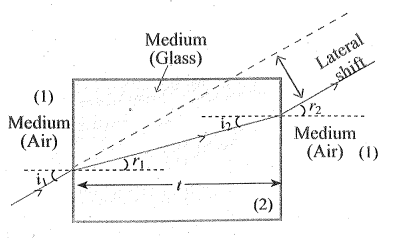
→As shown in figure ray is incident on a rectangular slab at an angle $i_1$ and is refracted through an angle $r_1$ and travels through the glass slab.
→This ray is incident on the other surface of the slab at an angle $i_2$.
→From this point a ray emerges at an angle $r_2$. Here, $i_1=r_2$ can be easily proved from Snell's law.
→Here, emergent ray is parallel to incident ray. Thus there is no deviation of incident ray.
→The perpendicular distance between the incident ray and the emergent ray is called lateral shift.

Need a full question paper?

Generate a complete, print-ready paper with questions like this in minutes — across 16+ boards, with answer keys.
Start Generating Free

Similar questions

In a Young's double slit experiment $\lambda=500\text{nm},$ d = 1.0mm and D = 1.0m. Find the minimum distance from the central maximum for which the intensity is half of the maximum intensity.
A pivoted aluminium bar falls much more slowly through a small region containing a magnetic field than a similar bar of an insulating material. Explain.
A parallel plate capacitor is charged with a potential difference 50 V . Thereafter it is discharged by a resistor for 2 sec , due to which its potential decreases by 10 V . Calculate the portion of energy stored in the capacitor.
The charge on a proton is +1.6 × 10-19C and that on an electron is -1.6 × 10-19C. Does it mean that the electron has a charge 3.2 × 10-19C less than the charge of a proton?
Answer the following question:
When viewing through a compound microscope, our eyes should be positioned not on the eyepiece but a short distance away from it for best viewing. Why? How much should be that short distance between the eye and eyepiece?
Can there be a potential difference between two adjacent conductors carrying the same charge?
Two bulbs are rated (P1, V) and (P2, V). If they are connected (i) in series and (ii) in parallel across a supply V.
Find the power dissipated in the two combinations in terms of P1 and P2.
Why are infrared waves often called heat waves ? Explain.
Explain what happens when iron filings are sprinkled on a sheet of glass placed over a short bar magnet.
If a particle is accelerating, it is either speeding up or speeding down. Do you agree with this statement?