Question
Explain the laws of perceptual organization.
Some laws of perceptual organization are as follows:
(i) Law of proximity – Stimuli that are near to each other are perceived as together, rather than stimuli that are far away from each other.
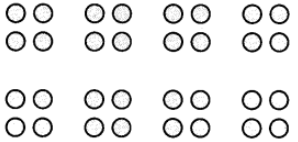
In the above figure, we perceive pairs of dots in each line because the dots which are near to each other are perceived together. So instead of perceiving a line of 8 dots, generally a line of four pairs of dots is perceived.
(ii) Law of similarity – Stimuli that are similar to each other are perceived together than stimuli that are distinct from each other.
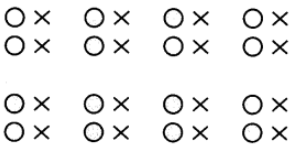
In the above figure, we perceive 4 alternate vertical lines each of circles and crosses as similar stimuli are perceived together. Generally, we do not perceive 4 horizontal lines each having circles and crosses in alternate sequence.
(iii) Law of continuity – There is a tendency to perceive a stimulus in continuation according to its established direction.
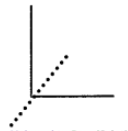
In the above figure, a straight vertical line and a straight horizontal line are perceived together as a letter ‘L’ and a cutting line is perceived separately as a line following the smoothest path. Generally, we do not perceive here four different lines going in different directions.
(iv) Law of closure – There is a tendency to fill in the gaps in an incomplete stimulus so as to perceive it as a meaningful figure.
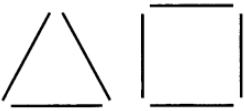
In the above figure, we fill in the gaps and perceive it as a triangle and square. Generally, we do not perceive here the three or four separate lines going in different directions.
Generate a complete, print-ready paper with questions like this in minutes — across 16+ boards, with answer keys.
Points :
What is meant by intelligence?