Tamilnadu BoardEnglish MediumSTD 11BIO BOTANYLiving World5 Marks
Question
Explain the lysogenic multiplication of phages.
✓
Answer
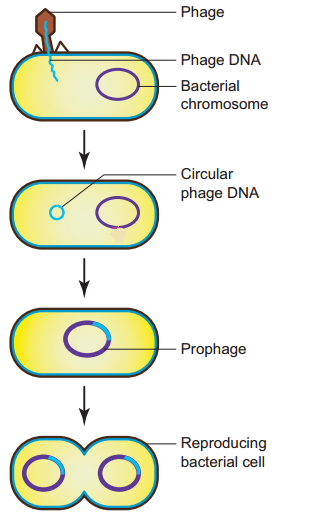
In the lysogenic cycle the phage DNA gets integrated into host DNA and gets multiplied along with nucleic acid of the host. No independent viral particle is formed.
As soon as the phage injects its linear DNA into the host cell, it becomes circular and integrates into the bacterial chromosome by recombination. The integrated phage DNA is now called prophage. The activity of the prophage gene is repressed by two repressor proteins which are synthesized by phage genes. This checks the synthesis of new phages within the host cell. However, each time the bacterial cell divides, the prophage multiplies along with the bacterial chromosome. On exposure to UV radiation and chemicals the excision of phage DNA may occur and results in lytic cycle.
Need a full question paper?
Generate a complete, print-ready paper with questions like this in minutes — across 16+ boards, with answer keys.