Questions

[5 Mark each]

🎯

Test yourself on this topic

31 questions · timed · auto-graded

Question 15 Marks
List out the beneficial aspects of lichens.
Answer
The Beneficial Aspects of Lichens:
  1. Lichens secrete organic acids like oxalic acids which corrodes the rock surface and helps in weathering of rocks, thus acting as pioneers in Xerosere.
  2. Usnic acid produced from lichens show antibiotic properties.
  3. Lichens are sensitive to air pollutants especially to sulphur-di-oxide. Therefore, they are considered as pollution indicators.
  4. The dye present in litmus paper used as acid base indicator in the laboratories is obtained from Roccella montagnei.
  5. Cladonia rangiferina (Reindeer moss) is used as food for animals living in Tundra regions.
View full question & answer
Question 25 Marks
Compare the characters of different types of Mycorrhiza.
Answer
The characters of different types of Mycorrhiza:
Mycorrhiza
EctomycorrhizaEndomycorrhizaEctendomycorrhiza
The fungal mycelium forms a dense sheath around the root called mantle. The hyphal network penetrate the intercellular spaces of the epidermis and cortex to form Hartignet. e.g.Pisolithus tinctorius.The hyphae grows mainly inside the roots, penetrate the outer cortical cells of the plant root. A small portion of the mycelium is found outside the root. This form is also called Vesicular Arbuscular Mycorrhizal fungi (VAM fungi) due to the presence of vesicle or arbuscle like haustoria.
1. Arbuscular mycorrhiza (VAM) e.g. Gigaspora
2. Ericoid mycorrhiza- e.g., Oidiodendron
3. Orchid mycorrhiza -e.g. Rhizoctonia
The fungi form both mantle and also penetrates the cortical cells.
View full question & answer
Question 35 Marks
List out the salient features of Basidiomycetes.
Answer
Features of Basidiomycetes:
  1. Basidiomycetes include puffballs, toad stools, Bird nest’s fungi, Bracket fungi, stink horns, rusts and smuts.
  2. The members are terrestrial and lead a saprophytic and parasitic mode of life.
  3. The mycelium is well developed, septate with dolipore septum (bracket like). Three types of mycelium namely primary (Monokaryotic), secondary (Dikaryotic) and tertiary are found.
  4. Clamp connections are formed to maintain dikaryotic condition.
  5. Asexual reproduction is by means of conidia, oidia or budding.
  6. Sexual reproduction is present but sex organs are absent. Somatogamy or spermatisation results in plasmogamy. Karyogamy is delayed and dikaryotic phase is prolonged. Karyogamy takes place in basidium and it is immediately followed by meiotic division.
  7. The four nuclei thus formed are transformed into basidiospores which are borne on sterigmata outside the basidium (Exogenous). The basidium is club shaped with four basidiospores, thus this group of fungi is popularly called “Club fungi”. The fruit body formed is called Basidiocarp.
View full question & answer
Question 45 Marks
List out the salient features of ascomycetes.
Answer
Features of Ascomycetes:
  1. Ascomycetes include a wide range of fungi such as yeasts, powdery mildews, cup fungi, morels and so on.
  2. Although majority of the species live in terrestrial environment, some live in aquatic environments both fresh water and marine.
  3. The mycelium is well developed, branched with simple septum.
  4. Majority of them are saprophytes but few parasites are also known. (Powdery mildew – Erysiphe).
  5. Asexual reproduction takes place by fission, budding, oidia, conidia and chlamydospore.
  6. Sexual reproduction takes place by the fusion of two compatible nuclei.
  7. Plasmogamy is not immediately followed by karyogamy, instead a dikaryotic condition is prolonged for several generations.
  8. A special hyphae called ascogenous hyphae is formed.
  9. A crozier is formed when the tip of the ascogenous hyphae recurves forming a hooked cell. The two nuclei in the penultimate cell of the hypha fuse to form a diploid nucleus. This cell form young ascus.
  10. The diploid nucleus undergo meiotic division to produce four haploid nuclei, which further divide mitotically to form eight nuclei. The nucleus gets organised into 8 ascospores.
  11. The ascospores are found inside a bag-like structure called ascus. Due to the presence of ascus, this group is popularly called “Sac fungi”.
  12. Asci gets surrounded by sterile hyphae forming fruit body called ascocarp.
  13. There are 4 types of ascocarps namely Cleistothecium (Completely closed), Perithecium (Flask shaped with ostiole), Apothecium (Cup shaped and open type) and Pseudothecium.
View full question & answer
Question 55 Marks
List out the salient features of zygomycetes.
Answer
The salient features of zygomycetes:
  1. Most of the species are saprophytic and live on decaying plant and animal matter in the soil. Some lead parasitic life (Example: Entomophthora on housefly)
  2. Bread mold fungi (Example: Mucor and Rhizopus) and Coprophilous fungi (Fungi growing on dung Example: Pilobolus) belong to this group.
  3. The mycelium is branched and coenocytic.
  4. Asexual reproduction by means of spores produced in sporangia.
  5. Sexual reproduction is by the fusion of the gametangia which results in thick walled zygospore. It remains dormant for long periods. The zygospore undergoes meiosis and produce spores.
View full question & answer
Question 65 Marks
Explain the various types of sexual reproduction in fungi.
Answer
The Various Types Of Sexual Reproduction In Fungi:
  1. Planogametic copulation: Fusion of motile gamete is called planogametic copulation.
    • Isogamy – Fusion of morphologically and physiologically similar gametes. (Example: Synchytrium).
    • Anisogamy – Fusion of morphologically or physiologically dissimilar gametes (Example: Allomyces).
    • Oogamy – Fusion of both morphologically and physiologically dissimilar gametes. (Example: Monoblepharis).
  2. Gametangial contact: During sexual reproduction a contact is established between antheridium and oogonium (Example: Albugo).
  3. Gametangial copulation: Fusion of gametangia to form zygospore. (Example: Mucor and Rhizopus).
  4. Spermatization: Auninucleate pycniospore/microconidium is transferred to receptive hyphal cell (Example: Puccinia / Neurospora)
  5. Somatogamy: Fusion of two somatic cells of the hyphae (Example: Agaricus).
View full question & answer
Question 75 Marks
Explain the various types of asexual reproduction in fungi.
Answer
The Various Types Of Asexual Reproduction In Fungi:
  1. Zoospores: They are flagellate structures produced in zoosporangia (Example: Chytrids)
  2. Conidia: The spores produced on condiophores (Example: Aspergillus)
  3. Oidia / Thallospores / Arthrospores: The hypha divide and develop into spores called oidia (Example: Erysiphe).
  4. Fission: The vegetative cell divide into 2 daughter cells. (Example: Schizosaccharomyces – yeast).
  5. Budding: A small outgrowth is developed on parent cell, which gets detached and become independent. (Example: Saccharomyces-yeast).
  6. Chlamydospore: Thick walled resting spores are called chlamydospores. (Example: Fusarium).
View full question & answer
Question 85 Marks
List out the salient features of cyanobacteria.
Answer
The Salient Features Of Cyanobacteria:
  • The members of this group are prokaryotes and lack motile reproductive structures.
  • The thallus is unicellular in Chroococcus, colonial in Gloeocapsa and filamentous trichome in Nostoc.
  • Gliding movement is noticed in some species (Oscillatoria).
  • The protoplasm is differentiated into central region called centroplasm and peripheral region bearing chromatophore called chromoplasm.
  • The photosynthetic pigments include c-phyocyanin and c-phycoerythrin along with myxoxanthin and myxoxanthophyll.
  • The reserve food material is cyanophycean starch.
  • In some forms a large colourless cell is found in the terminal or intercalary position called heterocysts. They are involved in nitrogen fixation.
  • They reproduce only through vegetative methods and produce akinetes (thick wall dormant cell formed from vegetative cell), hormogonia (a portion of filament get detached and reproduce by cell division), fission and endospores.
  • The presence of mucilage around the thallus is characteristic feature of this group. Therefore, this group is also called Myxophyceae.
  • Sexual reproduction is absent.
  • Microcystis aeruginosa and Anabaena flos-aquae cause water blooms and release toxins and affect the aquatic organism. Most of them fix atmospheric nitrogen and are used as biofertilizers (Example: Nostoc and Anabaena). Spirulina is rich in protein hence it is used as single cell protein.
View full question & answer
Question 95 Marks
Explain the role of bacteria in soil fertility.
Answer
The role of bacteria in soil fertility:
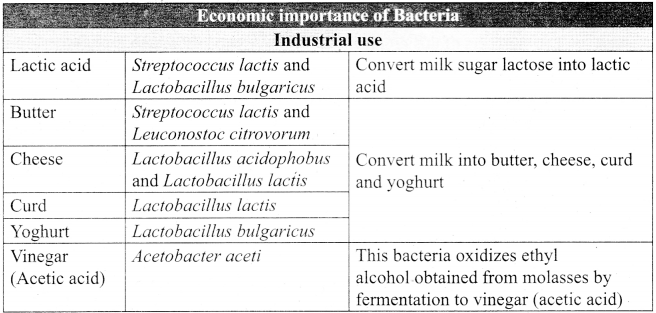
Economic importance of bacteria
S.No.Beneficial aspectsBacteriaRole
Soil fertility
1.Ammonification1. Bacillus ramosus
2. Bacillus mycoides
Convert complex proteins in the dead bodies of plants and animals into ammonia which is later converted into ammonium salt
2.Nitrification1. Nitrobacter
2. Nitrosomonas
Convert ammonium salts into nitrites and nitrates
3.Nitrogen fixation1. Azotobacter
2. Clostridium
3. Rhizobium
(i) Converting atmospheric nitrogen into organic nitrogen
(ii) The nitrogenous compounds are also oxidized to nitrogen
(iii) All these activities of bacteria increase soil fertility
View full question & answer
Question 105 Marks
Explain the role of bacteria in antibiotic production and medicines.
Answer
The role of bacteria in antibiotic production and medicines:
Economic importance of bacteria
Antibiotics
1.StreptomycinStreptomyces griseusIt's cures urinary infections, tuberculosis, meningitis and pneumonia
2.AureomycinStreptomyces aureofaciensIt's used as a medicine to treat whooping cough and eye infections
3.ChloromycetinStreptomyces venezuelaeIt cures typhoid fever
4.BacitracinBacillus licheniformisIt is used to treat syphilis
5.PolymyxinBacillus polymyxaIt cures some bacterial diseases
View full question & answer
Question 125 Marks
Write in detail about transduction and its types.
Answer
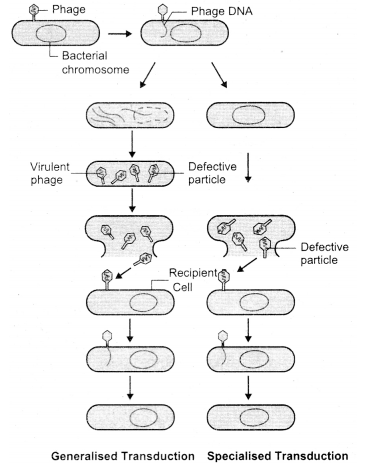
Zinder and Lederhcrg (1952) discovered transduction in Salmonella typhimurum. Phage mediated DNA transfer is called transduction.
Image
Transduction is of two types:
  1. Generalized transduction and
  2. Specialized or restricted transduction.
1. Generalized transduction: The ability of a bacteriophage to carryr genetic material of any region of bacterial DNA is called generalised transduction.

2. Specialized or restricted transduction: The ability of the bacteriophage to carry only a specific region of the bacterial DNA is called specialized or restricted transduction. 
View full question & answer
Question 135 Marks
Define conjugation and its mechanism.
Answer
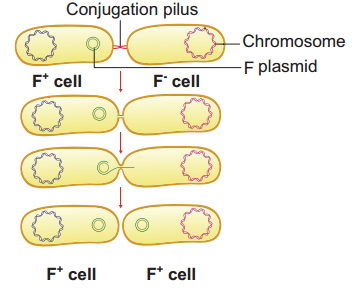
J. Lederberg and Edward L Tatum demonstrated conjugation in E. coil in the year 1946. In this method of gene transfer the donor cell gets attached to the recipient cell with the help of pili. Image
The pilus grows in size and forms the conjugation tube. The plasmid of donor cell which has the F+ (fertility factor) undergoes replication. Only one strand of DNA is transferred to the recipient cell through conjugation tube. The recipient completes the structure of double stranded DNA by synthesizing the strand that complements the strand acquired from the donor.
View full question & answer
Question 145 Marks
Describe the process of transformation.
Answer
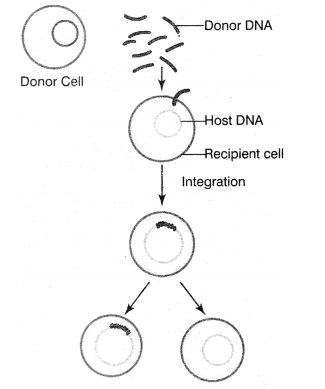
The process of transformation:
Image
Transfer of DNA from one bacterium to another is called transformation. In 1928, the bacteriologist Fredrick Griffith demonstrated transformation in mice using Diplococcus pneumoniae. Two strains of this bacterium are present. One strain produces smooth colonies and are virulent in nature (S type), in addition another strain produced rough colonies and are avirulent (R type). When S-type of cells were injected into the mouse, the mouse died. When R-type of cells were injected, the mouse survived. He injected heat killed S-type cells into the mouse the mouse did not die.

When the mixture of heat killed S-type cells and R-type cells were injected into the mouse. The mouse died. The avirulent rough strain of Diplococcus had been transformed into S-type cells. The hereditary material of heat killed S-type cells had transformed R-type cell into virulent smooth strains. Thus the phenomenon of changing the character of one strain by transferring the DNA of another strain into the former is called transformation.
View full question & answer
Question 155 Marks
Explain the mode of nutrition in bacteria.
Answer
On the basis of their mode of nutrition bacteria are classified into two types namely autotrophs and heterotrophs.
I. Autotrophic bacteria:
Bacteria which can synthesis their own food are called autotrophic bacteria. They may be further subdivided as
A. Photoautotrophic bacteria – Bacteria use sunlight as their source of energy to synthesize food. They may be:
  1. Photolithotrophs: In Photolithotrophs the hydrogen donor is an inorganic substance.
    • Green sulphur bacteria: In this type of bacteria the hydrogen donor is $H_2S$ and possess pigment called Bacterioviridin. Example: Chlorobium.
    • Purple sulphur bacteria: For bacteria belong to this group the hydrogen donor is thiosulphate, Bacteriochlorophyll is present. Chlorophyll containing chlorosomes are present. Example: Chromatium.
  2. Photoorganotrophs: They utilize organic acid or alcohol ‘as hydrogen donor. Example: Purple non-sulphur bacteria – Rhodospirillum.
B. Chemoautotrophic bacteria – They do not have photosynthetic pigment hence they cannot use sunlight energy. These type of bacteria obtain energy from organic or inorganic substance.
1. Chemolithotrophs: This type of bacteria oxidize inorganic compound to release energy.
Examples:
  • Sulphur bacteria – Thiobacillus thiooxidans
  • Iron bacteria – Ferrobacillus ferrooxidans
  • Hydrogen bacteria – Hydrogenomonas and
  • Nitrifying bacteria – Nitrosomonas and Nitrobacter.
2. Chemoorganotrophs: This type of bacteria oxidize organic compounds to release energy.
Examples:
  • Methane bacteria – Methanococcus
  • Acetic acid bacteria – Acetobacter and
  • Lactic acid bacteria – Lactobacillus
II. Heterotrophic bacteria:
They are parasites (Clostridium and Mycobacterium), Saprophytes (Bacillus mycoides) or symbiotic (Rhizobium in root nodules of leguminous crops).
View full question & answer
Question 165 Marks
Give an account on respiration types of bacteria.
Answer
SOLUTION Two types of respiration is found in bacteria. They are:
1. Aerobic respiration
2. Anaerobic respiration
1. Aerobic respiration: These bacteria require oxygen as terminal acceptor and will not grow under anaerobic conditions (i.e. in the absence of $O _2$ ) Example: Streptococcus.
(i) Obligate aerobes: Some Micrococcus species are obligate aerobes (i.e. they must have 1 oxygen to survive).
2. Anaerobic respiration:
These bacteria do not use oxygen for growth and metabolism but obtain their energy from fermentation reactions. Example: Clostridium.
(i) Facultative anaerobes: There are bacteria that can grow either using oxygen as a terminal electron acceptor or anaerobically using fermentation reaction to obtain energy. When a facultative anaerobe such as E. coli is present at a site of infection like an abdominal abscess, it can rapidly consume all available $O _2$ and change to anaerobic metabolism producing an anaerobic environment and thus allow the anaerobic bacteria that are present to grow and cause disease.
Example: Escherichia coli and Salmonella.
(ii) Capnophilic bacteria: Bacteria which require $CO _2$ for their growth are called as capnophilic bacteria.
Example: Campylobacter.
View full question & answer
Question 185 Marks
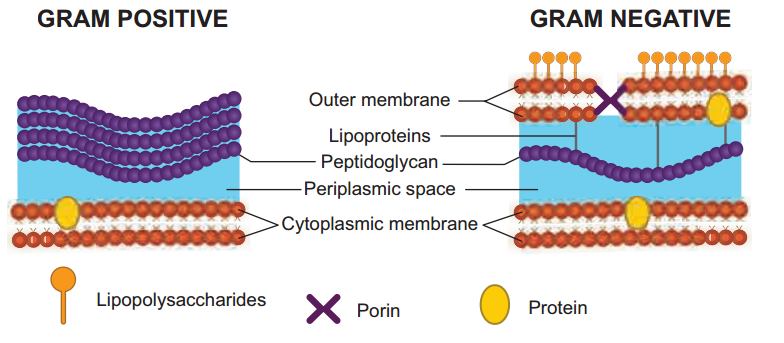
Describe the structure of Gram positive and Gram negative bacterial cell wall using diagram.
Answer
Most of the gram positive cell wall contain considerable amount of teichoic acid and teichuronic acid. In addition, they may contain polysaccharide molecules. The gram negative cell wall contains three components that lie outside the peptidoglycan layer:
  1. Lipoprotein
  2. Outer membrane and
  3. Lipopolysaccharide.
Thus the different results in the gram stain are due to differences in the structure and composition of the cell wall.
Image
View full question & answer
Question 195 Marks
Write in detail about Plasmids.
Answer
Plasmids are extrachromosomal double stranded, circular, self – replicating, autonomous elements. They contain genes for fertility, antibiotic resistant and heavy metals. It also help 1 in the production of bacteriocins and toxins which are not found in bacterial chromosome.

The size of a plasmid varies from 1 to 500 kb usually plasmids contribute to about 0.5 to 5% of the total DNA of bacteria. The number of plasmids per cell varies. Plasmids are classified into different types based on the function. Some of them are F (Fertility) factor, R (Resistance) plasmids, Col (Colicin) plasmids, Ri (Root inducing) plasmids and Ti (Tumour inducing) plasmids.
View full question & answer
Question 215 Marks
List out the general characters of bacteria.
Answer
The General Characters of Bacteria:
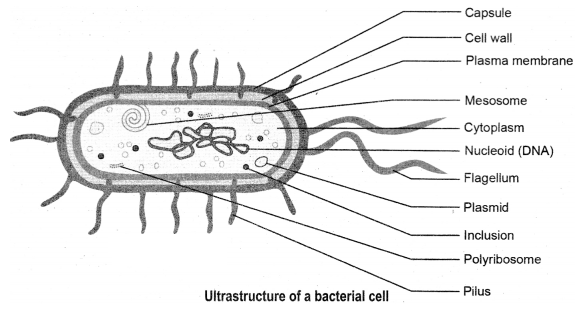
  1. They are prokaryotic organisms and lack nuclear membrane and membrane bound organelles.
  2. The genetic material is called nucleoid or genophore or incipient nucleus.
  3. The cell wall is made up of polysaccharides and proteins.
  4. Most of them lack chlorophyll, hence they are heterotrophic (Vibrio cholerae) but some are autotrophic and possess Bacteriochlorophyll (Chromatium).
  5. They reproduce vegetatively by binary fission and endospore formation.
  6. They exhibit variations which are due to genetic recombination and is achieved through conjugation, transformation and transduction.
View full question & answer
Question 225 Marks
Draw a tabular column and compare the characters of five kingdoms.
Answer
Comparison of Five Kingdoms
CriteriaKingdom
MoneraProtistaFungiPlantaeAnimalia
Cell typeProkaryoticEukaryoticEukaryoticEukaryoticEukaryotic
Level of organisationUnicellularUnicellularMulticellular and unicellularTissue/organTissue/organ/ organ system
Cell wallPresent (made up of peptidoglycan and mucopeptides)Present in some (made up of cellulose), absent in othersPresent (made up of chitin or cellulose)Present (made up of cellulose)Absent
NutritionAutotrophic (Phototrophic, Chemoautotrophic) Heterotrophic (parasitic and saprophytic)Autotrophic- Photosynthetic HeterotrophicHeterotrophic- parasitic or SaprophyticAutotrophic (Photosynthetic)Heterotrophic (Holozoic)
MotilityMotile or non-motileMotile or non-motileNon-motileMostly Non- motileMostly motile
OrganismsArchaebacteria, Eubacteria, Cyanobacteria, Actinomycetes and MycoplasmaChrysophytes, Dinoflagellates, Euglenoids, Slime molds, Amoeba, Plasmodium, Trypanosoma, ParameciumYeast, Mushrooms and MoldsAlgae, Bryophytes, Pteridophytes, Gymnosperms and Angiosperms SamacheerKalvi.GuruSponges, Invertebrates and Vertebrates
View full question & answer
Question 235 Marks
Explain the lysogenic multiplication of phages.
Answer
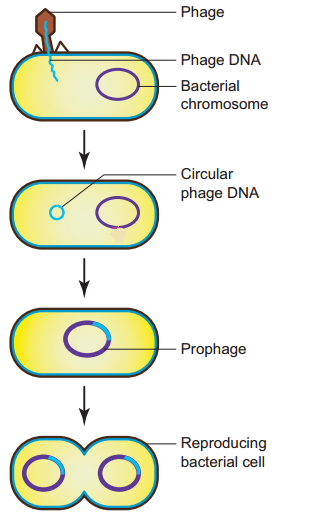
In the lysogenic cycle the phage DNA gets integrated into host DNA and gets multiplied along with nucleic acid of the host. No independent viral particle is formed.
Image
As soon as the phage injects its linear DNA into the host cell, it becomes circular and integrates into the bacterial chromosome by recombination. The integrated phage DNA is now called prophage. The activity of the prophage gene is repressed by two repressor proteins which are synthesized by phage genes. This checks the synthesis of new phages within the host cell. However, each time the bacterial cell divides, the prophage multiplies along with the bacterial chromosome. On exposure to UV radiation and chemicals the excision of phage DNA may occur and results in lytic cycle.
View full question & answer
Question 245 Marks
Describe in detail about the lytic cycle of phages with diagram.
Answer
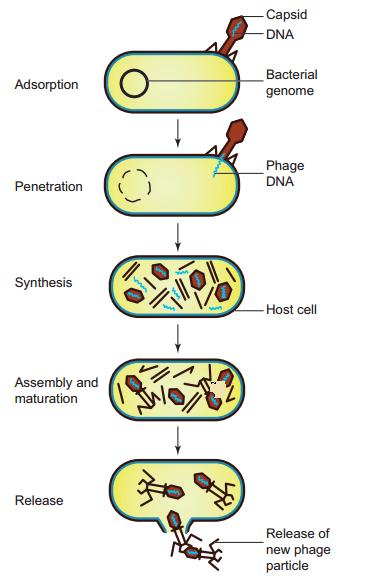
Lytic cycle: During lytic cycle of phage, dis integration of host bacterial cell occurs and the progeny virions are released.
Image
The steps involved in the lytic cycle are as follows:
(i) Adsorption: Phage ( $T_4$ ) particles interact with cell wall of host ( E . coli). The phage tail makes contact between the two, and tail fibres recognize the specific receptor sites present on bacterial cell surface. The lipopolysaccharides of tail fibres act as receptor in phages. The process involving the recognition of phage to bacterium is called landing. Once the contact is established between tail fibres of phage and bacterial cell, tail fibres bend to anchor the pins and base plate to the cell surface. This step is called pinning.
(ii) Penetration: The penetration process involves mechanical and enzymatic digestion of the cell wall of the host. At the recognition site phage digests certain cell wall structure by viral enzyme (Jysozyrne). After pinning the tail sheath contracts (using ATP) and appears shorter and thicker. After contraction of the base plate enlarges through which DNA is injected into the cell wall without using metabolic energy. The step involving injection of DNA particle alone into the bacterial cell is called Transfection. The empty protein coat leaving outside the cell is known as 'ghost'.
(iii) Synthesis: This step involves the degradation of bacterial chromosome, protein synthesis and DNA replication. The phage nucleic acid takes over the host biosynthetic machinery. Host DNA gets inactivated and breaks down. Phage DNA suppresses the synthesis of bacterial protein and directs the metabolism of the cell to synthesis the proteins of the phage particles and simultaneously replication of phage DNA also takes place.
(iv) Assembly and Maturation: The DNA of the phage and protein coat are synthesized separately and are assembled to form phage particles. The process of assembling the phage particles is known as maturation. After 20 minutes of infection about 300 new phages are assembled
(v) Release: The phage particle gets accumulated inside the host cell and are released by the lysis of the host cell wall
View full question & answer
Question 255 Marks
Explain the structure of T4 bacteriophage with a labelled diagram.
Answer
Image

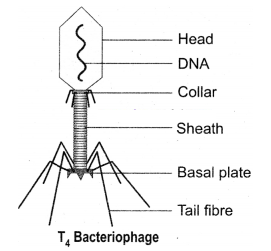
The $T_4$ phage is tadpole shaped and consists of head, collar, tail, base plate and fibres (figure). The head is hexagonal which consists of about 2000 identical protein subunits. The long helical tail consists of an inner tubular core which is connected to the head by a collar. There is a base plate attached to the end of tail The base plate contains six spikes and tail fibres. These fibres are used to attach the phage on the cell wall of bacterial host during replication. A dsDNA molecule of about $50 \mu m$ is tightly packed inside the head. The DNA is about 1000 times longer than the phage itself.
View full question & answer
Question 265 Marks
Give an account of viral genome.
Answer
Each virus possesses only one type of nucleic acid either DNA or RNA. The nucleic acid may be in a linear or circular form. Generally nucleic acid is present as a single unit but in wound tumour virus and in influenza virus it is found in segments. The viruses possessing DNA are called ‘Deoxyviruses’ whereas those possessing RNA are called ‘Riboviruses’.

Majority of animal and bacterial viruses are DNA viruses (HIV is the animal virus which possess RNA). Plant viruses generally contain RNA (Cauliflower Mosaic virus possess DNA). The nucleic acids may be single stranded or double stranded. On the basis of nature of nucleic acid viruses are classified into four categories. They are viruses with ssDNA (Parvo viruses), dsDNA (Bacteriophages), ssRNA (TMV) and dsRNA (wound tumour virus).
View full question & answer
Question 275 Marks
Write a note on David Baltimore’s classification of viruses.
Answer
David Baltimore (1971) classification is based on mechanism of RNA production, the nature of the genome (single stranded -ss or double stranded – ds ), RNA or DNA, the use of reverse transcriptase (RT), ss RNA may be (+) sense or (-) antisense. Viruses are classified into seven classes.

Table 1.2: Different Classes of viruses

Class

Example

Class 1 - Viruses with dsDNA

Class 2 -Viruses with (+) sense ssDNA

Class 3-Viruses with dsRNA

Class 4 -Viruses with (+) sense ssRNA

Class 5 - Viruses with (-) antisense ssRNA

Class 6 - Viruses with (+) sense ss RNA -RT that replicate with DNA intermediate in life cycle

Class 7 - Viruses with ds DNA - RT that replicate with RNA intermediate in life cycle

Adenoviruses

Parvo viruses

Reo viruses

Toga viruses

Rhabdo viruses

Retro viruses

Hepadna

viruses

View full question & answer
Question 285 Marks
Draw and describe the structure of tobacco mosaic virus.
Answer
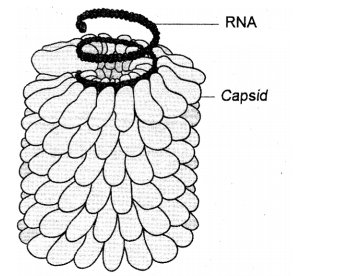
Image
Electron microscopic studies have revealed that TMV is a rod shaped helical virus measuring about $280 \times 150$ pm with a molecular weight of 39 $\times 10^6$ Daltons. The virion is made up of two constituents, a protein coat called capsid and a core called nucleic acid. The protein coat is made up of approximately 2130 identical protein subunits called capsomeres which are present around a central single stranded RNA molecule. The genetic information necessary for the formation of a complete TMV particle is contained in its RNA. The RNA consists of 6,500 nucleotides.
View full question & answer
Question 295 Marks
Enumerate the living and non – living characters of viruses.
Answer
Living characters:
  1. Presence of nucleic acid and protein.
  2. Capable of mutation.
  3. Ability to multiply within living cells.
  4. Able to infect and cause diseases in living beings.
  5. Show irritability.
  6. Host – specific.
Non – living characters:
  1. Can be crystallized.
  2. Absence of metabolism.
  3. Inactive outside the host.
  4. Do not show functional autonomy,
  5. Energy producing enzyme system is absent.
View full question & answer
Question 305 Marks
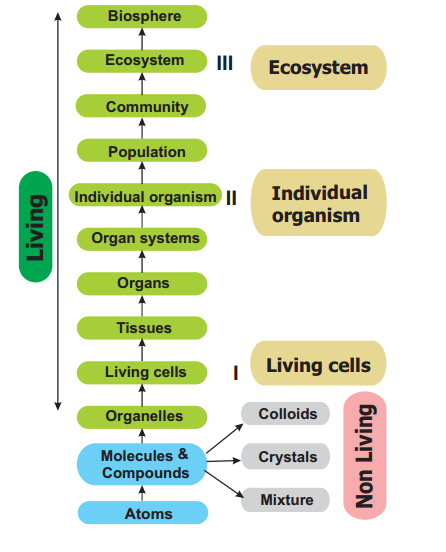
Draw a flow chart representing the various levels of organisation and integration in living organisms.
Answer
A flow chart representing the various levels of organisation and integration in living organisms:

Image
View full question & answer
Question 315 Marks
Define metabolism. List out the differences between the types of metabolism.
Answer
Metabolism: The sum total of all the chemical reactions taking place in a cell of living organism is called metabolism. It is broadly divided into anabolism and catabolism. The difference between anabolism and catabolism is given in table.
Difference between anabolism and catabolism
Anabolism Catabolism
Building up process Breaking down process
Smaller molecules combine together to form larger molecule Larger molecule break into smaller units
Chemical energy is formed and stored The stored chemical energy is released and used
Example: Synthesis of proteins from amino acids Example: Breaking down of glucose to $CO _2$ and water
View full question & answer
[5 Mark each] - BIO BOTANY STD 11 Questions - Vidyadip