Question
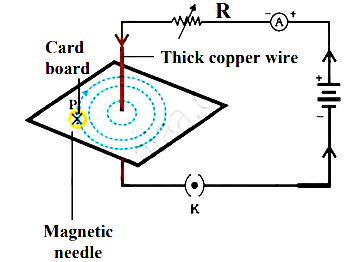
Explain the magnetic field created around a straight current carrying conductor with the help of a diagram.
Answer

  1. Consider a circuit connected as shown in the figure.
  2. A cardboard is placed around a thick copper wire. A magnetic needle is used to check the magnetic field around the wire.
  3. When a large current flows through the thick wire, the magnetic needle shows deflection. At different points on the cardboard, the needle points in different directions.
  4. When joined the directions shown by the needle, the lines formed indicate that the magnetic field produced around a current-carrying conductor is in the form of concentric circles.
  5. The deflection in the needle changes according to the current in the conductor. For a given current, if we move the compass needle away from the wire, its deflection decreases.
  6. The direction of the magnetic field formed around the conductor depends on the direction of the current and is given by the right-hand thumb rule.
  7. If the thumb of the right hand indicates the direction of the current then, the curled fingers indicate the direction of the magnetic field formed.

Need a full question paper?

Generate a complete, print-ready paper with questions like this in minutes — across 16+ boards, with answer keys.
Start Generating Free

Similar questions

State and explain the various methods for preventing or retarding rancidity of food.
Write short note: Production of Yoghurt.
Explain the concept of IVF.
What are the three R’s to save the environment? Explain with one example of each.
“Only variations that confer an advantage to an individual organism will survive in a population”. Do you agree with this statement? Give reason for your answer.
Give any four functional groups containing oxygen as the heteroatom in it. write name and structural formula of one example each.
Answer the questions on the following passage.
The minerals from which the metal can be separated economically are called ores. Ores contain many types of impurities such as soil, sand and rocky substances along with metal compounds. These impurities are called gangue.
Metals can be extracted from their ores by means of various methods of separation. The process of extraction of metal in a pure state from the ores is also a part of metallurgy.
Ores are taken out from the mines and the gangue is usually separated from the ore at the site itself by various methods. Then the ores are carried out to the place where metals are produced. Here metals are extracted in pure form. Then metals are further purified by different methods of purification. This entire process is called metallurgy. Most metals being reactive do not occur in nature in the free state but are found in combined state as their salts such as oxides, carbonates, sulphides, and nitrates. however, the most unreactive metals that are not affected by air, water and other natural factors like silver, gold, platinum, generally occur in a free state. The compounds of metals that occur in nature along with the impurities are called minerals.
  1. What are ores?
  2. Which processes are involved in the branch of metallurgy? What is metallurgy?
  3. Which metals are found in a free state?
  4. In what forms are metals found in combined state?
  5. What is gangue?
X is a wild animal which eats only the flesh of other animals whereas Y is a domestic animal which feeds mainly on green grass.
  1. What are animals like X known as?
  2. What are animals Y known as?
  3. Which animal, X or Y, has a longer small intestine? Why?
  4. Name one animal which is like X.
  5. Name one animal which is like Y.
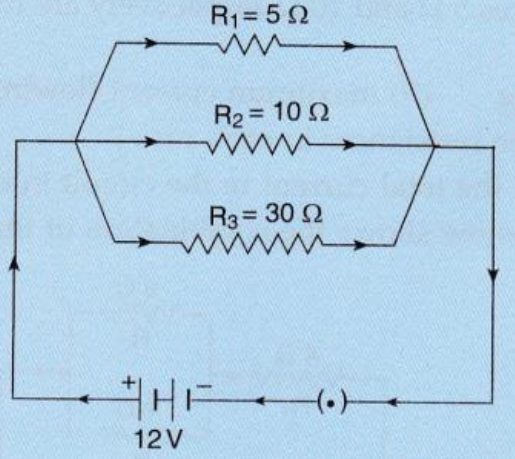
In the circuit diagram given below, three resistors R R , and R of $5 Ω, 10 Ω$ and $30 Ω,$ respectively are connected as shown.
Calculate:
  1. Current through each resistor.
  2. Total current in the circuit.
  3. Total resistance in the circuit.
  1. Match the terms given in column I with the terms given in column II and column III having the same meaning:
  1.   Column I Column II Column III
    (i)
    Secondary consumer
    Herbivore
    $1^{st}$ trophic level
    (ii)
    Primary consumer
    Autotroph
    $3^{rd}$ trophic level
    (iii)
    Producer
    Carnivore
    $4^{th}$ trophic level
    (iv)
    Tertiary consumer
    Large carnivore
    $2^{nd}$ trophic level
  2. Give one example of a food chain having four organisms. Below each organism write the three appropriate terms from the part $(a)$ above which you think it represents.