Question
Explain the major Cash Inflows and outflows from investing activities.

Answer

Investing activities are those activities that are related to sales and purchases of long-term fixed assets like, land and building, plant and machinery, furniture, etc. These fixed assets are not held for resale. The activities like sale and purchase of investments that are not included in the cash equivalents are also included in Investing activities. Any income arising from such investments (assets) are regarded a part of investing activities.
As per the AS3, the major cash inflows and outflows from investing activities are as follows:
  1. Cash payments to acquire fixed assets (including intangibles like, goodwill). These payments include capitalised cost of research and development and self constructed fixed assets.
  2. Cash receipts from disposal of fixed assets (including intangible assets).
  3. Cash payments to acquire shares, warrants, or debt instruments of other enterprises and interest in joint venture (other than payments of those instruments consider as cash equivalents and are held for the trading purposes).
  4. Cash receipts from disposal of shares, warrants or debt instruments of other enterprises and interest from joint ventures (other than receipts from those held for trading purposes).
  5. Cash advances and loans made to third parties (other than advances, and loans made by financial enterprises). These will be treated as cash flows from the operating activities.
  6. Cash receipts from repayment of advances and loans made to third parties (other than advances and loans of financial enterprises). These will be treated as cash flows from operating activities.
  7. Cash receipts from insurance company for any property involved in accident. Any income arising from fixed assets or investments like interest, dividend, rent etc. In case of financial enterprises interest and dividend is treated as operating activities.
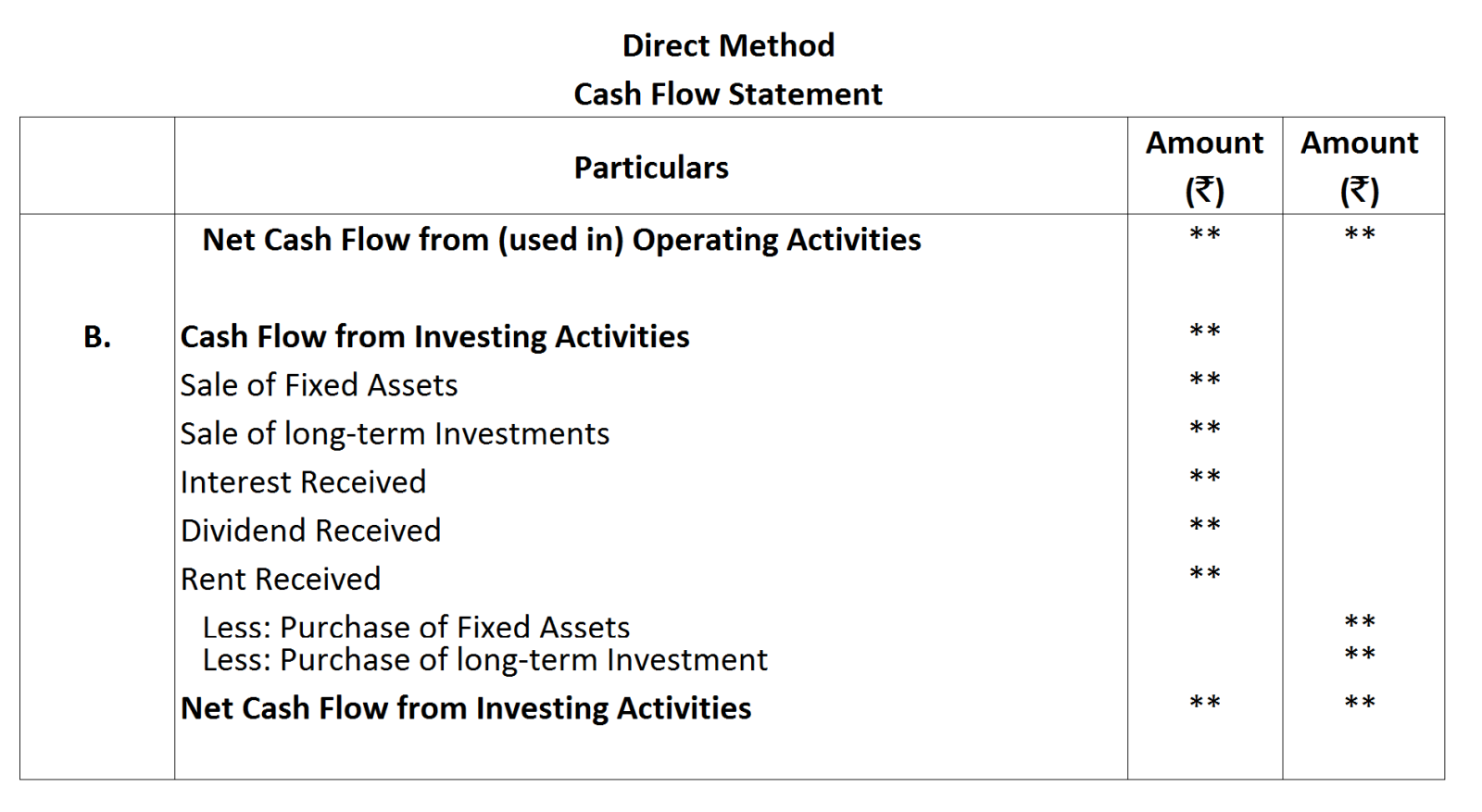
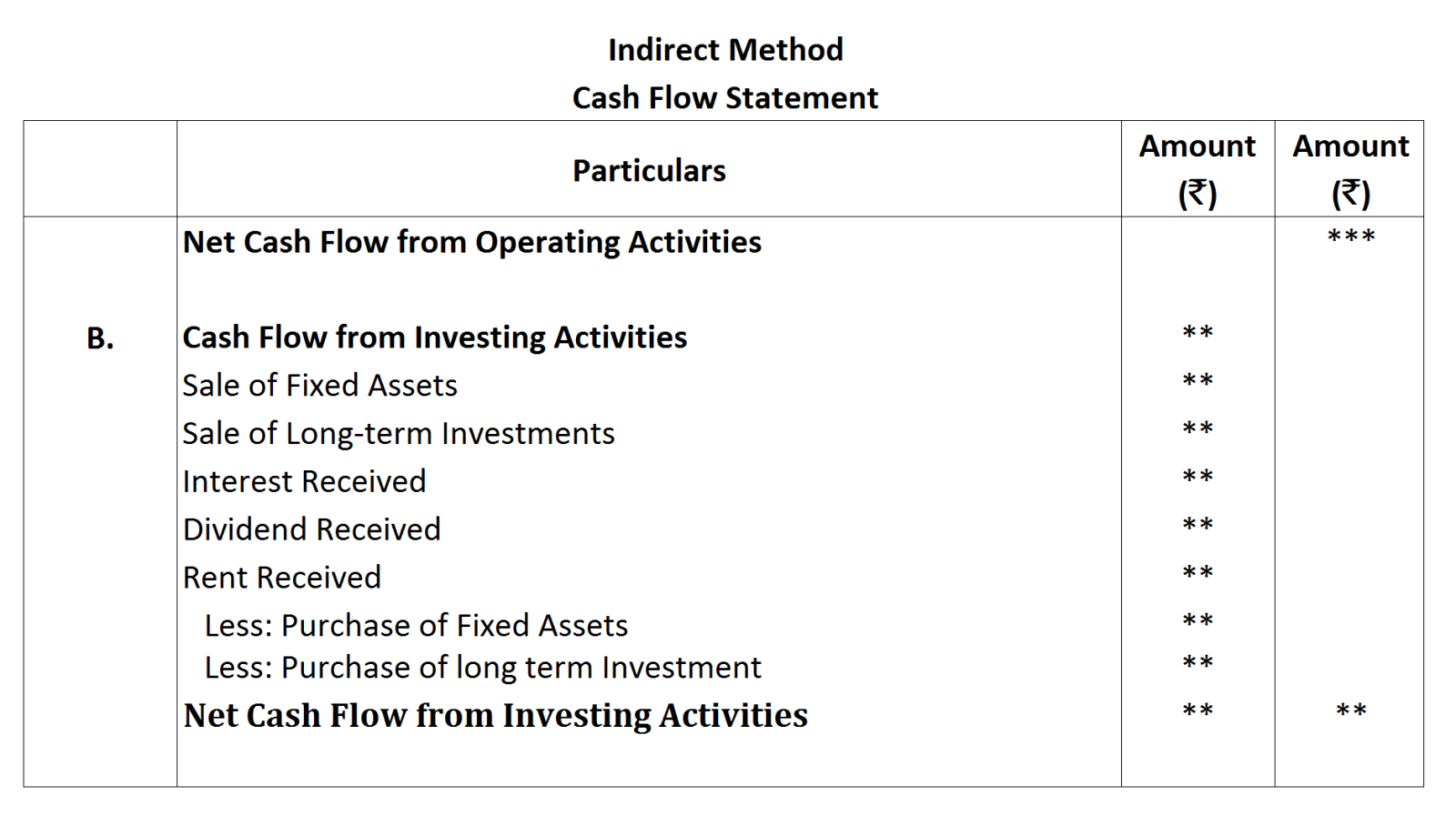
Note: Preparation of Cash Flow Statement using Direct Method has been excluded from the prescribed syllabus. The format is given since the question has not specified the method explicitly. Students can refer to the direct method for the knowledge purpose.
Need a full question paper?

Generate a complete, print-ready paper with questions like this in minutes — across 16+ boards, with answer keys.

Start Generating Free

Similar questions

Narain Laxmi Ltd. invited applications for issuing 7,500; 12% Debentures of ₹ 100 each at a premium of ₹ 35 per debenture. The full amount was payable on application. Applications were received for 10,000 Debentures. Allotment was made to all the applications on pro rata.
Pass necessary Journal entries for the above transactions in the books of Narain Laxmi Ltd.
From the following information, calculate Debt to Equity Ratio:
 
10,000 Equity Shares of ₹ 10 each fully paid.
1,00,000
5,000; 9% Preference Shares of 10 each fully paid.
50,000
General Reserve.
45,000
Surplus, i.e., Balance in Statement of Profit and Loss.
20,000
10% Debentures.
75,000
Current Liabilities.
50,000
M.Ltd. took over assets of ₹ 9,00,00,000 and liabilities of ₹ 70,00,000 of S.Ltd. and issued 8%Debenture of ₹ 100 each. Record necessary entries in the books of M. Ltd.
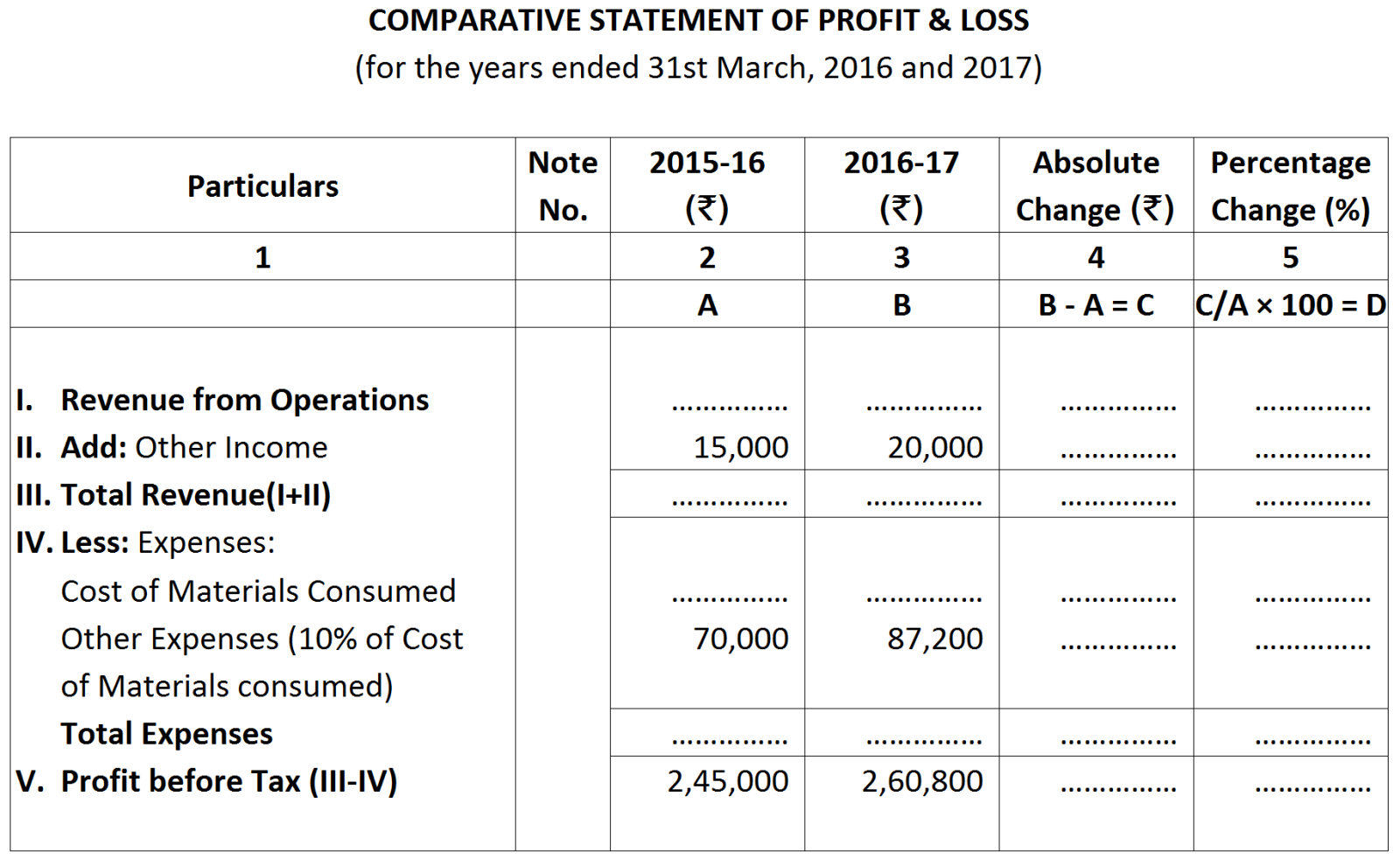
Jai Ltd. is into the business of shoe manufacturing. On the occasion of its silver jubilee, it decided to distribute 1,000 shoes free of cost to the students belonging to economically weaker section of the society. Following is the Comparative Statement of Profit & Loss of the Company:
You are required to:
  1. Fill in the missing figures in the Comparative Statment of Profit & Loss.
  2. Identif y the values involved.
From the following information, calculate Oprating Ratio:
Cost of Revenue
From Operation (Cost of Goods Sold).
52,000
Operating Expenses.
18,000
Revenue from Operation  
Gross Sales. 88,000
Sales Return. 8,000
Identify which of the following items will be shown in the Note to Accounts on Other Expenses?
  1. Salaries.
  2. Postage Expenses.
  3. Telephone and Internet Expenses.
  4. Rent for warehouse.
  5. Carriage Inwards.
  6. Depreciation on computers.
  7. Computer Software amortised.
  8. Computer Hiring Charges.
  9. Audit fee.
  10. Bonus.
List any three objectives of financial statements?
Footfall Ltd. issues 10,000 Debentures of ₹ 100 each at a discout of 10% redeemable at a premium of 5% after the explry of three yeras.
Pass journal entries for the issue of these debentures.
Current Ratio 2.6 : 1; Current Assets ₹ 1,95,000; Inventory ₹ 90,000. Calculate Acid Test Ratio.
Quick Ratio 1.5 Current Assets ₹ 1,00,000 Current Liabilities ₹ 40,000. Calculate the value of Inventory.