Question
Explain the mathematical analysis of progressive wave.

Answer

SELF

Need a full question paper?

Generate a complete, print-ready paper with questions like this in minutes — across 16+ boards, with answer keys.
Start Generating Free

Similar questions

A rain drop of radius 2 mm falls from a height of 500m above the ground. It falls with decreasing acceleration (due to viscous resistance of the air) untill at half its original height, it attains its maximum (terminal) speed, and moves with uniform speed thereafter. What is the work done by the gravitational force on the drop in the first and second half of its journey? What is the work done by the resistive force in the entire journey if its speed on reaching the grounds is $10 ms^{-1} ?$
Prove that from the surface of earth :
(i) accleration due to the gravity at a height $h$$
g_h=g\left(1-\frac{2 h}{ R }\right)
$(ii) Acceleration due to gravity at depth $h ^{\prime}$$
g_h^{\prime}=g\left(1-\frac{h^{\prime}}{ R }\right)
$
Where g is the gravitational acceleration on earth's surface and $R$ is the radius of the Earth. (Here assume $\rho$ and $h \ll R)$
An eye can distinguish between two points of an object if they are separated by more than 0.22mm when the object is placed at 25cm from the eye. The object is now seen by a compound microscope having a 20D objective and 10D eyepiece separated by a distance of 20cm. The final image is formed at 25cm from the eye. What is the minimum separation between two points of the object which can now be distinguished?
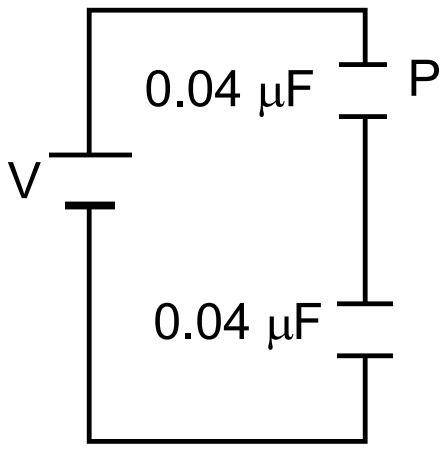
The particle P shown in figure has a mass of 10mg and a charge of $-0.01\mu\text{C}.$ Each plate has a surface area 100cm2 on one side. What potential difference V should be applied to the combination to hold the particle P in equilibrium?

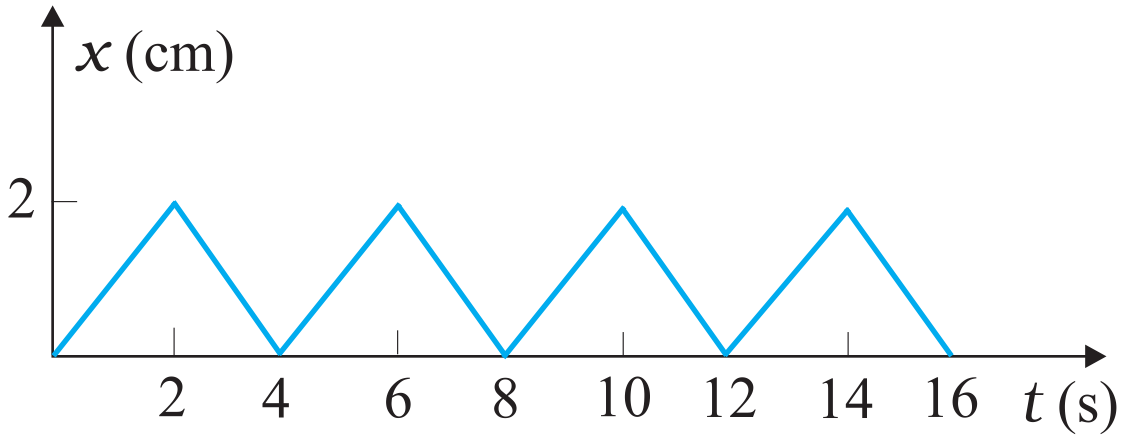
Figure 5.17 shows the position-time graph of a body of mass 0.04kg. Suggest a suitable physical context for this motion. What is the time between two consecutive impulses received by the body? What is the magnitude of each impulse?

Considering the pressure p to be proportional to the density, find the pressure p at a height h if the pressure on the surface of the earth is p0.
A uniform rod pivoted at its upper end hangs vertically. It is displaced through an angle of 60° and then released. Find the magnitude of the force acting on a particle of mass dm at the tip of the rod when the rod makes an angle of 37° with the vertical.
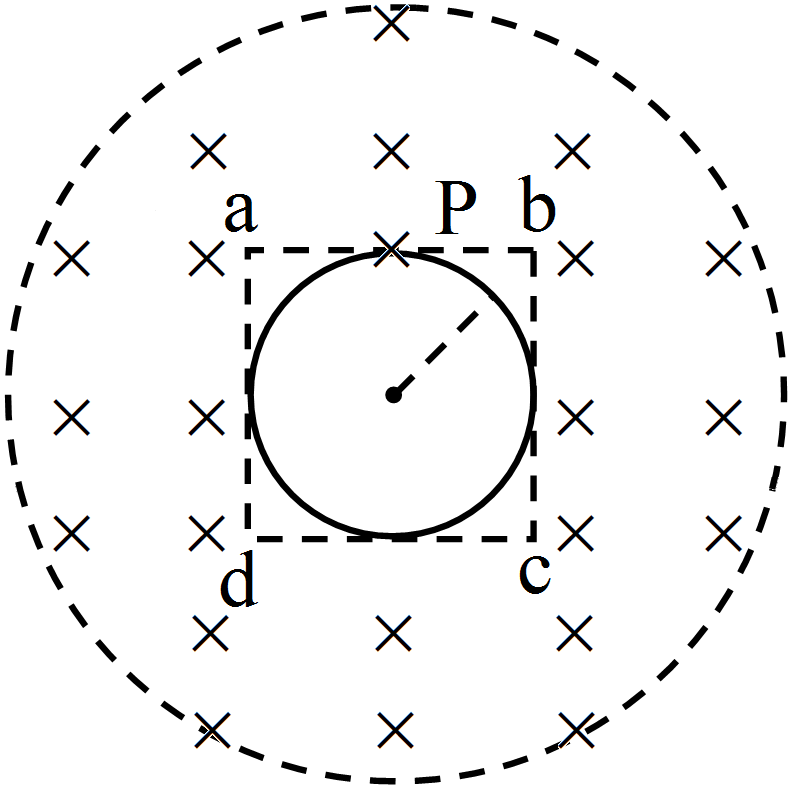
A uniform magnetic field B exists in a cylindrical region, shown dotted in figure. The magnetic field increases at a constant rate $\frac{\text{dB}}{\text{dt}}.$ Consider a circle of radius r coaxial with the cylindrical region.

  1. Find the magnitude of the electric field E at a point on the circumference of the circle.
  2. Consider a point P on the side of the square circumscribing the circle. Show that the component of the induced electric field at P along ba is the same as the magnitude found in part (a).


A train takes 4 min to go between stations 2.25km apart starting and finishing at rest. The acceleration is uniform for the first 40s and the deceleration is uniform for the last 20s.
Assuming the velocity to be constant for the remaining time, calculate the maximum speed, acceleration and retardation, use only the graphical method.
A room has a window fitted with a single 1.0m × 2.0m glass of thickness 2mm.
  1. Calculate the rate of heat flow through the closed window when the temperature inside the room is 32°C and that outside is 40°C.
  2. The glass is now replaced by two glasspanes, each having a thickness of 1mm and separated by a distance of 1mm. Calculate the rate of heat flow under the same conditions of temperature. Thermal conductivity of window glass = 1.0Js-1m-1°C-1 and that of air = 0.025Js-1m-1°C-1.