Question
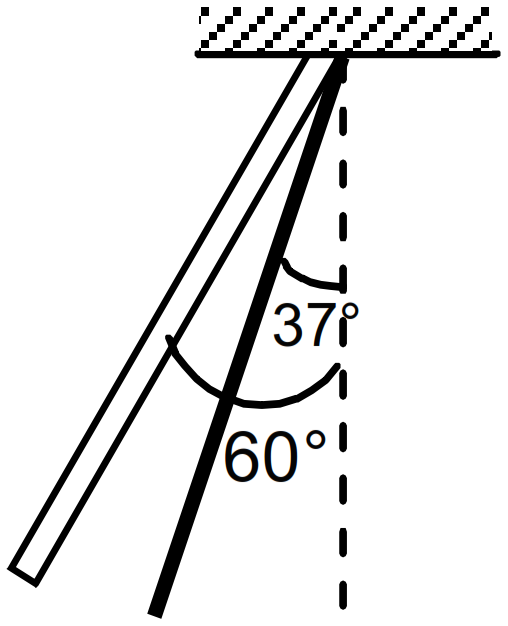
A uniform rod pivoted at its upper end hangs vertically. It is displaced through an angle of 60° and then released. Find the magnitude of the force acting on a particle of mass dm at the tip of the rod when the rod makes an angle of 37° with the vertical.
Answer


Let l = length of the rod, and m = mass of the rod.
Applying energy principle
$\Big(\frac{1}{2}\Big)\text{l}\omega^2-0=\text{mg}\Big(\frac{1}{2}\Big)(\cos37^\circ-\cos60^\circ)$
$\Rightarrow\frac{1}{2}\times\frac{\text{ml}^2}{3}\omega^2$
$=\text{mg}\times\frac{1}{2}\Big(\frac{4}{5}-\frac{1}{2}\Big)\text{t}$
$\Rightarrow\omega^2=\frac{9\text{g}}{10\text{l}}=0.9\Big(\frac{\text{g}}{\text{l}}\Big)$
Again $\Big(\frac{\text{ml}^2}{3}\Big)\alpha=\text{mg}\Big(\frac{1}{2}\Big)\sin37^\circ=\text{mgl}\times\frac{3}{5}$
$\therefore\alpha=0.9\Big(\frac{\text{g}}{\text{l}}\Big)=$ angular acceleration.
So, to find out the force on the particle at the tip of the rod
Fi = centrifugal force $=(\text{dm})\omega^2\text{l}=0.9(\text{dm})\text{g}$
Ft = tangential force $=(\text{dm})\alpha\text{l}=0.9(\text{dm})\text{g}$
So, total force $\text{F}=\sqrt{\big(\text{F}_{\text{i}}^2+\text{F}_{\text{t}}^2\big)}=0.9\sqrt2(\text{dm})\text{g}$

Need a full question paper?

Generate a complete, print-ready paper with questions like this in minutes — across 16+ boards, with answer keys.

Start Generating Free

Similar questions

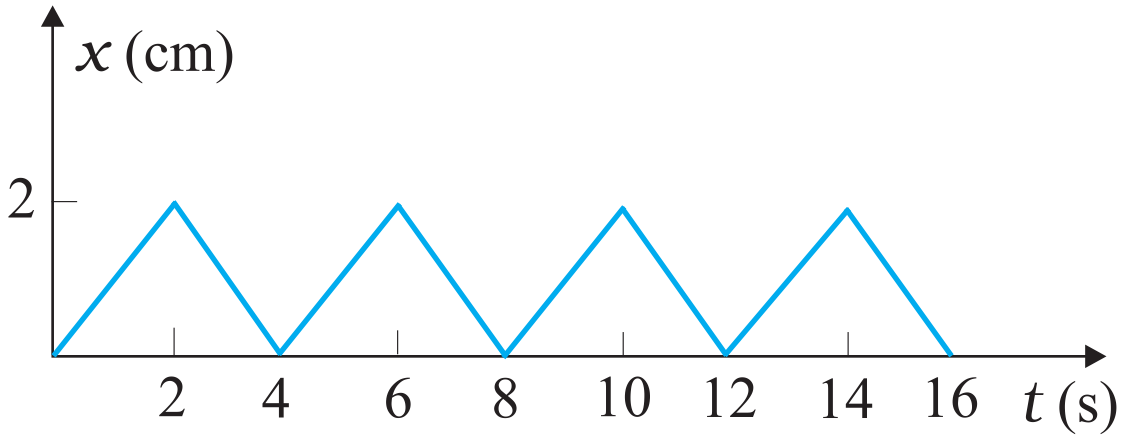
Figure 5.17 shows the position-time graph of a body of mass 0.04kg. Suggest a suitable physical context for this motion. What is the time between two consecutive impulses received by the body? What is the magnitude of each impulse?

The transverse displacement of a string (clamped at its both ends) is given by
$\text{y}(\text{x, t})=0.06\sin\Big(\frac{2\pi}{3}\text{x}\Big)\cos(120\pi\text{ t})$
where x and y are in m and t in s. The length of the string is 1.5m and its mass is 3.0 × 10–2kg.
Answer the following:
Interpret the wave as a superposition of two waves travelling in opposite directions. What is the wavelength, frequency, and speed of each wave?
A stone of mass 0.25kg tied to the end of a string is whirled round in a circle of radius 1.5m with a speed of 40 rev./min in a horizontal plane. What is the tension in the string? What is the maximum speed with which the stone can be whirled around if the string can withstand a maximum tension of 200N?
A uniform rod pivoted at its upper end hangs vertically. It is displaced through an angle of 60° and then released. Find the magnitude of the force acting on a particle of mass dm at the tip of the rod when the rod makes an angle of 37° with the vertical.
A particle is subjected to two simple harmonic motions given by $\text{x}_1=2.0\sin(100\pi\text{t})$ and $\text{x}_2=2.0\sin\Big(120\pi\text{t}+\frac{\pi}{3}\Big)$ where x is in centimeter and t in second. Find the displacement of the particle at
  1. t = 0.0125.
  2. t = 0.025.
Consider a circular ring of radius r, uniformly charged with linear charge density $\lambda.$ Find the electric potential at a point on the axis at a distance x from the centre of the ring. Using this expression for the potential, find the electric field at this point.
A scooter company gives the following specifications about its product.
  • Weight of the scooter - 95kg.
  • Maximum speed - 60km/h.
  • Maximum engine power - 3.5hp.
  • Pick up time to get the maximum speed - 5s.
  • Check the validity of these specifications.
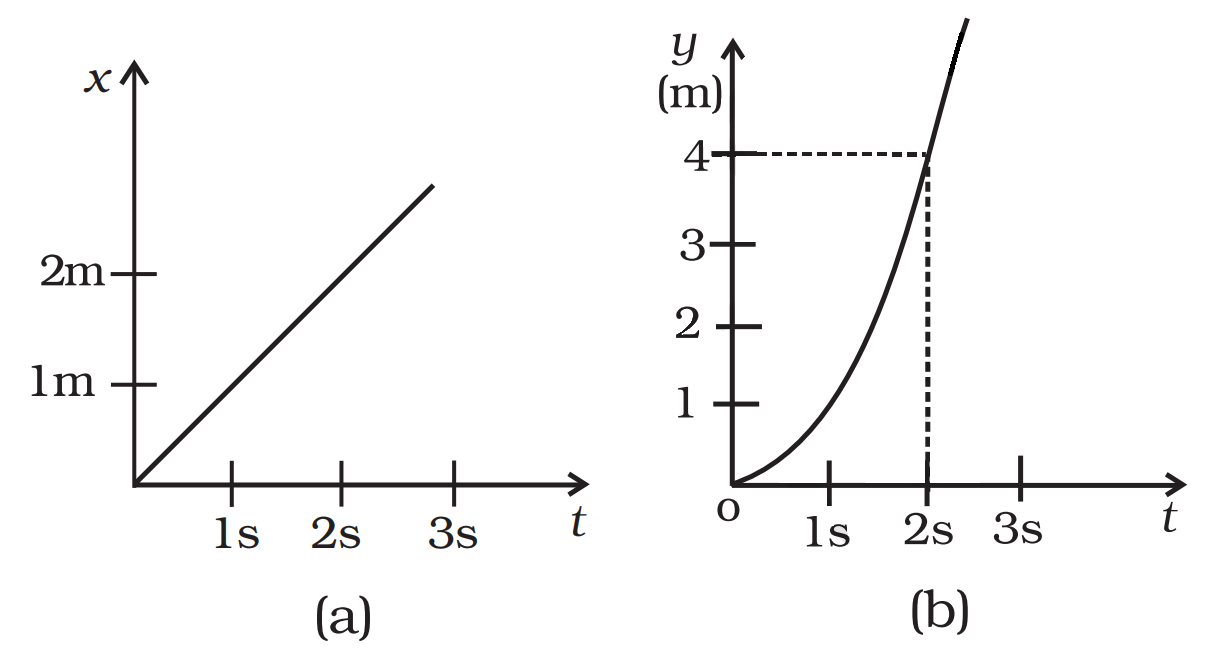
shows (x, t), (y, t) diagram of a particle moving in 2-dimensions.

If the particle has a mass of 500g, find the force (direction and magnitude) acting on the particle.

A transverse harmonic wave travelling on a string is described by $\text{y(x, t})=3.0\sin\Big[(36\text{t}+0.018\text{x})+\frac{\pi}{4}\Big]$ where x and y are in cm and t in s. The positive direction of x is from left to right.
  1. What are the speed and direction of propagation of the wave?
  2. What are its amplitude and frequency?
  3. What is the initial phase at the origin?
  4. What is the least distance between two successive crests in the wave?
A solid disc and a ring, both of radius 10cm are placed on a horizontal table simultaneously, with initial angular speed equal to 10 π rad s-1. Which of the two will start to roll earlier? The co-efficient of kinetic friction is $\mu_\text{k}=0.2$