CBSE BoardEnglish MediumSTD 10ScienceLife Processes5 Marks
Question
Explain the mechanism of photosynthesis.
✓
Answer
Mechanism of Photosynthesis:
Photosynthesis is formation of organic food from carbon dioxide and water with the help of sunlight inside chlorophyll containing cells. Oxygen is produced as by-product.
$6\text{CO}_2+12\text{H}_2\text{O}\xrightarrow[\ \text{Sunlight}\ ]{\ \text{Chlorophyll}}\text{C}_6\text{H}_{12}\text{O}_6+6\text{H}_2\text{O}+6\text{O}_2\uparrow\\\ \ \ \ \ \ \ \ \ \ \ \ \ \ \ \ \ \ \ \ \ \ \ \ \ \ \ \ \ \ \ \ \ \ \ \ \ \ \ \ \ \ \ \ \ \ \ \text{Glucose}$
Oxygen comes from water. Hydrogen of water is used to reduce carbon dioxide to form carbohydrate.
$2\text{H}_2\text{O}\xrightarrow[\ \text{Chlorophyll}]{\ \text{light energy}\ }2\text{H}_2+\text{O}_2$
$\text{CO}_2+2\text{H}_2\xrightarrow{\ \text{energy}\ }[\text{CH}_2\text{O}]+\text{H}_2\text{O}\\\ \ \ \ \ \ \ \ \ \ \ \ \ \ \ \ \ \ \ \ \ \ \ \ \ \ \ \ \ \text{Carbohydrate}$
Actually, photosynthesis occurs in two steps, photochemical and biochemical.
Photochemical Phase (Light or Hill Reaction): The reactions of this phase are driven by light energy. They are of two types- photolysis of water and formation of assimilatory power.
Photolysis of Water. Light energy splits up water into its components. $Mn ^{2+}, CL$ and $Ca ^{2+}$ are required for this.
Formation of Assimilatory Power: Light energy absorbed by chlorophyll molecules is used in synthesis of ATP and NADPH.
Both ATP and $NADPH_2$ together form assimilatory power.
$\text{ADP}+\text{Pi}+\text{energy}\xrightarrow{\ \ \ \ }\text{ATP}$
$\text{NADP}^{+}+2\text{e}^{-}+2\text{H}^{+}\xrightarrow{\ \ \ \ }\text{NADPH}+\text{H}^{+}\ \ (\text{NADPH}_2)$
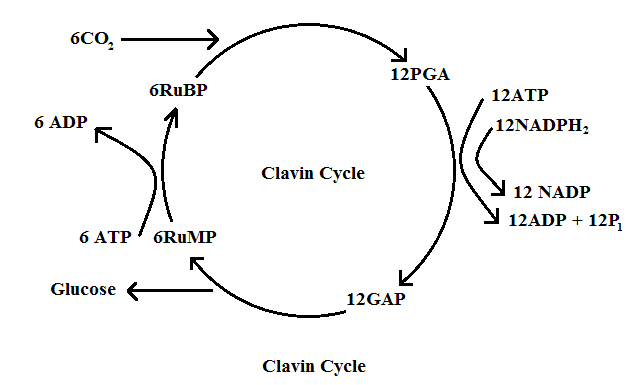
Biosynthetic Phase (Dark or Blackman’s Reaction). It is actually light independent reaction which can occur both in light as well as in dark. It requires the energy and reducing power contained in assimilatory power of light reaction. Common pathway of biosynthetic phase is Calvin cycle. Carbon dioxide combines with ribulose bisphosphate in the presence of enzyme ribulose biphosphate carboxylase or rubisco. It produces two molecules of phosphoglyceric acid (PGA).
In the presence of ATP, phosphoglyceric acid is reduced by $NADPH _2$ to form glyceraldehyde phosphate (GAP).
$PGA+ATP+NADPH 2 \rightarrow GAP+NADP+ADP+Pi$
A part of glyceraldehyde phosphate is changed into dihydroxyacetone phosphate. The two condense and form glucose. Ribulose biphosphate is regenerated to combine with carbon dioxide again. Glucose undergoes condensation to form reserve carbohydrate called starch.
Other inorganic Raw Materials: Synthesis of carbohydrates during photosynthesis is a mechanism to form food materials for body building and releasing energy.
Plants also require a number of other inorganic raw materials or minerals from soil for building other, e.g., nitrogen, phosphorus, iron, sulphur, magnesium, etc. Nitrogen and sulphur are required for building proteins. Phosphorus is required for synthesis of nucleotides. Minerals are absorbed in the form of ions, e.g., $NO _2{ }^{-}$and $NH _4{ }^{+}$for nitrogen. Some bacteria convert atmospheric nitrogen into compounds of nitrogen. Parts of them become available to plants.
Need a full question paper?
Generate a complete, print-ready paper with questions like this in minutes — across 16+ boards, with answer keys.