Question
Explain the method of charging by friction briefly.

Answer

►Historically, the credit of discovery of frictional electricity goes to Thales of Miletus, Greece around 600 BC .
►The name electricity is coined from the Greek word 'elektron' meaning amber.
►Many such pairs of materials were known which, on rubbing could attract light objects like straw, pith balls and bits of papers.
We can explain it with an activity also : Cut out long thin strips of white paper and lightly iron them.
►Take them near a TV screen or computer monitor. You will see that the strips get attracted to the screen. In fact they remain stuck to the screen for a while.
Need a full question paper?

Generate a complete, print-ready paper with questions like this in minutes — across 16+ boards, with answer keys.

Start Generating Free

Similar questions

Explain electricity conduction in intrinsic semi-conductors.
A ray of light, incident on an equilateral glass prism$(\mu_{g} = \sqrt{3})$ moves parallel to the base line of the prism inside it. Find the angle of incidence for this ray.
A voltmeter consists of a $25\Omega$ coil connected in series with a $575\Omega$ resistor. The coil takes 10mA for full scale deflection. What maximum potential difference can be measured by this voltmeter?
Can the refractive index of any medium be less than 1 relative to another medium?
A magnetic needle free to rotate in a vertical plane parallel to the magnetic meridian has its north tip pointing down at 22° with the horizontal. The horizontal component of the earth’s magnetic field at the place is known to be 0.35 G. Determine the magnitude of the earth’s magnetic field at the place.
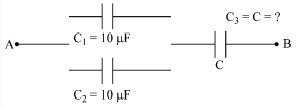
Calculate the capacitance of capacitor C if the equivalent capacitance of the connection between $A$ and $B$ is $15 \mu F$.
Image
Using the formula for the radius of $n ^{\text {th }}$ orbit $r_n=\frac{n^2 h^2 \varepsilon_0}{\pi m e^2}$ derive an expression for the total energy of electron in $n^{\text {th }}$ Bohr's orbit.
A closed organ pipe can vibrate at a minimum frequency of 500Hz. Find the length of the tube. Speed of sound in air = 340m/s.
The distance of the field point on the axis of a small dipole is doubled. By what factor will the electric field, due to the dipole change?
A convex lens (n = 1.5) of focal length fa is immersed.
  1. In water n = 1.33 and.
  2. In carbon disulphide n = 1.6, how does the lens behave in the two cases?