Question
Explain the methods for making host cell competent to insert the r DNA.

Answer

→ Since DNA is a hydrophilic molecule, it cannot pass through cell membranes.
→ In order to force bacteria to take up the plasmid, the bacterial cells must first be made 'competent' to take up DNA.
Micro-injection :
→ In a method known as micro-injection, recombinant DNA is directly injected into the nucleus of an animal cell.
Biolistics/ Particle bombardment :
→ In another method, suitable for plants, cells are bombarded with high velocity micro- particles of gold or tungsten coated with DNA in a method known as biolistics or gene gun.
Conformational change in the cell wall :
→ This is done by treating them with a specific concentration of a divalent cation, such as calcium, which increases the efficiency with which DNA the bacterium through pores in its cell wall.
→ Recombinant DNA can then be forced into such cells by incubating the cells with recombinant DNA on ice, followed by placing them briefly at 42°C (heat shock), and then putting them back on ice.
→ This enables the bacteria to take up the recombinant DNA.

Need a full question paper?

Generate a complete, print-ready paper with questions like this in minutes — across 16+ boards, with answer keys.

Start Generating Free

Similar questions

How is a transgenic tobacco plant protected against Meloidogyne incognita? Explain the procedure.
Explain loss of biodiversity.
Differentiate between following.
Read the following and answer any four questions from (i) to (v) given below:

Aditya went to his hometown located in countryside along with his parents during his summer vacations. His grand parents' house is surrounded by farmland from all sides. Lots of crops were growing nearby and Aditya was very excited to visit the crop fields. He seeked permission from his mother to play in farmland along with his friends and then went to play in the fields. On returning back he had running nose, watering eyes and continuous sneezing which was very frequent. TI1e symptoms worsened with time. Based on the above information, answer the following questions.

  1. What could be the possible reason for Aditya's condition?
  1. Allergy
  2. Infection
  3. Malnutrition
  4. Genetic disorder
  1. How can allergy be diagnosed in a person?
  1. Presence of large amount of IgE antibodies in the blood.
  2. Presence of large number of bacteria in the blood.
  3. Presence of bilirubin and bilirubin pigments in the stool.
  4. Presence of sickle shaped RBCs in the blood
  1. The symptoms which Aditya developed on account of being allergic are consequence of?
  1. Inflammation of membrane lining the nose and conjunctiva
  2. Swelling up of tissue surrounding bronchioles of lungs
  3. Dilation of all arteries so that large amount of fluid passes from blood to tissues.
  4. All of these.
  1. Name the type of allergy that Aditya developed.
  1. Asthma
  2. Anaphylaxis
  3. Hay fever
  4. Urticaria
  1. Assertion : Hay fever is the form of allergy due to pollens of grasses and other plants.

Reason : Hay fever symptoms are due to release of histamines and often respond well to treatment with antihistamines.

  1. Both assertion and reason are true, and reason is the correct explanation of assertion.
  2. Both assertion and reason are true, but reason is not the correct explanation of assertion.
  3. Assertion is true, but reason is false.
  4. Both assertion and reason are false.
Write a short note on pollination by wind.
Read the following and answer any four questions from (i) to (v) given below:

Deoxyribonucleic acid (DNA) and ribonucleic acid (RNA) are the two types of nucleic acids found in the living systems. DNA acts as the genetic material in most of the organisms. Although, RNA also acts as a genetic material in some organisms.

  1. In which of the following organisms, RNA acts as a genetic material?
  1. Escherichia coli
  2. $\text{Q}\beta$ Bacteriophage
  3. Tobacco Mosaic viruses
  4. Both (b) and (c)
  1. What is the reason for the additional stability of DNA in comparison to RNA?
  1. Presence of thymine
  2. Presence of uracil
  3. Presence of OH group
  4. Presence of deoxyribose sugar
  1. Which of the following criteria a molecule must fulfill to act as a genetic material?
  1. It should be able to generate its replica.
  2. It should be stable chemically and structurally.
  3. It should be able to express itself in the form of Mendelian character.
  4. All of these
  1. Assertion: RNA is liable and easily degradable.

Reason: The 2'- OH group present at every nucleotide in RNA is a reactive group
  1. Both assertion and reason are true, and reason is the correct explanation of assertion.
  2. Both assertion and reason are true, but reason is not the correct explanation of assertion.
  3. Assertion is true, but reason is false.
  4. Both assertion and reason are false.
  1. Read the given statement and select the option that correctly fill in the blanks. Pyrimidines present in DNA are (i) and (ii) while pyrimidines present in RNA are (iii) and (iv).
  1. (i)-Adenine (iii)-Guanine (iii)-Cytosine, (iv)-Thymine
  2. (i)-Cytosine (iii)Thymine (iii)-Cytosine, (iv)-Uracil
  3. (i)-Cytosine (iii)-Uracil (iii)-Adenine, (iv)-Guanine
  4. (i)-Cytosine (iii)-Uracil (iii)-Cytosine, (iv)-Thymine
Read the following text carefully and answer the questions that follow:
A pathogen is defined as an organism causing disease to its host, with the severity of the disease symptoms referred to as virulence. Pathogens are taxonomically widely diverse and comprise viruses and bacteria as well as unicellular and multicellular eukaryotes. The immune system of a person is suppressed. He was found positive for a pathogen in the diagnostic test ELISA.
Image
i. Name the disease, the patient is suffering from. (1)
ii. Which pathogen is identified by ELISA test? (1)
iii. Which cells of the body are attacked by the pathogen? (2)
OR
Suggest preventive measures of the infection. (2)
Read the following and answer any four questions from (i) to (v) given below:

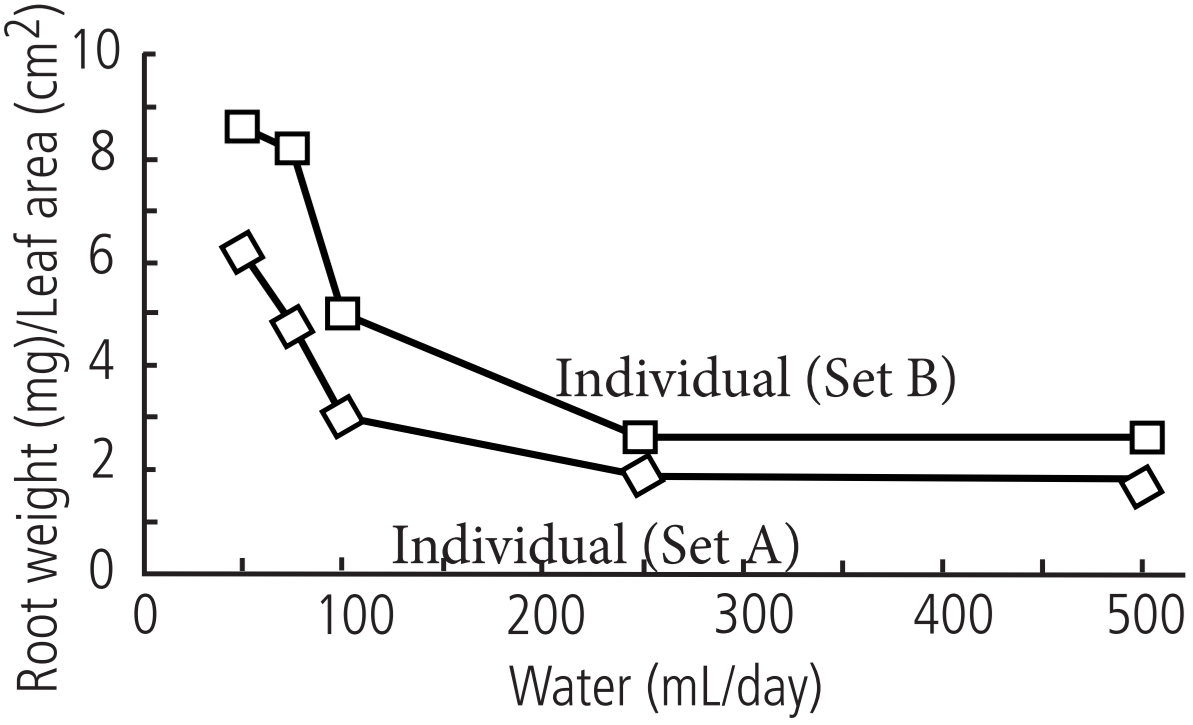
Ananya is a biologist, her research guide assigned project, i.e., to determine the effect ofin tra-specific competition on the growth of sapling of Eucalyptus. For this, she designed an experiment in which two sets of pots were used. ln the first set (set A) only I sapling was planted per pot and in the other set (set B) 16 saplings were planted per pot. To check for the effect of intra-specific competition on allocation of resources, a decreasing amount of water was added to each set. The results have been graphically indicated. Which of the following conclusions can indicated as follows:

  1. Which of the following statements can be concluded from the given study?
  1. More resources are allocated to the root during low water conditions.
  2. Competition for water among individuals of a population causes more root growth as compared to individuals who are growing alone.
  3. Lesser leaves are formed under low water conditions.
  4. Root growth is higher in individual grown singly as compared to individuals in populations.
  1. Which of the following associations is an example of competitions?
  1. Cuscuta and hedge plant.
  2. Balanus and Cathamalus.
  3. Cactus and moth.
  4. Orchid and mango.
  1. If '+' sign is assigned to beneficial interaction, '-' sign to detrimental and O sign to neutral interaction, then the population interaction of competition refers to:
  1. +, +
  2. -, -
  3. +, -
  4. +, 0
  1. lntraspecific competition is more severe due to:
  1. similar needs.
  2. similar adaptations.
  3. common resources.
  4. all of these.
  1. Assertion: Two members of a competing species may co-exist.

Reason: Different individuals of a species have different resource requirements.

  1. Both assertion and reason are true and reason is the correct explanation of assertion.
  2. Both assertion and reason are true but reason is not the correct explanation of assertion.
  3. Assertion is true but reason is false.
  4. Both assertion and reason are false.
What is oogenesis? Give a brief account of oogenesis.###Define or Characterise: (i) Primary oocyte. (ii) Primary follicle. (iii) Secondary follicle. (iv) Tertiary follicle. (v) Antrum. (vi) Secondary oocyte. (vii) Graafian follicle.
Read the following and answer any four questions from (i) to (v) given below:

Mutation explains the relationship between gene and DNA. The effects of large deletions and rearrangement in a segment of DNA results in loss or gain of gene and its function. Insertion or deletion of one or two bases changes the reading frame from the point of insertion or deletion. A classical example of point mutation is a change of single base pair in the gene for beta globin chain that results in change of amino acid residue glutamate to valine and results into a diseased condition called sickle cell anaemia.

  1. A mutation is a change produced by an alteration in the genetic mechanism and.
  1. May arise spontaneously.
  2. Is always induced by the environment.
  3. Is never advantageous.
  4. Is not inherited.
  1. The DNA code for glutamic acid is CTC or CTT. The code for valine is CAA or CAT. In sickle cell haemoglobin, valine is present instead of glutamic acid.

Assuming a single base pair substitution has occurred, what is the mRNA code in the affected mutant?

  1. CUU
  2. GAA
  3. GAG
  4. GUA
  1. A mutation involving the substitution of one nitrogenous base for another has altered the base sequence of a DNA molecule, coding for four amino acids, as shown below.

Normal A-G-C-A-T-G-G-A-T-C-C-T

Mutant A-G-C-A-T-G-C-A-T-C-C-T

The table shows six codons and the corresponding amino acids into which each is translated.

mRNA codon
Amino acid
AAG
Lysine
CUA
Leucine
GGA
Glycine
GUA
Valine
UAC
Tyrosine
UCG
Serine
The mutation has changed the amino acid.

  1. Leucine to valine.
  2. Lysine to glycine.
  3. Serine to leucine.
  4. Tyrosine to lysine.
  1. Assertion : Insertion or deletion of three or its multiple bases, insert or delete one or multiple codons and so one or multiple amino acids.

Reason: Reading frame remains unaltered with insertion or deletion of three or its multiple bases.

  1. Both assertion and reason are true, and reason is the correct explanation of assertion.
  2. Both assertion and reason are true, but reason is not the correct explanation of assertion.
  3. Assertion is true, but reason is false.
  4. Both assertion and reason are false.
  1. Part of the amino acid sequences in normal and sickle cell haemoglobin are shown.
Normal haemoglobin Sickle cell haemoglobin
Thr-Pro-Glu-Glu Thr-Pro-Val-Glu
mRNA codons for these amino acids are

Glutamine (Glu) GAA GAG

Praline (Pro) CCU CCC

Threonine (Thr) ACU ACC

Valine (Val) GUA GUG

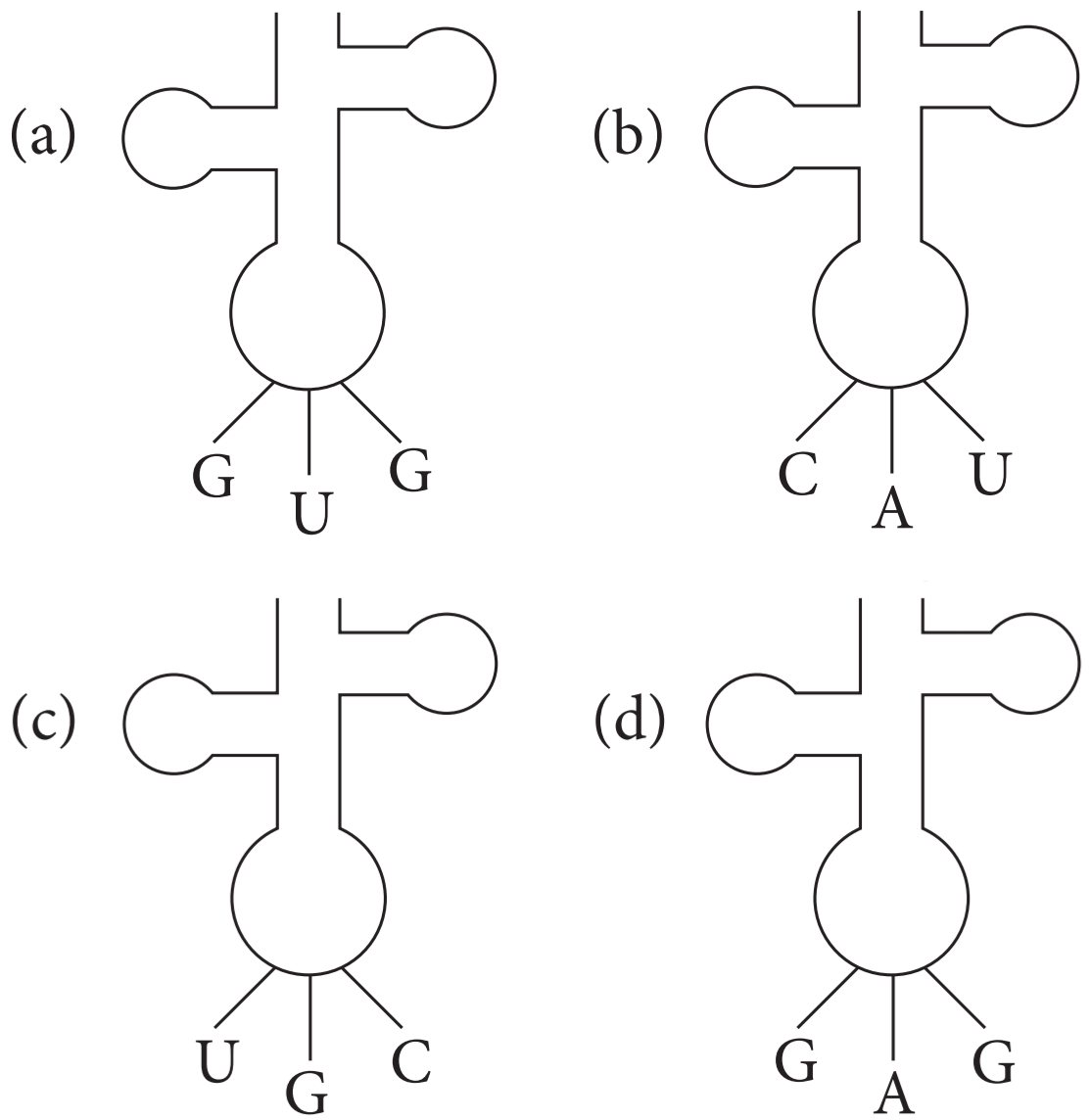
Which transfer RNA molecule is involved in the formation of this part of the sickle cell haemoglobin?