Question
Read the following and answer any four questions from (i) to (v) given below:

Deoxyribonucleic acid (DNA) and ribonucleic acid (RNA) are the two types of nucleic acids found in the living systems. DNA acts as the genetic material in most of the organisms. Although, RNA also acts as a genetic material in some organisms.

  1. In which of the following organisms, RNA acts as a genetic material?
  1. Escherichia coli
  2. $\text{Q}\beta$ Bacteriophage
  3. Tobacco Mosaic viruses
  4. Both (b) and (c)
  1. What is the reason for the additional stability of DNA in comparison to RNA?
  1. Presence of thymine
  2. Presence of uracil
  3. Presence of OH group
  4. Presence of deoxyribose sugar
  1. Which of the following criteria a molecule must fulfill to act as a genetic material?
  1. It should be able to generate its replica.
  2. It should be stable chemically and structurally.
  3. It should be able to express itself in the form of Mendelian character.
  4. All of these
  1. Assertion: RNA is liable and easily degradable.

Reason: The 2'- OH group present at every nucleotide in RNA is a reactive group

  1. Both assertion and reason are true, and reason is the correct explanation of assertion.
  2. Both assertion and reason are true, but reason is not the correct explanation of assertion.
  3. Assertion is true, but reason is false.
  4. Both assertion and reason are false.
  1. Read the given statement and select the option that correctly fill in the blanks. Pyrimidines present in DNA are (i) and (ii) while pyrimidines present in RNA are (iii) and (iv).
  1. (i)-Adenine (iii)-Guanine (iii)-Cytosine, (iv)-Thymine
  2. (i)-Cytosine (iii)Thymine (iii)-Cytosine, (iv)-Uracil
  3. (i)-Cytosine (iii)-Uracil (iii)-Adenine, (iv)-Guanine
  4. (i)-Cytosine (iii)-Uracil (iii)-Cytosine, (iv)-Thymine
Answer

  1.  (c) Both (b) and (c)

Explanation:

DNA is the genetic material in E. coli. RNA is the genetic material in Tobacco Mosaic virus and $\text{Q}\beta$ bacteriophage.

  1. (a) Presence of thymine

Explanation:

The presence of thymine in DNA at the place of uracil which is present in RNA provides additional stability to DNA.

  1. (d) All of these
  2. (a) Both assertion and reason are true, and reason is the correct explanation of assertion.
  3. (b) (i)-Cytosine (iii)Thymine (iii)-Cytosine, (iv)-Uracil

Explanation:

Purines present in DNA and RNA are adenine and guanine, while pyrimidines present in DNA are cytosine and thymine and pyrimidines present in RNA are cytosine and uracil. 

Need a full question paper?

Generate a complete, print-ready paper with questions like this in minutes — across 16+ boards, with answer keys.

Start Generating Free

Similar questions

Read the following and answer any four questions from (i) to (v) given below:
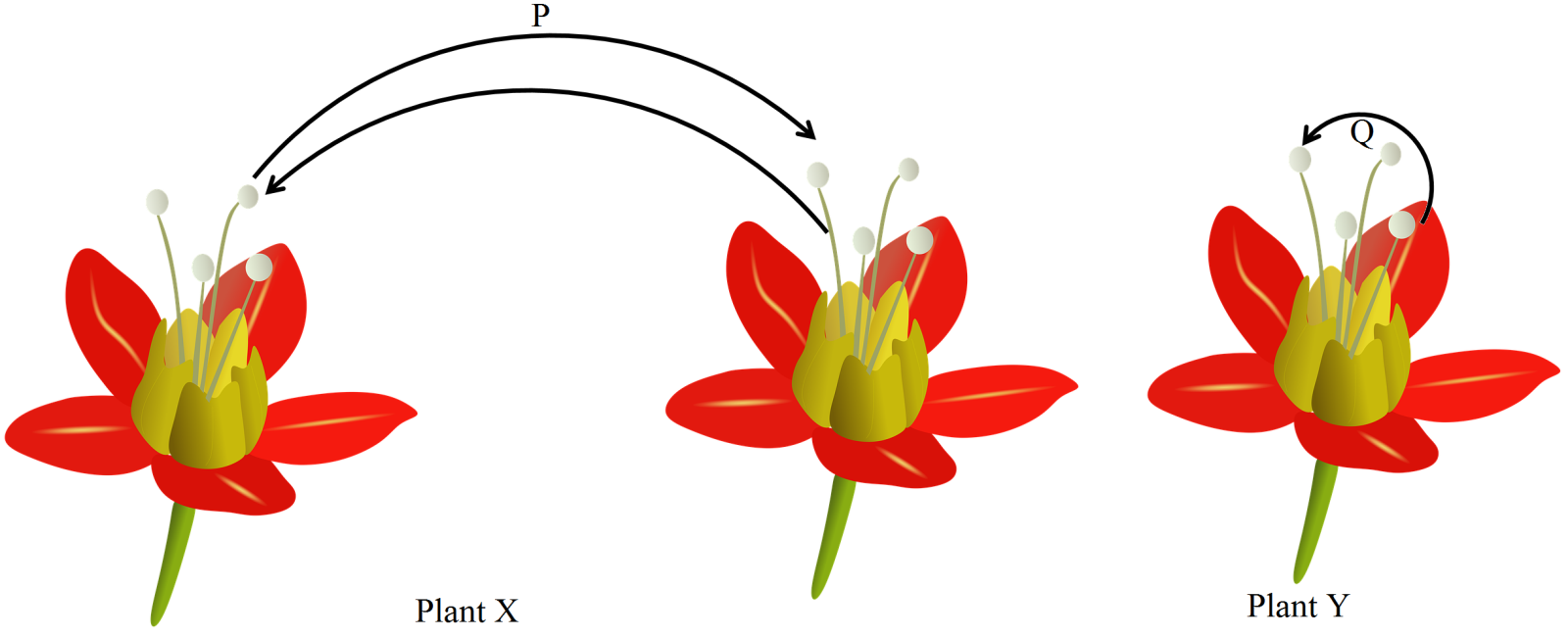
In angiosperms, the pollen grains are being transferred from the anther to the stigma and is termed pollination. This phenomenon was first discovered by Camerarius (1694) in the end of seventeenth century. Pollen grains are immobile. They cannot reach the stigma by themselves. An external agent is required for this. The pollination is mainly of two types-self pollination and cross pollination. The diagram given below shows two plants of the same species showing different types of pollination.

  1. What is transferred between the plants in the process indicated by arrow P?
  1. Ova.
  2. Pollen.
  3. Nutrients.
  4. Seeds.
  1. Which of the following statements is correct regarding processes P, Q and R?
  1. Processes P, Q and R introduce genetic variability in the offspring of sexually reproducing plants X and Y.
  2. Wind serves as agent for process Q if plants X and Y belong to Genus Salvia.
  3. Flowers of plants X and Y need to produce odour and nectar for completion of processes P and Q if they are entomophilous.
  4. If plants X and Y belong to Genus Cannabis, then their flowers need to produce sticky and heavy pollens in very small amount for accomplishment of process Q.
  1. Identify the processes P, Q and R.
S. No
P
Q
R
(a)
Geitonogamy
Xenogamy
Autogamy
(b)
Allogamy
Chasmogamy
Cleistogamy
(c)
Autogamy
Geitonogamy
Xenogamy
(d)
Geitonogamy
Allogamy
Autogamy
  1. In Catliarantl1us, the growth of style brings the stigma in contact of ripe anthers present on the mouth of corolla tube. This is an example of:
  1. Homogamy.
  2. Cleistogamy.
  3. Geitonogamy.
  4. Xenogamy.
  1. Which of the given processes represents a type of pollination that would result in greater adaptability of the particular species to potential environmental changes?
  1. P.
  2. Q.
  3. R.
  4. All of these.
Explain the life cycle of Plasmodium (with diagram).
A patient is suffering from ADA deficiency. Can he be cured? How?
Read the following text carefully and answer the questions that follow:
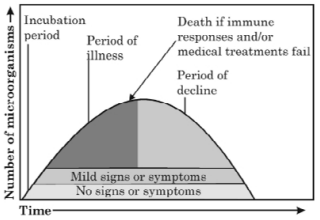
When a microorganism invades a host, a definite sequence of events usually occur leading to infection and disease, causing suffering to the host. This process is called pathogenesis. Once a microorganism overcomes the defense system of the host, development of the disease follows a certain sequence of events as shown in the graph. Study the graph given below for the sequence of events leading to appearance of a disease and answer the questions that follow:
Image
i. In which period, according to the graph there are maximum chances of a person transmitting a disease/infection and why? (1)
ii. Study the graph and write what is an incubation period. Name a sexually transmitted disease that can be easily transmitted during this period. Name the specific type of lymphocytes that are attacked by the pathogen of this disease. (1)
iii. Draw a schematic labelled diagram of an antibody. (2)
OR
In which period, the number of immune cells forming antibodies will be the highest in a person suffering from pneumonia?
Name the immune cells that produce antibodies. (2)
Give a detailed description of human male reproductive system. (Diagram required)
Read the following and answer any four questions from (i) to (v) given below:

The process of translation requires transfer of genetic information from a polymer of nucleotides to synthesise a polymer of amino acids. The relationship between the sequence of amino acids in a polypeptide and nucleotide sequence of DNA or mRNA is called genetic code. George Gamow suggested that in order to code for all the 20 amino acids, code should be made up of three nucleotides.

  1. What is a codon?
  1. A length of DNA which codes for a particular protein.
  2. A part of the tRNA molecule to which a specific amino acid is attached.
  3. A part of the tRNA molecule which recognises the triplet code on the messenger RNA.
  4. A part of the messenger RNA molecule that has a sequence of bases coding for an amino acid.
  1. Three consecutive bases in the DNA molecule provide the code for each amino acid in a protein molecule. What is the maximum number of different triplets that could occurs?
  1. 16
  2. 20
  3. 24
  4. 64
  1. Listed below are some amino acids and their corresponding mRNA triplets.
Amino acid
mRNA triplet
Phenylalanine
UUU
Lysine
AAG
Arginine
CGA
Alanine
GCA
Which DNA sequence would be needed to produce the following polypeptide sequence? Alanine-Arginine-Lysine-Phenylalanine

  1. $\text{CGT}\ \ \ \text{GCT}\ \ \ \text{TTC}\ \ \ \text{AAA}$

  2. $\text{CGT}\ \ \ \text{GCT}\ \ \ \text{TTC}\ \ \ \text{TTT}$

  3. $\text{CGU}\ \ \ \text{GCU}\ \ \ \text{UUC}\ \ \ \text{AAA}$

  4. $\text{CGU}\ \ \ \text{GCU}\ \ \ \text{UUC}\ \ \ \text{TTT}$

  1. Identify the non-sense codons among the following.
  1. AUG
  2. GUG
  3. UAA
  4. UGG
  1. A polypeptide is made using synthetic mRNA molecules as shown.
Synthetic mRNA used
Polypeptide produced
UUUAAAUUUAAA
Phenylalanine-Iysine-phenylalanine-Iysine

What are the DNA codes for the amino acids phenylalanine and lysine?

S.no
Phenylalanine
Lysine
(a)
AAA
TTT
(b)
AAA
UUU
(c)
GGG
CCC
(d)
TTT
GGG
Read the following and answer any four questions from (i) to (v) given below:
Green manuring is the fanning practice where a leguminous plant which has derived enough benefits from its association with appropriate species of Rhizobium, is ploughed into the field soil and then a non-legume is sown and allowed to get benefitted from the already present nitrogen fixer. Some legumes, such as, Crotolaria juncea, Sesbania rostrata, Lencaena leucocephala, etc. are used as green manure. Rhizobia, that fix atmospheric nitrogen in the form of nitrate, live in the roots ofleguminous plants. These nutrients are used by non-leguminous plants through the practice of green manuring.
  1. Green manures mainly provide nutrient enriched in:
  1. Magnesium.
  2. Sulphur.
  3. Nitrogen.
  4. Both (a) and (b).
  1. Which of the following plants is used as green manure in crop fields?
  1. Saccharum.
  2. Dichanthium.
  3. Phyllonthus.
  4. Crotolaria.
  1. Green manure plants belong to the Family:
  1. Lamiaceae.
  2. Papilionaceae.
  3. Liliaceae.
  4. Poaceae.
  1. Due to excess use of chemical fertilisers rich in nitrate, ________ disease occurred in children.
  1. Jaundice.
  2. Septicemia.
  3. Methemoglobinemia.
  4. Botulism.
  1.  A green manure is:
  1. Rice.
  2. Maize.
  3. Sorghum.
  4. Sesbania.
Read the following and answer any four questions from (i) to (v) given below:

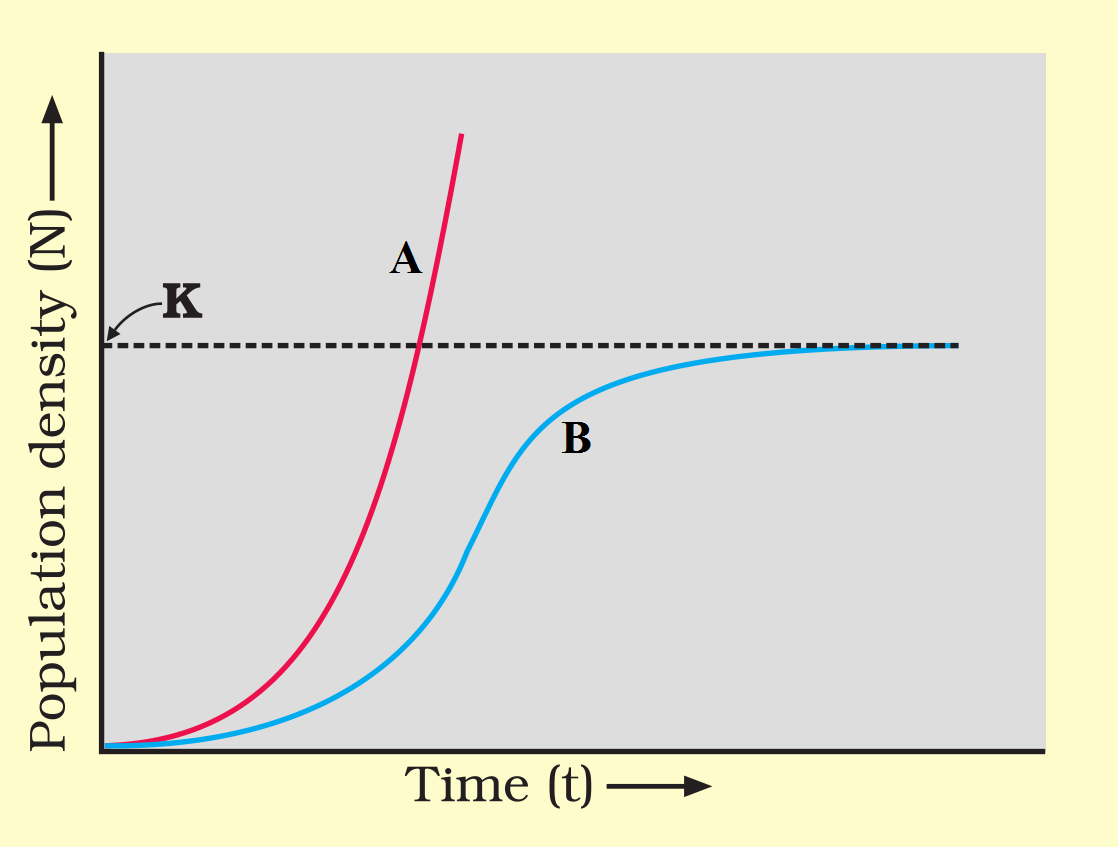
Growth of a population with time shows specific and predictable patterns. Two types of growth pattern of population are exponential and logistic growth. When resources in the habitat are unlimited each species has the ability to realise fully its innate potential to grow in number. Then the population grows in exponential fashion. When the resources are limited growth curve shows an initial slow rate and then it accelerates and finally slows giving the growth curve which is sigmoid.

  1. Which of the following statement is incorrect?
  1. Exponential growth occurs in organism such as lemmings.
  2. Logistic growth is more realistic.
  3. Exponential growth has two phases lag and log.
  4. ln logistic growth, population passes well beyond the carrying capacity of ecosystem.
  1. Which of the following equations correctly represents the exponential population growth curve?
  1. $\text{dN}/\text{dt}=\text{rN}$

  2. $\text{dN}/\text{dt}=\text{rN}\Big(\frac{\text{K-N}}{\text{K}}\Big)$

  3. $\text{N}_\text{t}=\text{N}_\text{o}\text{e}^\text{rt}$

  4. Both (a) and (c).
  1. Which of the following equations correctly represents Verhulst-Pearl logistic growth?
  1. $\text{dN}/\text{dt}=\text{rN}\Big(\frac{\text{K-N}}{\text{K}}\Big)$

  2. $\text{dN}/\text{dt}=\frac{\text{rN}}{\text{K}}$

  3. $\text{dN}/\text{dt}=\frac{\text{N}(\text{K}-\text{N})}{\text{K}}$

  4. $\text{dN}/\text{dt}=\frac{\text{r}(\text{K}-\text{N})}{\text{K}}$

  1. The population growth is generally described by the following equation:

$\frac{\text{dN}}{\text{dt}}=\text{rN}\Big(\frac{\text{K}-\text{N}}{\text{K}}\Big)$

What does 'r' represent in the given equation?

  1. Population density at time 't'.
  2. Intrinsic rate of natural increase.
  3. Carrying capacity.
  4. The base of natural logarithm.
  1. Study the population growth curves (A and B) in the given graph and select the incorrect option.

  1. Curve 'A: shows exponential growth, represented by equation $\frac{\text{dN}}{\text{dt}}=\text{rN}$.

  2. Curve 'B' shows logistic growth, represented by equation $\frac{\text{dN}}{\text{dt}}=\text{rN}\Big(\frac{\text{K}-\text{N}}{\text{K}}\Big)$

  3. Exponential growth curve is considered as more realistic than the logistic growth curve.
  4. Curve 'A' can also be represented by equation $\text{N}_\text{t}=\text{N}_\text{o}\text{e}^\text{rt}$.

Read the following text carefully and answer the questions that follow:
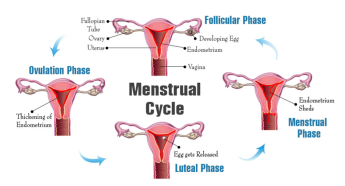
The image below shows the menstrual cycle of a human female. On the basis of this cycle:
Image
i. Explain the menstrual phase in a human female. State the level of ovarian and pituitary hormones during this phase. (1)
ii. Why is follicular phase in the menstrual cycle also referred as proliferative phase? Explain. (1)
iii. Explain the events that occur in a Graafian follicle at the time of ovulation and thereafter. (2)
OR
Draw a Graafian follicle and label antrum and secondary oocyte. (2)
Read the following and answer any four questions from (i) to (v) given below:

Rajesh, Ravi, and Rohit are roommates. 'They are doing their graduation. Few months back Ravi fell ill. it took him around 3 weeks to recover. Both his friends were absolutely healthy at that time. After sometime, Rajesh also fell ill from some other disease. This time Ravi and Rohit both contracted the same illness. Based on the above information, answer the following questions.

  1. Which of the following holds true for Ravi's illness?
  1. Ravi was suffering from a communicable disease that is transmitted through vector.
  2. Ravi was suffering from a communicable disease that is transmitted through faecal oral route.
  3. Ravi was suffering from a non-communicable disease like anaemia.
  4. Ravi was suffering from a non-communicable disease like Down's syndrome.
  1. Select the correct statement.
  1. Ravi contracted a disease caused by air borne microbes.
  2. Ravi could have suffered a nutritional disorder.
  3. Ravi suffered a non-contagious disease.
  4. Both (b) and (c)
  1. Which could be correctly said for Rajesh's illness?
  1. Rajesh's illness was due to a microbial infection.
  2. Rajesh's illness could be contagious or non-contagious.
  3. Rajesh's illness could be cured by antibiotics.
  4. All of these
  1. Which of the following may depicts Ravi's and Rajesh's illness?
S.no
Ravi
Rajesh
(a)
Which of the following may depicts Ravi's and Rajesh's illness?
Myocardial infection
(b)
Whooping cough
Tetanus
(c)
Gastritis
Rhinitis
(d)
Hypertensio
Thyroid
  1. Assertion: Diabetes mellitus is a non-communicable disease which can be completely cured.

Reason: Diabetes mellitus is caused by deficiency of aldosterone hormone.

  1. Both assertion and reason are true, and reason is the correct explanation of assertion.
  2. Both assertion and reason are true, but reason is not the correct explanation of assertion.
  3. Assertion is true, but reason is false.
  4. Both assertion and reason are false.