Question
Explain the phenomenon of nuclear fission.

Answer

When a heavy nucleus is bombarded with a neutron, then first neutron is absorbed. This nucleus is in a highly excited state. As a result, it splits into two lighter nuclei of approximately equal mass to become stable.
Neutron is chargeless so it does not have to face coulomb forces. So neutron is a best projectile.
When a neutron is bombarded on the nucleus of uranium its nucleus breaks into two almost equal parts. Its nuclear reaction is as below :
$\begin{array}{l}
{ }_{92}^{235} U +{ }_0^1 n \rightarrow{ }_{92}^{236} U \rightarrow{ }_{56}^{144} B a+{ }_{36}^{89} K r+3\left({ }_0^1 n\right)+ Q \\
{ }_{92}^{235} U +{ }_0^1 n \rightarrow{ }_{92}^{236} U \rightarrow{ }_{51}^{133} S b+{ }_{41}^{99} N b+4\left({ }_0^1 n\right)+ Q \\
{ }_{92}^{235} U +{ }_0^1 n \rightarrow{ }_{92}^{236} U \rightarrow{ }_{54}^{140} Xe +{ }_{38}^{94} S r+2\left({ }_0^1 n\right)+ Q
\end{array}$
The fission fragments are radioactive and by successive emmision of $\beta$-particles results in the stable nuclei.
During the fission process of uranium the energy released per fission is almost 200 MeV .
Suppose a nucleus with mass number $A =240$ breaks into two fragments each of $A =120$.
Binding energy per nucleon for a nucleus with $A =240$ is 7.6 MeV and for a nucleus with $A =120$ is 8.5 MeV .
Gain in binding energy per nucleon
$\begin{array}{l}
=8.5-7.6 \\
=0.9 MeV
\end{array}$
Total gain in binding energy
$\begin{array}{l}
=0.9 \times 240 \\
=216 MeV .
\end{array}$
The disintegration energy in fission events first appears as the kinetic energy of the fragments and neutrons. Eventually it is transferred to the surrounding matter appearing as heat.
In a nuclear reactor this process takes place in a controlled manner whereas in an atomic bomb this process takes place in an uncontrolled manner.

Need a full question paper?

Generate a complete, print-ready paper with questions like this in minutes — across 16+ boards, with answer keys.
Start Generating Free

Similar questions

Define the term 'resolving power' of an astronomical telescope. How does it get affected on?

  1. Increasing the aperture of the objective lens?
  2. Increasing the wavelength of the light used?

Justify your answer in each case.

A parallel-plate capacitor having plate area 25cm2 and separation 1.00mm is connected to a battery of 6.0V. Calculate the charge flown through the battery. How much work has been done by the battery during the process?
A transformer has 50 turns in the primary and 100 in the secondary. If the primary is connected to a 220V DC supply, what will be the voltage across the secondary?
A 5.0 diopter lens forms a virtual image which is 4 times the object placed perpendicularly on the principal axis of the lens. Find the distance of the object from the lens.
In the Bohr model of hydrogen atom, the electron is treated as a particle going in a circle with the centre at the proton. The proton it self is assumed to be fixed in an inertial frame. The centripetal force is provided by the Coloumb attraction. In the ground state, the electron goes round the proton in a circle of radius 5.3 × 10-11m. Find the speed of the electron in the ground state. Mass of the electron = 9.1 × 10-31kg and charge of the electron = 1.6 × 10-19C.
Water is boiled in a container having a bottom of surface area 25cm2, thickness 1.0mm and thermal conductivity $50\text{wm}^{-1}{^{\circ}}\text{C}^{-1}.$ 100g of water is converted into steam per minute in the steady state after the boiling starts. Assuming that no heat is lost to the atmosphere, calculate the temperature of the lower surface of the bottom. Latent heat of vaporization of water $=0.26\times10^6\text{Jkg}^{-1}.$
Find the moment of inertia of a uniform square plate of mass m and edge a about one of its diagonals.
When a charged comb is brought near a small piece of paper, it attracts the piece. Does the paper become charged when the comb is brought near it?
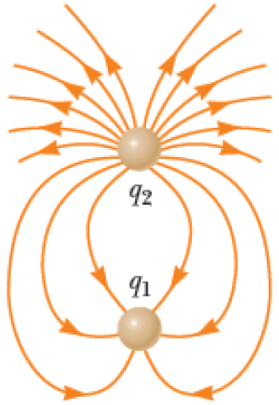
Consider the situation shown in figure. What are the signs of q1 and q2? If the lines are drawn in proportion to the charge, what is the ratio $\frac{\text{q}_1}{\text{q}_2}?$

A person standing on a platform finds that a train moving with velocity 0.6c takes one second to pass by him. Find:
  1. The length of the train as seen by the person and.
  2. The rest length of the train.