Question
Explain the phenomenon of resonance giving examples.

Answer

When the frequency of the forced vibration is equal to the natural frequency of a body nearby or an integer multiple of it then the body vibrates with a large amplitude. This phenomenon is called resonance.
E.g.1 all stringed instruments are provided with sound box (or sound chamber). This box is so constructed that the column of of air inside it, has a natural frequency which is the same as that of the strings stretched on it, so that when the strings are made to vibrate, the air column inside the box is set to forced vibrations. Since the sound box has a large area, it sets a large volume of air into vibration of the same frequency as that of the string. So, due to resonance, a loud sound is produced.
E.g.2 Radio and TV receivers have electronic circuits which produce electrical vibrations, the frequency of which can be changed by changing the values of the electrical components of that circuit. When we want to tune a radio or TV receiver, we merely adjust the values of the electronic components to produce vibrations of frequency equal to that of the incoming radio waves which we want to receive. When the two frequencies match, due to resonance, the energy or signal of that particular frequency is received from the incoming waves. The signal is then amplified in the receiver set.
Need a full question paper?

Generate a complete, print-ready paper with questions like this in minutes — across 16+ boards, with answer keys.

Start Generating Free

Similar questions

What is an ohmic resistor? Give one example of an ohmic resistor. Draw a graph to show its current voltage relationship. How is the resistance of the resistor determined from this graph?
What is the form of that graph between
(i) $K.E.$ and velocity for a constant mass?
(ii) $K.E.$ and mass for a constant velocity?
Draw diagrams of pulley systems having velocity ratio
(a) six (b) three.
Point out the difference between a convex lens and a concave lens.
Name the three classes of levers and distinguish between them. Give two examples of each class.
Out of the three fuses with current ratings 5A, 10A, 15A, which one is to be connected in a geyser circuit marked 3 kW, 220V? Give reason for your answer.
(i) A mucleus ${ }_2^{ A } X$ emits an alpha particle followed by $\gamma$ emission; thereafter it emits two $\beta$ particles to form $X _3$.
(a) Copy and complete the values of A and Z for $X _3$ :
$\frac{Z}{Z} X \xrightarrow{-a} X_1 \xrightarrow{-y} X_2 \xrightarrow{-28} \underset{\ldots}{\cdots} X_3$
(b) Out of alpha ( $\alpha$ ), beta ( $\beta$ ) and gamma ( $\gamma$ ) radiations -
(i) Which radiation is the most penetrating?
(ii) Which radiations are negatively charged?
(ii) (a) What happens to the atomic number of an element, when it emits :
(i) an alpha particle;
(ii) a beta particle?
(b) Explain why alpha and beta particles are deflected in an electric or a magnetic field but gamma rays are not deflected in such a field.
(iii) A nucleus ${ }_{11} Na ^{24}$ emits a beta particle to change into magnesium ( Mg ).
(a) Write the symbolic equation for the process.
(b) What are numbers 24 and 11 called?
(c) What is the general name of ${ }_{12}^{24} Mg$ with respect to ${ }_{11}^{24} Na$ ?
A lens forms the image of an object placed at a distance of 45 cm from it on a screen placed at a distance 90 cm on other side of it. find:
  1. the focal length of lens,
  2. the magnification of image.
State the medical use of radioactivity.
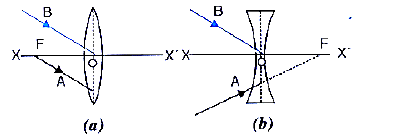
In the diagram below, XX’ represents the principal axis, O the optical centre and F the focus of the lens. Complete the path of rays A and B as they emerge out of the lens.