Question
Explain the preparation of ethers with mech$-$anism by dehydration of alcohols.

Answer

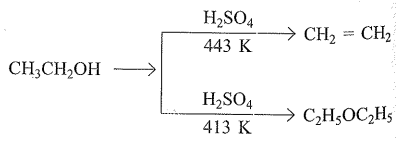
$\rightarrow$ Alcohols undergo dehydration in the presence of protic acids $\ce{(H_2SO_4, H_3PO_4)}.$ The formation of the reaction product, alkene or ether depends on the reaction conditions. For example, ethanol is dehydrated to ethene in the presence of sul$-$phuric acid at $443 K.$ At $413 K,$ ethoxyethane is the main product.
Image
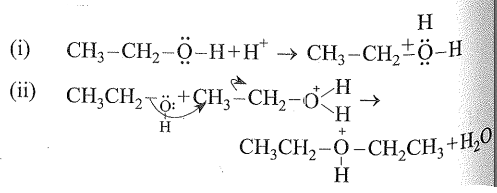
$\rightarrow$ The formation of ether is a nucleophilic bimolecular reaction $(S_N2)$ involving the attack of alcohol molecule on a protonated alcohol, as indicated below:​​​​​​​
Image
$(iii)$​​​​​​​
Image
$\rightarrow$ Acidic dehydration of alcohols, to give an alkene is also associated with substitution reaction to give an ether.

Need a full question paper?

Generate a complete, print-ready paper with questions like this in minutes — across 16+ boards, with answer keys.
Start Generating Free

Similar questions

  1. How would you account for the following:
  1. Actinoid contraction is greater than lanthanoid contraction.
  2. Transition metals form coloured compounds.
  1. Complete the following equation:
$\text{2MnO}_{4}^{-}+\text{6H}^{+}+\text{5NO}_{2}^{-}\rightarrow$
Write a note on molecularity of a reaction and its different types.
Write the $\text{IUPAC}$ name of the ionisation isomer of the coordination compound $\ce{[Co(NH_{3)5}Br]SO_4}$. Give one chemical test to distinguish between the two compounds.
Define the following terms:
  1. Glycosidic linkage.
  2. Invert sugar.
  3. Oligosaccharides.
Write structures of compounds $A, B$ and $C$ in each of the following reactions:
  1. $ \text{C}_6\text{H}_5\text{Br}\xrightarrow{\text{Mg/dry ether}}\text{A}\xrightarrow[(b )\text{ }\text{H}_3\text{O}^+]{(a)\text{ }\text{Co}_{2\text{(g)}}}\text{B}\xrightarrow{\text{PC}l_5}\text{C}$
  2. $ \text{C}\text{H}_3\text{CN}\xrightarrow[(b )\text{ }\text{H}_3\text{O}^+]{(a)\text{ }\text{SnC}l_{2}/\text{HC}l}\text{A}\xrightarrow{\text{dil.NaOH}}\text{B}\xrightarrow{\text{ }\text{ }\text{ }\text{ }\text{ }\triangle\text{ }\text{ }\text{ }\text{ }\text{ }\text{ }\text{ }\text{ }}\text{C}$
Give Uses of aldehydes and ketones
What is organo metallic compound? Explain grignard reagent.
What is spectrochemical series? Explain the difference between a weak field ligand and a strong field ligand.
Write the structures of fragments produced on complete hydrolysis of DNA. How are they linked in DNA molecule? Draw a diagram to show pairing of nucleotide bases in double helix of DNA.
Give the structures of $A$ and $B$ in the following sequence of reactions:
  1. $\text{CH}_3\text{COOH}\xrightarrow[\Delta]{\text{NH}_3\ \ \ }\text{A}\ \ \ \xrightarrow{\text{NaOBr}}\text{B}$
  2. $\text{C}_6\text{H}_5\text{No}_2\xrightarrow{\text{Fe}/ \text{ HCl}}\text{A}\ \ \ \ \ \xrightarrow[0^\circ-5^\circ\text{C}]{\text{NaNo}_2+\text{HCl}}\text{B}$
  3. $\text{C}_6\text{H}_5\text{N}_2^+\text{Cl}^{-}\xrightarrow[\Delta]{\text{CuCN}}\text{A}\ \ \ \ \xrightarrow{\text{H}_2\text{O}/\text{ H}^+}\text{B}$
