Question
Explain the principle and working of an atom bomb?
(ii) This releases a huge amount of energy in a very small time interval and leads to an explosion.
<img src="https://vidyadip.s3.amazonaws.com/question/fDReno8nsIc8665V.png" alt="Image">
Structure:
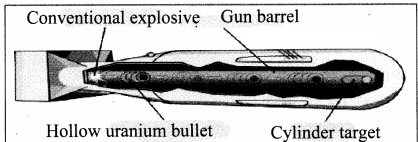
(i) An atom bomb consists of a piece of fissile material whose mass is subcritical. This piece has a cylindrical void.
(ii) It has a cylindrical fissile material which can fit into this void and its mass is also subcritical. When the bomb has to be exploded, this cylinder is injected into the void using a conventional explosive.
(iii) The two pieces of fissile material join to form the supercritical mass, which leads to an explosion. During this explosion, a tremendous amount of energy in the form of heat, light and radiation is released.
(iv) A region of very high temperature and pressure is formed in a fraction of a second along with the emission of hazardous radiation like y rays, which adversely affect the living creatures. This type of atom bombs was exploded in 1945 at Hiroshima and Nagasaki in Japan during World War II.
Generate a complete, print-ready paper with questions like this in minutes — across 16+ boards, with answer keys.