Questions

[4 Mark Questions]

🎯

Test yourself on this topic

5 questions · timed · auto-graded

Question 14 Marks
Write a note about stellar energy.
Answer
The stars like our Sun emit a large amount of energy in the form of light and heat. This energy is termed as the stellar energy. Where does this high energy come from? All-stars contain a large amount of hydrogen. The surface temperature of the stars is very high which is sufficient to induce fusion of the hydrogen nuclei.

Fusion reaction that takes place in the cores of the Sun and other stars results in an enormous amount of energy, which is called as ‘stellar energy’. Thus, nuclear fusion or thermonuclear reaction is the source of light and heat energy in the Sun and other stars.
View full question & answer
Question 24 Marks
Write down the medical and industrial application of radioisotopes?
Answer
1. Radio sodium $\left( Na ^{24}\right)$ is used for the effective functioning of the heart.
2. Radio - lodine $\left( I ^{131}\right)$ is used to cure goitre.
3. Radio - Iron is $\left( Fe ^{59}\right)$ is used to diagnose anaemia and also to provide treatment for the same.
4. Radio Phosphorous $\left( P ^{32}\right)$ is used in the treatment of skin diseases.
5. Radio Cobalt $\left( Co ^{60}\right)$ and radio - gold $\left( Au ^{198}\right)$ are used in the treatment of skin cancer.
6. Radiations are used to sterilize the surgical devices as they can kill the germs and microbes.
7. Radio cobalt $\left( Co ^{60}\right)$ and radio - gold $\left( Au ^{198}\right)$ are used in the treatment of skin cancer.
8. Radiations are used to sterilize the surgical devices as they can kill the germs and microbes.
View full question & answer
Question 34 Marks
Write down the features of nuclear fission and nuclear fusion.
Answer
Nuclear FissionNuclear Fusion
1. The process of breaking up (splitting) of a heavy nucleus into two smaller nuclei is called ‘nuclear fission’.1. Nuclear fusion is the combination of two lighter nuclei to form a heavier nucleus.
2. Can be performed at room temperature.2. Extremely high temperature and pressure are needed.
3. Alpha, beta and gamma radiations are emitted.3. Alpha rays, positrons, and neutrinos are emitted.
4. Fission leads to emission of gamma radiation. This triggers the mutation in the human gene and causes genetic transform diseases.4. Only light and heat energy are emitted.
View full question & answer
Question 44 Marks
State and define the units of radioactivity.
Answer
Curie : It is the traditional unit of radioactivity. It is defined as the quantity of a radioactive substance which undergoes $3.7 \times 10^{10}$ disintegrations in one second. This is actually close to the activity of Ig of radium 226.1 curie $=3.7 \times 10^{10}$ disintegrations per second.

Rutherford (Rd) : It is another unit of radioactivity. It is defined as the quantity of a radioactive substance, which produces $10^6$ disintegrations in one second.
$1 Rd =10^6$ disintegrations per second.
Becquerel $( Bq )$ : It is the $SI$ unit of radioactivity is becquerel. It is defined as the quantity of one disintegration per second.

Roentgen $(R)$ : It is the radiation exposure of $\gamma$ and $x$-rays is measured by another unit called roentgen. One roentgen is defined as the quantity of radioactive substance which produces a charge of $2.58 \times 10^{-4}$ coulomb in $1 kg$ of air under standard conditions of pressure, temperature and humidity.

View full question & answer
Question 54 Marks
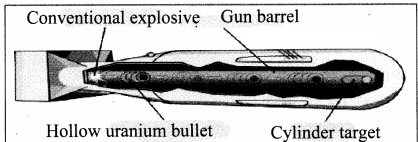
Explain the principle and working of an atom bomb?
Answer
Atom bomb:
(i) The atom bomb is based on the principle of the uncontrolled chain reaction. In an uncontrolled chain reaction, the number of neutrons and the number of fission reactions multiply almost in a geometrical progression.

(ii) This releases a huge amount of energy in a very small time interval and leads to an explosion.

Image

<img src="https://vidyadip.s3.amazonaws.com/question/fDReno8nsIc8665V.png" alt="Image">

Structure:
(i) An atom bomb consists of a piece of fissile material whose mass is subcritical. This piece has a cylindrical void.

(ii) It has a cylindrical fissile material which can fit into this void and its mass is also subcritical. When the bomb has to be exploded, this cylinder is injected into the void using a conventional explosive.

(iii) The two pieces of fissile material join to form the supercritical mass, which leads to an explosion. During this explosion, a tremendous amount of energy in the form of heat, light and radiation is released.

(iv) A region of very high temperature and pressure is formed in a fraction of a second along with the emission of hazardous radiation like y rays, which adversely affect the living creatures. This type of atom bombs was exploded in 1945 at Hiroshima and Nagasaki in Japan during World War II.

View full question & answer
[4 Mark Questions] - Science STD 10 Questions - Vidyadip