Question
Explain the principle, construction, working and application of moving coil galvanometer.

Answer

Image
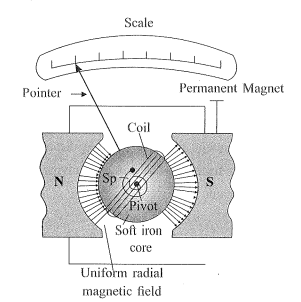
Figure shows a moving coil galvanometer.
• Principle :
A torque is exerted on the current carrying coil placed in uniform magnetic field.
• Construction :
A thin copper wire is wounded on rectangular frame placed between two cylindrical permanent magnets as shown in the figure. The coil is arranged so it can rotate freely.
A small cylinder of soft iron is placed on the axis of the coil, without touching the coil, to produce a uniform radial magnetic field.
When current is passed through the coil a torque acts on it and it deflects. The steady deflection of coil is indicated by a pointer attached with it.
• Working :
When a current flows through the coil, a torque acts on it, causing it to deflect.
If the area vector of the coil makes an angle $\theta$ with the magnetic field, torque acting on coil is
$\tau= NIBA \sin \theta$
Due to the radial magnetic field, the angle between $\overrightarrow{ A }$ and $\overrightarrow{ B }$ will always be $90^{\circ}$.
$\therefore \tau=\text { NIBA }$
Due to the deflection of the coil, the restoring torque is produced in the spring which is directly proportional to the deflection of the coil $(\phi)$
$\therefore$ Restoring torque $\tau^{\prime}=k \phi$
Where, $k=$ torsional constant of the spring.
For steady deflection, from equation (1) \& (2)
$\begin{aligned}
\tau^{\prime} & =\tau \\
k \phi & =\text { NIAB } \\
\therefore \phi & =\left(\frac{ BAN }{k}\right) \cdot I \\
\therefore \phi & \propto I \quad(\because B , A , N , K \text { are constant })
\end{aligned}$
Thus, the deflection of the coil is directly proportional to the current.
Uses : Galvanometer is used to detect the presence of current in the circuit.
To measure small electric currents (of the order $10^{-6} A$ )
Using galvanometer, ammeter and voltmeter can be constructed.

Need a full question paper?

Generate a complete, print-ready paper with questions like this in minutes — across 16+ boards, with answer keys.

Start Generating Free

Similar questions

The specific heat capacities of hydrogen at constant volume and at constant pressure are ${2.4cal-g^{-1} }{^\circ C^{−1}}$ and ${3.4cal-g^{-1} }{^\circ C^{-1}}$ respectively. The molecular weight of hydrogen is $2g-mol^{-1}$ and the gas constant, $R = 8.3 \times 10^7$ erg$^\circ C^{-1}$ mol$^{-1}$. Calculate the value of J.
Obtain expression $\vec{J}=\sigma \vec{E}$ of Ohm's law on the basis of drift velocity.
Define the terms half-life period and decay constant of a radioactive substance. Write their S.I.units. Establish the relationship between the two.
In an experiment on photoelectric effect, the slope of the cut-off voltage versus frequency of incident light is found to be $4.12 \times 10^{–15}$ Vs. Calculate the value of Planck’s constant.
A long cylindrical wire of radius b carries a current i distributed uniformly over its cross-section. Find the magnitude of the magnetic field at a point inside the wire at a distance a from the axis.
A long, straight wire of radius r carries a current i and is placed horizontally in a uniform magnetic field B pointing vertically upward. The current is uniformly distributed over its cross-section.
  1. At what points will the resultant magnetic field have maximum magnitude? What will be the maximum magnitude?
  2. What will be the minimum magnitude of the resultant magnetic field?
Which wavelengths will be emitted by a sample of atomic hydrogen gas (in ground state) if electrons of energy 12.2eV collide with the atoms of the gas?
The near point and the far point of a child are at 10cm and 100cm. If the retina is 2.0cm behind the eye-lens, what is the range of the power of the eye-lens?
Figure, shows an aluminium wire of length 60cm joined to a steel wire of length 80cm and stretched between two fixed supports. The tension produced is 40N. The cross-sectional area of the steel wire is $1.0mm^2$ and that of the aluminium wire is $3.0 mm^2$. What could be the minimum frequency of a tuning fork which can produce standing waves in the system with the joint as a node? The density of aluminium is $2.6g/cm^3$ and that of steel is $7.8g/cm^3.$​​​​​​​
An electromagnetic wave of wavelength λ is incident on a photosensitive surface of negligible work function. If the photo-electrons emitted from this surface have the de-Broglie wavelength $\lambda_{1}$, prove that $\lambda = \begin{pmatrix} 2 \text{mc} \\ h \end{pmatrix}\lambda^{2}_{1}$.