Questions

3 Marks Question

Take a timed test

5 questions · self-marked practice — reveal the answer and mark yourself.

Question 13 Marks
Explain the principle, construction, working and application of moving coil galvanometer.
Answer
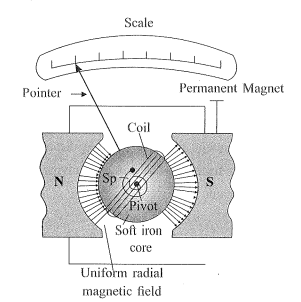
Image
Figure shows a moving coil galvanometer.
• Principle :
A torque is exerted on the current carrying coil placed in uniform magnetic field.
• Construction :
A thin copper wire is wounded on rectangular frame placed between two cylindrical permanent magnets as shown in the figure. The coil is arranged so it can rotate freely.
A small cylinder of soft iron is placed on the axis of the coil, without touching the coil, to produce a uniform radial magnetic field.
When current is passed through the coil a torque acts on it and it deflects. The steady deflection of coil is indicated by a pointer attached with it.
• Working :
When a current flows through the coil, a torque acts on it, causing it to deflect.
If the area vector of the coil makes an angle $\theta$ with the magnetic field, torque acting on coil is
$\tau= NIBA \sin \theta$
Due to the radial magnetic field, the angle between $\overrightarrow{ A }$ and $\overrightarrow{ B }$ will always be $90^{\circ}$.
$\therefore \tau=\text { NIBA }$
Due to the deflection of the coil, the restoring torque is produced in the spring which is directly proportional to the deflection of the coil $(\phi)$
$\therefore$ Restoring torque $\tau^{\prime}=k \phi$
Where, $k=$ torsional constant of the spring.
For steady deflection, from equation (1) \& (2)
$\begin{aligned}
\tau^{\prime} & =\tau \\
k \phi & =\text { NIAB } \\
\therefore \phi & =\left(\frac{ BAN }{k}\right) \cdot I \\
\therefore \phi & \propto I \quad(\because B , A , N , K \text { are constant })
\end{aligned}$
Thus, the deflection of the coil is directly proportional to the current.
Uses : Galvanometer is used to detect the presence of current in the circuit.
To measure small electric currents (of the order $10^{-6} A$ )
Using galvanometer, ammeter and voltmeter can be constructed.
View full question & answer
Question 23 Marks
Derive the equation for the torque acting on a current carrying loop placed at an angle $\theta$ with uniform magnetic field $(\vec{B})$.
Answer
Image
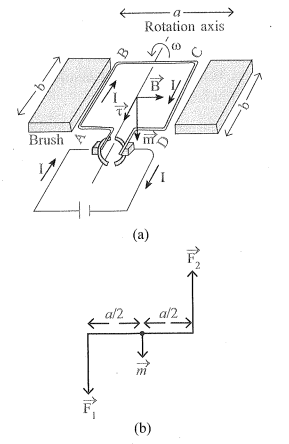
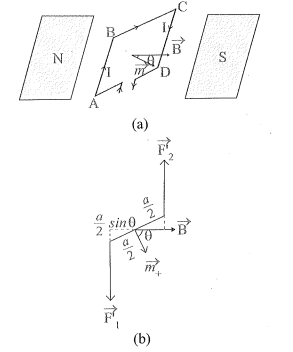
→As shown in the figure (a), the coil is placed in such a way that the magnetic field marks an angle $\theta$ with normal to the coil.
→The current passing through the coil is I. The length and width of the coil are $a$ and $b$ respectively.
→The force on the arm BC of the coil due to the current is $F _1= I a B \cos \theta$ and the force on the $\operatorname{arm} AD$ is $F _2= I a B \cos \theta$.
→Since, both these forces are equal, opposite and act along the axis of the coil, the resultant force and torque is zero.
→Similarly, the force acting perpendicular to the side AB and CD of the coil is $F _1{ }^{\prime}= F _2{ }^{\prime}= I b B$ respectively.
→Since, these two forces are equal in magnitude and opposite to each other the net force is zero. But they are non collinear, they form a couple, so a torque is exerted on the coil.
→From the figure (b) the torque acting on the coil.
$\begin{aligned}
\tau & =\left( F _1{ }^{\prime}\right) \frac{a}{2} \sin \theta+\left( F _2{ }^{\prime}\right)\left(\frac{a}{2}\right) \sin \theta \\
\therefore \tau & = I b B\left(\frac{a}{2}\right) \sin \theta+ I b B\left(\frac{a}{2}\right) \sin \theta \\
\therefore \quad \tau & =2 I b B \frac{a}{2} \sin \theta \\
\therefore \tau & = IB (a b) \sin \theta
\end{aligned}$
But $a b= A$ is the area of the rectangle.
$\therefore \tau= IAB \sin \theta$
→Vector form, $\vec{\tau}=I \vec{A} \times \vec{B}$
→But the magnetic dipole moment $\vec{m}= I \overrightarrow{ A }$
→The direction of the magnetic dipole moment is in the direction of area vector.
→Thus, torque acting on the coil $\vec{\tau}=\vec{m} \times \overrightarrow{ B } \ldots$
→If there are N turns in the coil then the torque is $\tau= NIAB \sin \theta$
Where, NIA $=m$ (magnetic moment)
View full question & answer
Question 33 Marks
Derive the equation for the torque acting on current-carrying coil place in uniform magnetic ficld $\overrightarrow{ B }$.
Answer
Image


Figure shows a rectangular coil ABCD is placed in a uniform magnetic field in such a way that its plane lies in the magnetic field.
The current passing through the coil is I . The length and width of the coil are $a$ and $b$ respectively.
The field exerts no force on the two arms AD and BC of the loop. (Because the field is parallel to the currents through these two arms.)
Suppose a force $\overrightarrow{F_1}$ is applied perpendicularly to the $\operatorname{arm} AB$ of the coil, which is directed into the plane of the loop. Its magnitude is $F _1{ }^{\prime}=I b B$
Similarly, it exerts a force $\overrightarrow{ F _2^{\prime}}$ on the arm CD and it is directed out of the plane of the paper. Its magnitude is $F _2{ }^{\prime}= I b B$
Both these forces $\vec{F}_1^{\prime}$ and $\overrightarrow{ F _2^{\prime}}$ are equal in magnitude and opposite in direction, so the net force is zero.
But, these two forces are not collinear so they form a couple, causing a torque on the loop. This torque causes the coil to rotate.
Torque acting on the coil,
$\begin{aligned}
\tau & = F _1{ }^{\prime}\left(\frac{a}{2}\right)+ F _2{ }^{\prime}\left(\frac{a}{2}\right) \\
\therefore \tau & = I b B\left(\frac{a}{2}\right)+ I b B\left(\frac{a}{2}\right) \\
\therefore \tau & =2 I b B \frac{a}{2} \\
\therefore \quad \tau & = I (a b) B \\
\therefore \quad \tau & = IAB
\end{aligned}$
Where, $A =a b$ is a area of the rectangle.
View full question & answer
Question 43 Marks
Derive the formula for the force acting on current carrying rod placed in a magnetic field.
Answer
Image
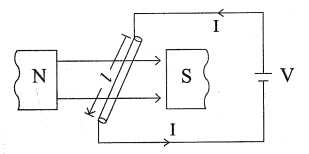
As shown in figure, consider a uniform conducting rod of length $l$ and cross-sectional area A.
Suppose the number density of mobile charge carriers (moving charges) in conductor is $n$. Hence, the total number of (free) electric charges will be $n A l$.
In this conduction rod, a steady current is I and the drift velocity of electron is $\overrightarrow{v_d}$. In the presence of an external magnetic field $\vec{B}$ The force on these carriers is
$\overrightarrow{ F }=(n l A) q\left(\overrightarrow{v_d} \times \overrightarrow{ B }\right)$
Where, $q\left(\overrightarrow{v_d} \times \vec{B}\right)$ is magnetic force acting on one particle.
But, electric current density
$\therefore \vec{j}=n q \overrightarrow{v_d}$
From, equation (1) and (2)
$\overrightarrow{ F }=\vec{j} l A \times \overrightarrow{ B }$
Hence, current density $\hat{j}$ and length $l$ both are in the same direction.
So, $\vec{j} l=\vec{l} j$
So, the equation becomes
$\overrightarrow{ F }=j \vec{l} A \times \overrightarrow{ B }$
But $I =j A$
$\therefore \overrightarrow{ F }= I (\vec{l} \times \overrightarrow{ B })$
Where, $\vec{l}$ is a vector magnitude of $l$ and it is in the direction of the current I .
Here equation (3) is only applicable for a straight rod. In this equation $\vec{B}$ is the external magnetic field. It is not the magnetic field which is produced by the current carrying rod.
If the wire has an arbitrary shape, we consider the wire is made up of rubber & linear strips of $d l$ and by summing up the force.
$\overrightarrow{ F }=\sum_j I d \vec{l}_j \times \overrightarrow{ B }$
If $d l \rightarrow 0$, then it is converted in to an integral.
$\overrightarrow{ F }=\int I d \vec{l} \times \overrightarrow{ B }$
• Special Cases :
(i) If $\theta=0$ or $\theta=\pi$ then
$F = Bl l \sin \theta=0$
because, $\sin 0=\sin \pi=0$
Thus, if the current is parallel or antiparallel to the external magnetic field, the magnetic force on the conductor is zero.
(ii) If $\theta=\frac{\pi}{2}$ then, $F = BI l \sin \theta= BI l$ because, $\sin \frac{\pi}{2}=+1$
Thus, if the current and the external magnetic field are mutually perpendicular, the magnetic force on the conductor is maximum.
→Note :
Image
The magnetic force exerted on a current-carrying wire placed in a uniform magnetic field.
$\overrightarrow{ F }= I \vec{l} \times \overrightarrow{ B }$
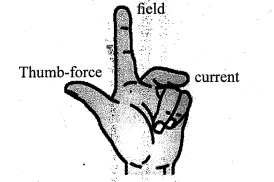
The direction of this force can be obtained using Fleming's left hand rule.
"As shown in the diagram, the first finger of the left hand is placedin the direction of the magnetic field and the middle finger in the direction of the current, the direction of the thumb represents the direction of magnetic force."
View full question & answer
Question 53 Marks
Explain Lorentz force and state its characteristics.
Answer
Suppose a point charge $q$ moving with a velocity $\vec{v}$ in presence of the electric field $\overrightarrow{ E }(\vec{r})$ and the magnetic field $\overrightarrow{ B }(\vec{r})$.
Force on charge $q$ due to the electric and magnetic field.
$\begin{aligned}
\overrightarrow{ F } & =q[\overrightarrow{ E }(r)+(\vec{v} \times \overrightarrow{ B }(\vec{r}))] \\
\therefore \quad \overrightarrow{ F } & =q \overrightarrow{ E }(\vec{r})+q \times \times \overrightarrow{ B })
\end{aligned}$
[Here $\overrightarrow{ B }(r)=\overrightarrow{ B }$ ]
Electric force $\overrightarrow{ F }_{\text {electric }}=q \cdot \overrightarrow{ E }(\vec{r})$
Magnetic force $\overrightarrow{ F }$. magnetic $=q(\overrightarrow{ v } \times \overrightarrow{ B })$
$\therefore \overrightarrow{ F }=\overrightarrow{ F }_{\text {electric }}+\overrightarrow{ F }_{\text {magnetic }}$
The combination of electric and magnetic force here is known as Lorentz force.
• Characteristics :
(1) The Lorentz force depends on charge ( $q$ ), velocity ( $\vec{v}$ ) and the magnetic field $(\vec{B})$. Force on negative charge is opposite to that on a positive charge.
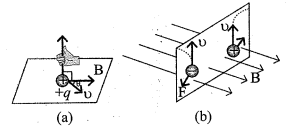
(2) The direction of magnetic force $\vec{F}_m=q(\vec{v} \times$ $\vec{B}$ ) can be found using right hand screw rule.
Image
(3) If velocity $\vec{v}$ and the magnetic field $\vec{B}$ are parallel $(\theta=0)$ anti parallel $\left(\theta=180^{\circ}, \pi\right)$ to each other, the force becomes zero.
The magnetic force is maximum when the velocity $\vec{v}$ and the magnetic field $\vec{B}$ are perpendicular to each other.
(4) If charge is not moving i.e. the charge is stationary. then $\vec{v}=0$ hence the magnetic force is zero.
View full question & answer