Question
Explain the principle, construction, working and application of moving coil galvanometer.
Answer

Image
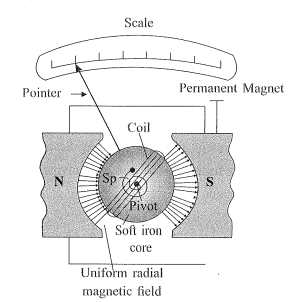
Figure shows a moving coil galvanometer.
• Principle :
A torque is exerted on the current carrying coil placed in uniform magnetic field.
• Construction :
A thin copper wire is wounded on rectangular frame placed between two cylindrical permanent magnets as shown in the figure. The coil is arranged so it can rotate freely.
A small cylinder of soft iron is placed on the axis of the coil, without touching the coil, to produce a uniform radial magnetic field.
When current is passed through the coil a torque acts on it and it deflects. The steady deflection of coil is indicated by a pointer attached with it.
• Working :
When a current flows through the coil, a torque acts on it, causing it to deflect.
If the area vector of the coil makes an angle $\theta$ with the magnetic field, torque acting on coil is
$\tau= NIBA \sin \theta$
Due to the radial magnetic field, the angle between $\overrightarrow{ A }$ and $\overrightarrow{ B }$ will always be $90^{\circ}$.
$\therefore \tau=\text { NIBA }$
Due to the deflection of the coil, the restoring torque is produced in the spring which is directly proportional to the deflection of the coil $(\phi)$
$\therefore$ Restoring torque $\tau^{\prime}=k \phi$
Where, $k=$ torsional constant of the spring.
For steady deflection, from equation (1) \& (2)
$\begin{aligned}
\tau^{\prime} & =\tau \\
k \phi & =\text { NIAB } \\
\therefore \phi & =\left(\frac{ BAN }{k}\right) \cdot I \\
\therefore \phi & \propto I \quad(\because B , A , N , K \text { are constant })
\end{aligned}$
Thus, the deflection of the coil is directly proportional to the current.
Uses : Galvanometer is used to detect the presence of current in the circuit.
To measure small electric currents (of the order $10^{-6} A$ )
Using galvanometer, ammeter and voltmeter can be constructed.

Need a full question paper?

Generate a complete, print-ready paper with questions like this in minutes — across 16+ boards, with answer keys.

Start Generating Free

Similar questions

  1. Using the phenomenon of polarisation, show how transverse nature of light can be demonstrated.
  2. Two polaroids P1 and P2 are placed with their pass axes perpendicular to each other. Unpolarised light of intensity Io is incident on P1. A third polaroid P3 is kept in between P1 and P2 such that its pass axis makes an angle of 300 with that of P1. Determine the intensity of light transmitted through P1, P2 and P3.
  1. Calculate the equivalent resistance of the given electrical network between points A and B.
  2. Also calculate the current through CD and ACB, if a 10 V d.c. source is connected between A and B, and the value of R is assumed as 2 Ω.

In a Coolidge tube, electrons strike the target and stop inside it. Does the target get more and more negatively charged as time passes?
Define half-life of a radioactive sample. Which of the following radiations: $\alpha-$rays, $\beta-$rays and $\gamma-$rays.
  1. Are similar to X-rays.
  2. Are easily absorbed by matter.
  3. Travel with the greatest speed.
  4. Are similar in nature to cathode rays?
  1. What is linearly polarized light? Describe briefly using a diagram how sunlight is polarised.
  2. Unpolarised light is incident on a polaroid. How would the intensity of transmitted light change when the polaroid is rotated?
Three particles, each of mass 200g, are kept at the corners of an equilateral triangle of side 10cm. Find the moment of inertia of the system about an axis:
  1. Joining two of the particles.
  2. Passing through one of the particles and perpendicular to the plane of the particles.
The length of a rod is exactly 1m when measured at rest. What will be its length when it moves at a speed of:
  1. 3 × 10⁵m/s.
  2. 3 × 10⁶m/s.
  3. 3 × 10⁷m/s.
Define the term 'resolving power' of an astronomical telescope. How does it get affected on?

  1. Increasing the aperture of the objective lens?
  2. Increasing the wavelength of the light used?

Justify your answer in each case.

A uniform square plate of mass 2.0kg and edge 10cm rotates about one of its diagonals under the action of a constant torque of 0.10N-m. Calculate the angular momentum and the kinetic energy of the plate at the end of the fifth second after the start.
Two harmonic waves of monochromatic light

$\text{y}_{1} = \text{a} \cos\omega\text{t}\text{ and } \text{y}_{2} = \text{a} \cos(\omega\text{t} + \Phi)$

are superimposed on each other. Show that maximum intensity in interference pattern is four times the intensity due to each slit. Hence write the conditions for constructive and destructive interference in terms of the phase angle$\Phi$.