Question
Explain the process of fertilisation in human female, and trace the postfertilisation events in a sequential order up to implantation of the embryo.
OR
Explain the process of fertilisation and implantation in humans.
Answer

Fertilisation:
  • The process of fusion of a sperm (male gamete) with an ovum (female gamete) is called fertilisation.
  • During coitus, semen is released by the penis into the vagina (insemination).
  • The motile sperms swim rapidly through the cervix, enter into the uterus and reach the ampullary – isthmic junction of the oviduct.
  • A sperm comes in contact with the zona pellucida layer of the ovum and induces changes in the membrane to block the entry of additional sperms.
  • The enzymes of the acrosome of sperm help to dissolve zona pellucida and plasma membrane of the ovum and sperm head is allowed to enter into the cytoplasm of the ovum, i.e., secondary oocyte.
  • Ultimately diploid zygote is produced by the fusion of a sperm and an ovum.
Implantation:
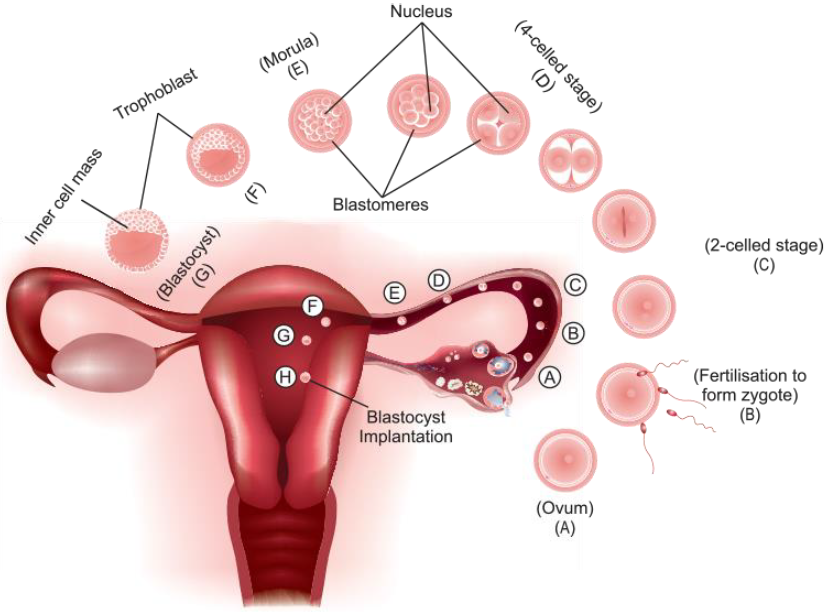
  • Zygote divides rapidly by mitotic division as it moves through isthmus of oviduct towards uterus. This is called cleavage. As a result 2, 4, 8, 16 daughter cells are produced which are termed as blastomeres.
  • Embryo with 8–16 blastomeres is called a morula.
  • The morula continues to divide and transforms into a large mass of cells called blastocyst, which passes further into the uterus.
  • Blastomeres in the blastocyst are arranged into an outer layer called trophoblast and an inner group of cells attached to trophoblast called inner cell mass.
  • Transport of ovum, fertilisation and passage of growing embryo through fallopian tube.
  • The trophoblast layer gets attached to the cells of the endometrium and the inner cell mass gives rise to the embryo.
  • After attachement, the cells of endometrium divide rapidly and cover the blastocyst.
  • So, the blastocyst gets embedded in the endometrium of the uterus. This is called implantation, which leads to pregnancy.

Need a full question paper?

Generate a complete, print-ready paper with questions like this in minutes — across 16+ boards, with answer keys.

Start Generating Free

Similar questions

What initiatives were taken for reducing vehicular air pollution in Delhi? Has air quality improved in Delhi?
  1. How is artificial hybridisation considered a crop improvement programme?
  2. Explain the process of artificial hybridisation, if
  1. Female parent bears bisexual flowers.
  2. Female parent bears unisexual flowers.
What do you understand by the evidences of Evolutions describe in detail with suitable example the three evidences of evolution?
Describe the functions of the following:
Vas deferens.
Work out a monohybrid cross upto F, generation, between two pea plants and two Antirrhinum plants, both having contrasting traits with respect to colour of flower. Comment on the patterns of inheritance in the crosses carried above.
A true breeding homozygous pea plant with green pods and axial flowers as dominant characters, is crossed with a recessive homozygous pea plant with yellow pods and terminal flowers. Work out the cross up to $F_2$ generation giving the phenotypic ratios of $F_1$ and $F_2$ generation respectively.
Enlist the salient features of the double helix structure of DNA.
Describe the events of spermatogenesis with the help of a schematic representation.
  1. Draw a simplified model of phosphorus cycling in a terrestrial ecosystem.
  2. Write the importance of such cycles in ecosystems.
  1. How is mature insulin different from proinsulin secreted by pancreas in humans?
  2. Explain how was human functional insulin produced using rDNA technology.
  3. Why is the functional insulin thus produced considered better than the ones used earlier by diabetic patients?