Question
Explain the process of nutrition in Amoeba.

Answer

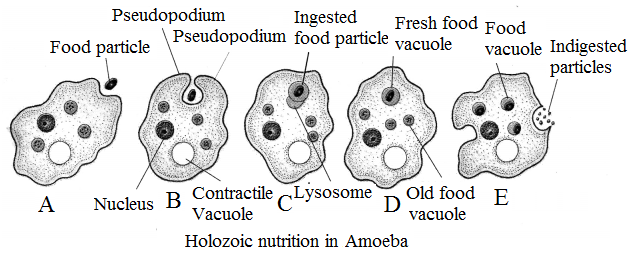
  1. Ingestion: (L. ingestus - taken in). It is taking in of solid food with the help of temporary or permanent mouth. Amoeba can ingest food particles from any point on its surface. Paramoecium (another unicellular organism) has fixed point for the same. Amoeba captures food with the help of temporary finger-like processes called pseudopodia. Paramoecium has small hair-like processes called cilia. Beating of cilia creates current in water that pushes food particle through cytostome or cell mouth. The process of ingestion of solid food particle by a cell or unicellular organism is called phagocytosis.
As soon as Amoeba comes in contact with a food particle or prey, it throws pseudopodia all around the same. The tips of encircling pseudopodia fuse and the prey comes to lie in a vesicle or phagosome.
  1. Digestion: It is conversion of complex insoluble food ingredients into simple absorbable form. Digestion can be intracellular or intercellular. Intercellular digestion occurs in a digestive tract. Intracellular digestion takes place in the cytoplasm of cells. Here, a lysosome fuses with phagosome to produce a food vacuole, also called gastriole or temporary stomach. Reaction of food vacuole is acidic at first and alkaline later on. Digestion of food occurs with the help of digestive enzymes brought by lysosome. It changes complex insoluble substances of food into simpler absorbable substances.
  2. Absorption: The digested simple and soluble substances pass out of food vacuole into the surrounding cytoplasm.
  3. The absorbed food materials are converted into various constituents of protoplasm including food reserve.
  4. (L. egestus - discharge): It is throwing of undigested components of food out of the body. In Amoeba, the old food vacuole with heavier undigested material reaches the rear end, passes to the surface, fuses with surface membrane and throws out the undigested materials. The process is called egestion. Paramoecium has a definite cytopyge or cell anus.

Need a full question paper?

Generate a complete, print-ready paper with questions like this in minutes — across 16+ boards, with answer keys.

Start Generating Free

Similar questions

Give reason for the following:
a. During reproduction inheritance of different proteins will lead to altered body designs.
b. Fertilization cannot take place in flowers if pollination does not occur.
c. All multicellular organisins cannot give rise to new individuals through fragmentation or regeneration.
d. Vegetative propagation is practised for growing only some type of plants.
e. The parents and off-springs of organisms reproducing sexually have the same number of chromosomes.
  1. Give an example of a metal which:
  1. Is a liquid at room temperature.
  2. Is kept immersed in kerosene for storing.
  3. Is both malleable and ductile.
  4. Is the best conductor of heat.
  1. Name the process of obtaining a pure metal from an impure metal through electrolysis. Suppose you have to refine copper using this process, then explain mentioning inwith the help of a labelled diagram the process of purification, brief the materials used as (i) anode, (ii) cathode and (iii) electrolyte.
The liquid connective tissue A circulates in our body continuously without stopping. This tissue contains a pigment B which imparts it a colour C. The tissue A consists of four components D, E, F and G. The component D fights infection and protects us from diseases. The component E helps in the clotting of tissue A if a person gets a cut. The component F is a liquid which consists mainly of water with many substances dissolved in it and component G carries oxygen from the lungs to all the parts of the body.
  1. What is (i) tissue A, (ii) pigment B and (iii) colour C?
  2. Name (i) D, (ii) E, (iii) F and (iv) G.
  3. Name one substance (other than oxygen) which is transported by tissue A in the human body.
  4. Which two components of tissue A are the cells without nucleus?
  5. Name any two organisms (animals) which do not have liquid like A in their body.
Name the raw materials required for photosynthesis. How do plants obtain these raw materials?
When the branches of a plant growing in the field are pulled towards the ground and a part of them is covered with moist soil (leaving the tips of the branches exposed above the ground), then after some time new roots develop from the parts of branches buried in the soil. On cutting these branches from the parent plant, new plants are produced from the cut parts of branches which had developed roots.
  1. What is this method of propagation of plants known as?
  2. What type of branches should a plant have to be able to be propagated by this method?
  3. Name any two plants which are grown for their flowers and propagated by this method.
  4. Name any two plants which are grown for their fruits and propagated by this method.
  5. Name one plant which gets propagated by this method naturally by forming runners (soft horizontal stems running above the ground).
What are the limitations in obtaining energy from wind?
i. Name the mode of reproduction of the following organisms and state the important feature of each mode:
a. Planaria
b. Hydra
c. Rhizopus
ii. We can develop new plants from the leaves of Bryophyllum. Comment.
iii. List two advantages of vegetative propagation over other modes of reproduction.
A metal X forms a water soluble salt $XNO _3$. When an aqueous solution of $XNO _3$ is added to common salt solution, then a white precipitate of compound $Y$ is formed alongwith sodium nitrate solution. Metal $X$ is said to be the best conductor of electricity and it does not evolve hydrogen when put in dilute hydrohloric acid.
a. What is metal X ?
b. What is salt $XNO _3$ ?
c. Name the compound Y .
d. Write the chemical equation of the reaction which takes place on reacting $XNO _3$ solution and common salt solution giving the physical states of all the reactants and products.
e. What type of chemical reaction is illustrated by the above equation?
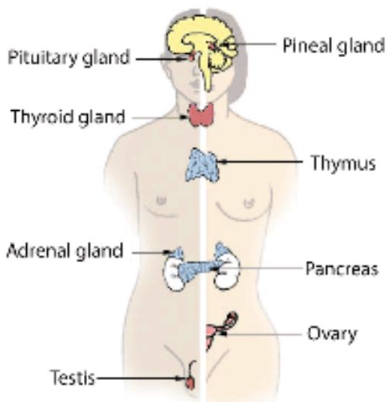
Given below is a diagram of the human endocrine system.
Image
Using the given diagram, answer the following questions:
i. How pituitary gland regulates the growth of the body?
ii. Which hormone is responsible for the carbohydrate, protein, and fat metabolism in the body?
iii. Which pair of glands prepare the body to deal with emergency situations?
iv. Which gland secretes insulin and what does it do in the body?
v. What is the function of endocrine glands?
What happens when an iron strip is put into separate beakers containing aqueous solutions of copper sulphate and zinc sulphate? Where is iron placed in the activity series with respect to copper and zinc? Describe the steps involved in the extraction of zinc from its sulphide and carbonate ores. Support your answer with balanced chemical equation for the chemical reactions involved in the process.