Questions

[5 marks Questions]

🎯

Test yourself on this topic

12 questions · timed · auto-graded

Question 15 Marks
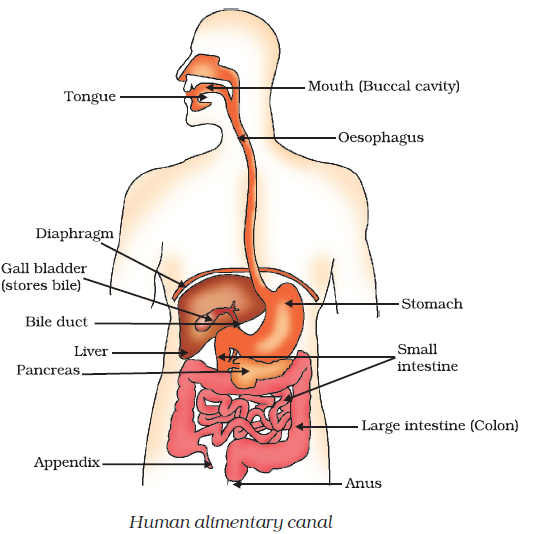
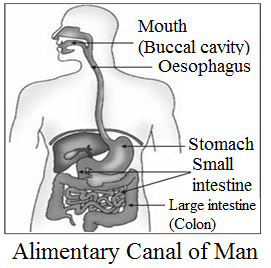
Draw the diagram of alimentary canal of man and label the following parts.Mouth, Oesophagus, Stomach, Intestine.
Answer
The diagram of alimentary canal of man and its parts are shown below:
View full question & answer
Question 25 Marks
Differentiate between an autotroph and a heterotroph.
Answer
  Autotroph Heterotroph
1. Food: It manufactures its own food. It obtains its food from outside source.
2. Chlorophyll: It has chlorophyll for performing photosynthesis. Chlorophyll is absent.
3. Energy: It is obtained from sunlight and changed into chemical energy. It does not require an external source of energy as the same is present in food obtained from outside.
4. Digestion: It is absent. Food obtained from outside is digested before being absorbed and assimilated.
View full question & answer
Question 35 Marks
How do carbohydrates, proteins and fats get digested in human beings?
Answer
Digestion of carbohydrates: Digestion of carbohydrates begins from buccal cavity. Salivary amylase converts starch into sugar. Other complex carbohydrates are converted into glucose in the small intestine.
Digestion of Proteins: Protein is partially digested in the stomach. For this, stomach secretes the enzyme pepsin. In small intestine, pancreatic juice provides the enzymes trypsin and chymotrypsin. These enzymes complete the digestion of proteins.
Digestion of Fats: Digestion of fats takes place in small intestine. Bile; from liver; emulsifies the fat. Due to this, fat is broken into small globules. This makes it easier for the enzyme to digest fat. Lipase is the enzyme which converts fat into glycerol and fatty acid.
View full question & answer
Question 45 Marks
Describe the flow of blood through the heart of human beings.
Answer
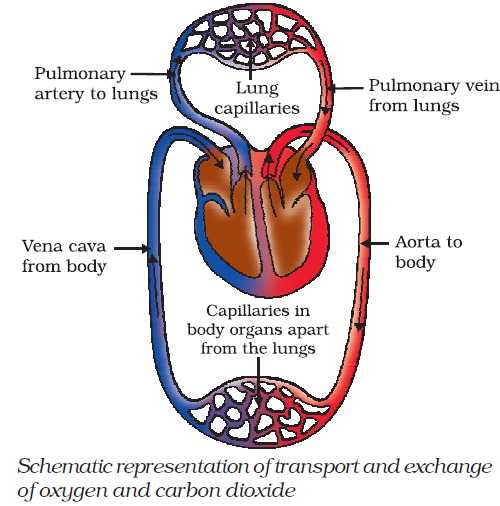
Human heart has four completely separated chambers which allow two completely separated circuits of oxygenated and deoxygenated blood; hence the name, double circulation.
The pulmonary circuit includes flow of blood through heart-lung-heart while systemic circuit includes heart-rest of the body-heart. This ensures that left side of heart receives and pumps only oxygenated blood while the right side receives and pumps only deoxygenated blood.
Two pulmonary veins come from each lung and pass $O_2$-rich blood to left atrium. The left ventricle pumps blood into the aorta which in turn branches and delivers blood to the major body regions and organs. The anterior vena cava collects deoxygenated blood from the head, chest, and arms and enters the right atrium while the inferior vena cava collects blood from the lower body regions. Both venae cavae pass the deoxygenated blood to the right atrium. Blood from right atrium enters right ventricle and pulmonary arteries carry deoxygenated blood from right ventricle to lungs for oxygenation.
View full question & answer
Question 55 Marks
Explain the process of nutrition in Amoeba.
Answer
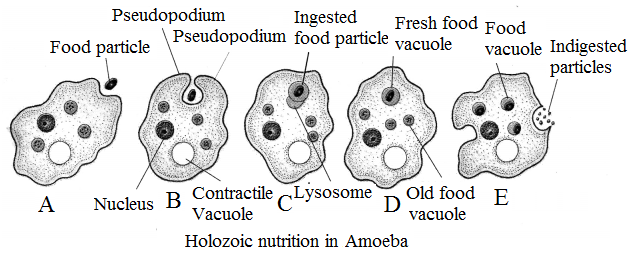
  1. Ingestion: (L. ingestus - taken in). It is taking in of solid food with the help of temporary or permanent mouth. Amoeba can ingest food particles from any point on its surface. Paramoecium (another unicellular organism) has fixed point for the same. Amoeba captures food with the help of temporary finger-like processes called pseudopodia. Paramoecium has small hair-like processes called cilia. Beating of cilia creates current in water that pushes food particle through cytostome or cell mouth. The process of ingestion of solid food particle by a cell or unicellular organism is called phagocytosis.
As soon as Amoeba comes in contact with a food particle or prey, it throws pseudopodia all around the same. The tips of encircling pseudopodia fuse and the prey comes to lie in a vesicle or phagosome.
  1. Digestion: It is conversion of complex insoluble food ingredients into simple absorbable form. Digestion can be intracellular or intercellular. Intercellular digestion occurs in a digestive tract. Intracellular digestion takes place in the cytoplasm of cells. Here, a lysosome fuses with phagosome to produce a food vacuole, also called gastriole or temporary stomach. Reaction of food vacuole is acidic at first and alkaline later on. Digestion of food occurs with the help of digestive enzymes brought by lysosome. It changes complex insoluble substances of food into simpler absorbable substances.
  2. Absorption: The digested simple and soluble substances pass out of food vacuole into the surrounding cytoplasm.
  3. The absorbed food materials are converted into various constituents of protoplasm including food reserve.
  4. (L. egestus - discharge): It is throwing of undigested components of food out of the body. In Amoeba, the old food vacuole with heavier undigested material reaches the rear end, passes to the surface, fuses with surface membrane and throws out the undigested materials. The process is called egestion. Paramoecium has a definite cytopyge or cell anus.
View full question & answer
Question 65 Marks
Differentiate between an artery and a vein.
Answer
 
Artery
Vein
1.
Direction of Flow: It carries blood from heart to an organ.
It brings blood from an organ towards the heart.
2.
Speed: Blood flow is rapid in artery.
Blood flow is slow in vein.
3.
Jerks: Blood flows with jerks.
Blood flows smoothly.
4.
Pressure: Blood flows under pressure.
There is little pressure.
5.
Internal Valves: They are absent.
Internal valves are present to prevent back flow.
6.
Wall: It is thick and elastic.
It is comparatively thinner and little elastic.
7.
Lumen: Narrow.
Wide.
8.
Type of Blood: Artery carries oxygenated blood except pulmonary arteries.
Vein carries deoxygenated blood except pulmonary veins.
9.
Occurrence: It is deep seated.
It is superficial.
10.
Collapsibility: Artery is not collapsible.
Vein is collapsible.
11.
Blood After Death: It does not contain blood after death.
Vein is full of blood even after death.
View full question & answer
Question 75 Marks
Explain the process of breathing in man.
Answer
Breathing or the process of taking in fresh air and releasing foul air can be easily observed because thorax shows alternate expansion and contraction. It is involuntary though it can be prevented for a brief period. Rate of breathing is controlled by respiratory centre of brain. Expansion of thorax causes fresh air to be drawn in. Contraction of thorax causes foul air to be expelled. Therefore, breathing consists of two steps, inspiration and expiration.
  1. Inspiration or Inhalation: It is bringing of fresh air into lungs for exchange of gases. During inhalation, thoracic cavity enlarges due to two types of inspiratory muscles, phrenic and external intercostals. Phrenic muscles straighten the diaphragm by moving its curved part downwards. It increases length of thorax. Contraction of external intercostal muscles pushes the rib cage in outward and upward direction. It increases girth of thorax. Being air tight, increase in size of thoracic cavity causes expansion of lungs. It decreases air pressure in the lungs. As a result outside air rushes into lungs through external nostrils, nasal cavities, internal nostrils, pharynx, larynx, trachea, bronchi, bronchioles to alveoli. While passing through respiratory tract, the incoming air is:
  • Filtered by hair present in anterior part of nasal cavities.
  • Cleansed of dust and microbes throughout respiratory tract by lysozyme, mucus and cilia.
  • Air conditioned (bringing temperature of inhaled air to that of body) with the help of blood capillaries present below nasal epithelium.
  • Moistened by water vapours from wet epithelium.
  1. Exchange of Gases: It occurs in the alveoli. Fresh air has high concentration of oxygen and a very low concentration of carbon dioxide. As a result, oxygen diffuses from alveolar air to blood present in capillaries around the alveoli. Carbon dioxide diffuses from blood into alveolar air.
View full question & answer
Question 85 Marks
Mention the major events during photosynthesis.
Answer
1. Photolysis: With the help of light energy, oxygen evolving Z-complex splits up water into its components- protons $\left( H ^{+}\right)$, electrons $\left( e ^{-}\right)$and oxygen.
$2 H_2 O \xrightarrow[Mn, Ca, Cl]{OEC} O_2+4 H^{+}+4 e^{-}$
2. Absorption of Light Energy: Chlorophyll absorbs light energy.
3. Primary Reaction: Chlorophyll converts the absorbed light energy into chemical energy. It is called primary reaction of photosynthesis. It builds up ATP with the help of excited electrons.
4. Formation of Reducing Power: Coenzyme NADP ${ }^{+}$is changed to reduced form of NADPH.
$NADP^{+}+H^{+}+2 e^{-} \rightarrow NADPH$
5. Reduction of $C O _2$ : Carbon dioxide is reduced enzymatically with the help of NADPH and ATP to form carbohydrates.
$6 CO_2+12 NADPH+18 ATP \rightarrow C_6 H_{12} O_6+12 NADP^{+}+18 ADP+18 Pi$
View full question & answer
Question 95 Marks
Explain the three pathways of breakdown in living organisms.
Answer
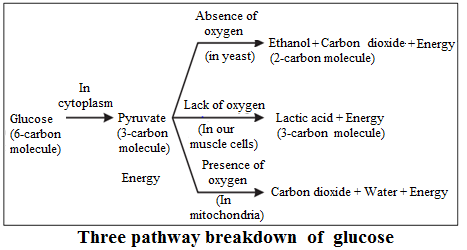
Cellular respiration is the process of breakdown of food substances into simpler ones to release the stored energy. On the basis of presence or absence of oxygen, it can occur through aerobic or anaerobic pathway.
  1. Aerobic respiration: Glucose in the presence of oxygen (air), breaks down to carbon dioxide and water with release of large amount of energy. It occurs in three steps, glycolysis , citric acid cycle and ETC.
Glycolysis is breakdown of glucose into pyruvate. It is oxygen independent pathway occurs in cytoplasm. Pyruvate is decarboxylated into acetyl coA in cytoplasm only.
Citric acid cycle is the second phase of cellular respiration in which acetyl Co are enzymatically oxidized into carbon dioxide and the released energy is stored in NADH and $FADH_2$.
Electron transport chain includes downhill flow of electrons to final electron acceptor (Oxygen, which is then reduced into water) through a chain of membrane-bound carriers to facilitate the uphill transport of protons across a proton-impermeable membrane and ATP synthesis.
Enzymes of citric acid cycle are present in mitochondrial matrix while the electron transport chain is present in inner mitochondrial membrane, hence, the last two phases of aerobic respiration takes place in mitochondria only.
  1. Anaerobic respiration: Glycolysis is breakdown of glucose into pyruvate. It is oxygen independent pathway and is common to both aerobic and anaerobic respiration. Fate of pyruvate depends on oxygen availability. Anaerobic respiration can occur via lactic acid fermentation or alcohol fermentation.
  • Alcohol fermentation due to limited oxygen availability, pyruvate remains in cytoplasm where pyruvate decarboxylase and alcohol dehydrogenase enzymes carry out the second phase of anaerobic respiration and produce ethanol and carbon dioxide with limited amount of energy being released.
  • Lactic acid fermentation due to limited oxygen availability, pyruvate remains in cytoplasm where it is broken down into lactic acid with limited amount of energy being released.
View full question & answer
Question 105 Marks
Describe the alimentary canal of man.
Answer
Human alimentary canal consists of organs of digestion which are namely, in sequence, mouth, oesophagus, stomach, small intestine, large intestine and anus.
Mouth cavity: It is the oral cavity inside mouth, containing teeth, tongue and three pairs of salivary glands.
Pharynx: The oral cavity opens into the pharynx. It is the part where food passage and air passage cross each other.
Oesophagus: It is a long muscular, tube that passes through thoracic cavity and diaphragm into abdominal cavity and carries the food down to the stomach by peristalsis.
Stomach: The stomach is a thick-walled, J-shaped organ present on the left side of the abdominal cavity and is continuous with the esophagus above and the duodenum of the small intestine below.
Small intestine: The pyrolic valve of Stomach leads to a tubular structure called as small intestine. It has three divisions, i.e., duodenum, jejunum and ileum.
Large intestine: The ileoceacal valve of small intestine leads to large intestine, which can be divided into two parts as anterior colon and posterior rectum.
The rectum opens at the anus, which in turn serves as site of defecation, the expulsion of feces.
View full question & answer
Question 115 Marks
Explain the mechanism of photosynthesis.
Answer
Mechanism of Photosynthesis: Photosynthesis is formation of organic food from carbon dioxide and water with the help of sunlight inside chlorophyll containing cells. Oxygen is produced as by-product.$6\text{CO}_2+12\text{H}_2\text{O}\xrightarrow[\ \text{Sunlight}\ ]{\ \text{Chlorophyll}}\text{C}_6\text{H}_{12}\text{O}_6+6\text{H}_2\text{O}+6\text{O}_2\uparrow\\\ \ \ \ \ \ \ \ \ \ \ \ \ \ \ \ \ \ \ \ \ \ \ \ \ \ \ \ \ \ \ \ \ \ \ \ \ \ \ \ \ \ \ \ \ \ \ \text{Glucose}$
Oxygen comes from water. Hydrogen of water is used to reduce carbon dioxide to form carbohydrate.$2\text{H}_2\text{O}\xrightarrow[\ \text{Chlorophyll}]{\ \text{light energy}\ }2\text{H}_2+\text{O}_2$
$\text{CO}_2+2\text{H}_2\xrightarrow{\ \text{energy}\ }[\text{CH}_2\text{O}]+\text{H}_2\text{O}\\\ \ \ \ \ \ \ \ \ \ \ \ \ \ \ \ \ \ \ \ \ \ \ \ \ \ \ \ \ \text{Carbohydrate}$
Actually, photosynthesis occurs in two steps, photochemical and biochemical.
  1. Photochemical Phase (Light or Hill Reaction): The reactions of this phase are driven by light energy. They are of two types- photolysis of water and formation of assimilatory power.
  1. Photolysis of Water. Light energy splits up water into its components. $Mn ^{2+}, CL$ and $Ca ^{2+}$ are required for this.
$2\text{H}_2\text{O}\xrightarrow[\ \text{Mn, Cl, Ca}\ ]{\ \ \text{light}\ \ }\text{O}_2+4\text{H}^{+}+4\text{e}^{-}$
  1. Formation of Assimilatory Power: Light energy absorbed by chlorophyll molecules is used in synthesis of ATP and NADPH.
Both ATP and $NADPH_2$ together form assimilatory power.
$\text{ADP}+\text{Pi}+\text{energy}\xrightarrow{\ \ \ \ }\text{ATP}$
$\text{NADP}^{+}+2\text{e}^{-}+2\text{H}^{+}\xrightarrow{\ \ \ \ }\text{NADPH}+\text{H}^{+}\ \ (\text{NADPH}_2)$
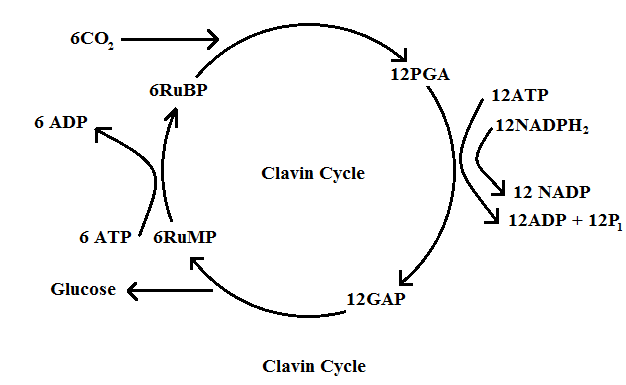
  1. Biosynthetic Phase (Dark or Blackman’s Reaction). It is actually light independent reaction which can occur both in light as well as in dark. It requires the energy and reducing power contained in assimilatory power of light reaction. Common pathway of biosynthetic phase is Calvin cycle. Carbon dioxide combines with ribulose bisphosphate in the presence of enzyme ribulose biphosphate carboxylase or rubisco. It produces two molecules of phosphoglyceric acid (PGA).
$\text{RuBP}+\text{CO}_2\xrightarrow{\ \text{rubisco}\ }2\text{PGA}$
  1. In the presence of ATP, phosphoglyceric acid is reduced by $NADPH_2$ to form glyceraldehyde phosphate (GAP).
PGA + ATP + NADPH2 → GAP + NADP + ADP +Pi
  1. A part of glyceraldehyde phosphate is changed into dihydroxyacetone phosphate. The two condense and form glucose. Ribulose biphosphate is regenerated to combine with carbon dioxide again. Glucose undergoes condensation to form reserve carbohydrate called starch.
  2. Other inorganic Raw Materials: Synthesis of carbohydrates during photosynthesis is a mechanism to form food materials for body building and releasing energy.

Plants also require a number of other inorganic raw materials or minerals from soil for building other, e.g., nitrogen, phosphorus, iron, sulphur, magnesium, etc. Nitrogen and sulphur are required for building proteins. Phosphorus is required for synthesis of nucleotides. Minerals are absorbed in the form of ions, e.g., $NO _2^{-}$and $NH _4^{+}$ for nitrogen. Some bacteria convert atmospheric nitrogen into compounds of nitrogen. Parts of them become available to plants.
View full question & answer
Question 125 Marks
Describe the process of urine formation in kidneys.
Answer
Mechanism of Urine Formation: It has four components - glomerular filtration, selective reabsorption, tubular secretion and concentration.
  1. Glomerular Filtration: Blood flows in glomerulus under pressure due to narrowness of efferent arteriole. As a result it undergoes pressure filtration or ultrafiltration. All small volume solutes (e.g., urea, uric acid, amino acids, hormones, glucose, ions, vitamins) and water are filtered out and enter the Bowman’s capsule. The product is called nephric or glomerular filtrate. Its volume is 125 ml/min (180 litres/ day).
  2. Reabsorption: Nephric filtrate is also called primary urine. It passes into proximal convoluted tubule. The peritubular capillaries around PCT reabsorb all the useful components of nephric filtrate, e.g, glucose, amino acids, vitamins C, calcium, potassium, sodium, chloride, bicarbonate and water (75%). Selective reabsorption also occurs in the region of distal convoluted tubule. The amount of water absorption depends upon amount of excess water present in the body and the amount of dissolved waste to be excreted.
  3. Tubular Secretion (Augmentation): It occurs mostly in the distal convoluted tubule which is also surrounded by peritubular capillaries. Smaller amount of tubular secretion also takes place in the area of proximal convoluted tubule. Tubular secretion is active secretion of waste products by the blood capillaries into the urinary tubule. It ensures removal of all the waste products from blood, viz.,’ urea, uric acid, creatinine. Extra salts, $K^+$ and $H^+$ are also secreted into urinary tubule to maintain a proper concentration and pH of the urine.
  4. Concentration of the Urine: 75% of water content of nephric filtrate is reabsorbed in the region of proximal convoluted tubule. Some 10% of water passes out of the filtrate through osmosis in the area of loop of Henle. It is because loops of Henle are immersed in hyper-osmotic interstitial fluid, Further concentration takes place in the area of collecting tubes in the presence of hormone called antidiuretic hormone (ADH) or vasopressin. The hormone is secreted only when concentrated urine is to be passed out. It is not secreted when a person drinks a lot of water. Absence of antidiuretic hormone produces a dilute urine. Hormone action, therefore, maintains osmotic concentration of body fluids. Deficiency of ADH causes excessive, repeated, dilute urination (diabetes insipidus).
View full question & answer
[5 marks Questions] - Science STD 10 Questions - Vidyadip